John Holm - Böcker
Visar alla böcker från författaren John Holm. Handla med fri frakt och snabb leverans.
5 produkter
5 produkter
17 927 kr
Skickas inom 7-10 vardagar
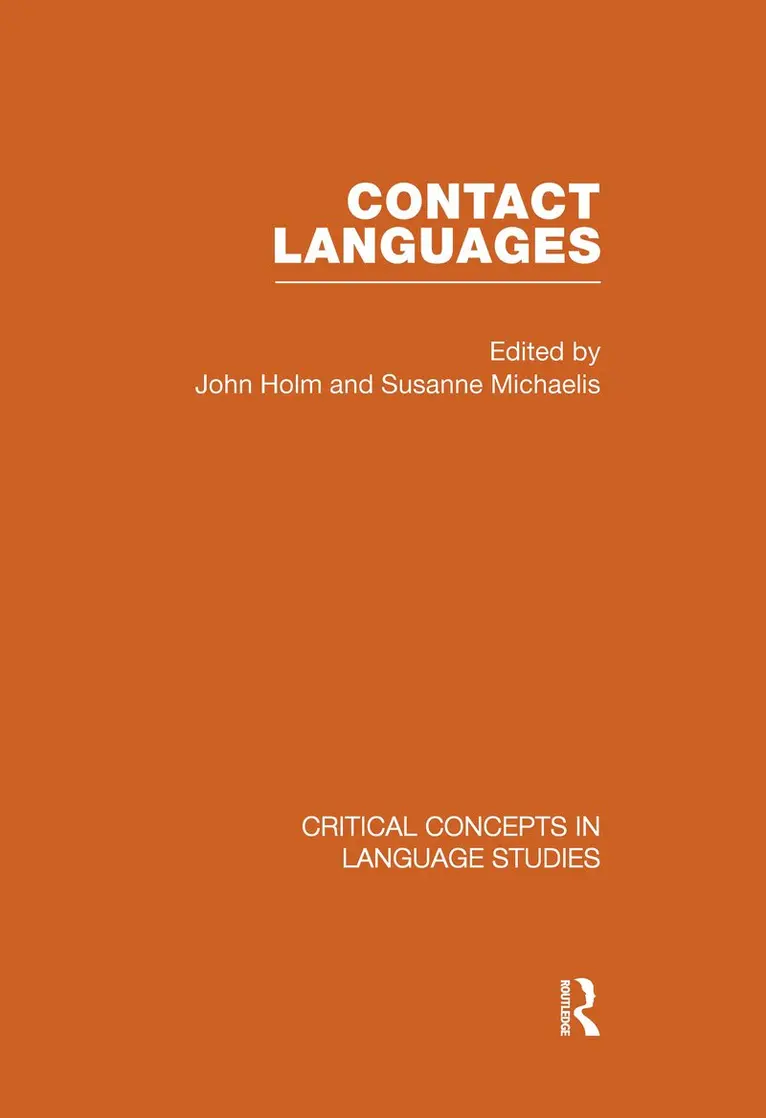
Contact has always been a normal part of the development of languages, from those of ancient empires, those of colonial expansion, and to those of our globalizing planet today. Pidgin and creole studies have merged with the study of other language contact phenomena (adult second-language acquisition, bilingualism, bilingual mixed languages, language shift, partially restructured languages, language attrition, etc.) to form the flourishing field of contact linguistics.This new Routledge Major Work brings together the most important contributions advancing our understanding of language contact phenomena. Beginning fitfully in the mid-nineteenth century and then gathering momentum after 1960, the field of pidgin and creole linguistics has developed from a marginal field associated with the stigma of the languages it studied to a subfield which is now at the centre of linguistic enquiry. As it became clear that contact, far from being bizarre, has always been a normal part of the development of languages, from those of ancient empires to those of colonial expansion to those of our globalising planet today, pidgin and creole studies have merged with the study of other language contact phenomena (adult second language acquisition, bilingualism, bilingual mixed languages, language shift, partially restructured languages, language attrition, etc) to form the new field of contact linguistics. This selection of the most important contributions advancing our understanding of language contact phenomena covers almost two hundred years of scholarship and will provide students with an overview of how insights about the new languages that emerged as a result of European expansion to Africa, Asia, the New World and the Pacific have led to a clearer view of what language is.Articles are arranged chronologically; unusually for a Critical Concepts collection, each individual article is preceded by a short introduction making clear the intellectual context in which it was written, its thematic connection to earlier work, and why it is an important contribution to the field. As well as articles from scholarly journals, there are also some chapters from major books in the field. The collection is indexed for theme and language.
534 kr
Skickas inom 7-10 vardagar
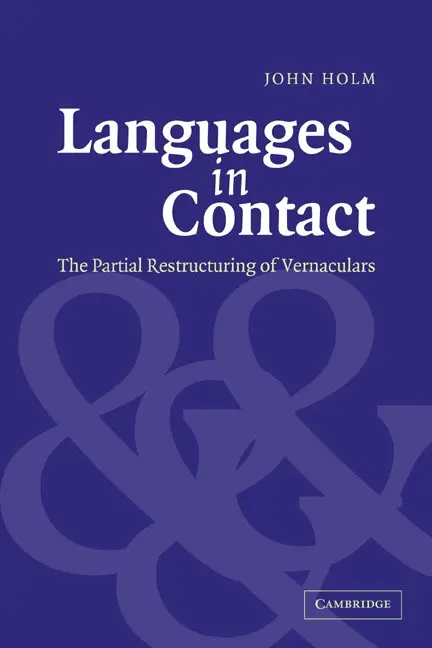
There is widespread agreement that certain non-Creole language varieties are structurally quite different from the European languages out of which they grew; however, until recently, linguists have found difficulty in accounting for either their genesis or their synchronic structure. This 2003 study argues that the transmission of source languages from native to non-native speakers led to 'partial restructuring', whereby some of the source languages' morphosyntax was retained, but a significant number of substrate and interlanguage features were also introduced. Comparing languages such as African-American English, Afrikaans and Brazilian Vernacular Portuguese, John Holm identifies the linguistic processes that lead to partial restructuring, bringing into focus a key span on the continuum of contact-induced language change which has not previously been analysed. Informed by the first systematic comparison of the social and linguistic facts in the development of these languages, this book will be welcomed by students of contact linguistics, sociolinguistics and anthropology.
1 376 kr
Skickas inom 7-10 vardagar
There is widespread agreement that certain non-Creole language varieties are structurally quite different from the European languages out of which they grew; however, until recently, linguists have found difficulty in accounting for either their genesis or their synchronic structure. This 2003 study argues that the transmission of source languages from native to non-native speakers led to 'partial restructuring', whereby some of the source languages' morphosyntax was retained, but a significant number of substrate and interlanguage features were also introduced. Comparing languages such as African-American English, Afrikaans and Brazilian Vernacular Portuguese, John Holm identifies the linguistic processes that lead to partial restructuring, bringing into focus a key span on the continuum of contact-induced language change which has not previously been analysed. Informed by the first systematic comparison of the social and linguistic facts in the development of these languages, this book will be welcomed by students of contact linguistics, sociolinguistics and anthropology.
1 397 kr
Skickas inom 7-10 vardagar
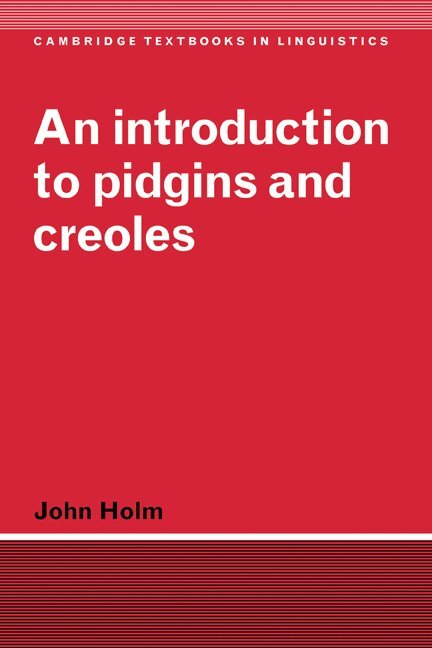
This textbook is a clear and concise introduction to the study of how new languages come into being. Starting with an overview of the field's basic concepts, it surveys the new languages that developed as a result of the European expansion to the Americas, Africa, Asia and the Pacific. Long misunderstood as 'bad' versions of European languages, today such varieties as Jamaican Creole English, Haitian Creole French and New Guinea Pidgin are recognized as distinct languages in their own right. John Holm examines the structure of these pidgins and creoles, the social history of their speakers, and the theories put forward to explain how their vocabularies, sound systems and grammars evolved. His new findings on structural typology, including non-Atlantic creoles, permit a wide-ranging assessment of the nature of restructured languages worldwide. This much-needed book will be welcomed by students and researchers in linguistics, sociolinguistics, western European languages, anthropology and sociology.
635 kr
Skickas inom 7-10 vardagar
This textbook is a clear and concise introduction to the study of how new languages come into being. Starting with an overview of the field's basic concepts, it surveys the new languages that developed as a result of the European expansion to the Americas, Africa, Asia and the Pacific. Long misunderstood as 'bad' versions of European languages, today such varieties as Jamaican Creole English, Haitian Creole French and New Guinea Pidgin are recognized as distinct languages in their own right. John Holm examines the structure of these pidgins and creoles, the social history of their speakers, and the theories put forward to explain how their vocabularies, sound systems and grammars evolved. His new findings on structural typology, including non-Atlantic creoles, permit a wide-ranging assessment of the nature of restructured languages worldwide. This much-needed book will be welcomed by students and researchers in linguistics, sociolinguistics, western European languages, anthropology and sociology.