John Shelton Reed - Böcker
Visar alla böcker från författaren John Shelton Reed. Handla med fri frakt och snabb leverans.
15 produkter
15 produkter
239 kr
Skickas inom 3-6 vardagar
266 kr
Skickas inom 3-6 vardagar
313 kr
Skickas inom 10-15 vardagar
If it can be said that there are many Souths, wrote W. J. Cash in The Mind of the South, ""the fact remains that there is also one South.""In the informal, engaging essays brought together in One South, John Shelton Reed focuses on the South's strong regional identity and on the persistence, well into the last decades if the twentieth century, of Southern cultural distinctiveness. Reed argues that Southerners are similar in much the same way that members if an ethnic group are similar. He discusses the South's shared cultural values, ranging from serious examinations of Southern violence and regional identity to considerations of Southern humor, country music, and the emergence of a new Southern middle class, epitomized by the family of former president Jimmy Carter.Reed opens his volume with three essays dealing with the discipline of sociology and its relation to the South. The first essay proposes ways that sociology can contribute to the mainstream of regional studies; the second traces the history of sociological attention to the South in our century; and the this suggests that the sociological way of thinking may be somewhat alien to well-bred Southerners. In the next section, Reed looks at the question of group identity, arguing in one essay, ""The Heart of Dixie,"" that the South is best defined by locating Southerners, rather than by isolating a particular geographic region. Reed then turns his attention to minority and fringe groups within the South, including, in ""Shalom, Y'All,"" Southern Jews. A final section looks at some of the particular advantages and disadvantages of life in the New South today.Reed's explorations into the region's culture reveal that Southerners are identifiable as a group less by obvious background characteristics, education, occupation, rural or urban residence, than by shared attitudes toward family and community, religious beliefs and practices, and violence and the private use of force: the kind of things that customarily identify ethnic groups. In this way, One South demonstrates how history and the heritage of Southernness have for now triumphed over the disintegrating forces of geography and economics.
314 kr
Skickas inom 10-15 vardagar
In the years following World War I, the New Orleans French Quarter attracted artists and writers with its low rents, faded charm, and colourful street life. By the 1920s Jackson Square had become the center of a vibrant if short-lived bohemia. A young William Faulkner and his roommate William Spratling, an artist who taught at Tulane University, resided among the ""artful and crafty ones of the French Quarter."" In Dixie Bohemia John Shelton Reed introduces Faulkner's circle of friends - ranging from the distinguished Sherwood Anderson to a gender-bending Mardi Gras costume designer - and brings to life the people and places of New Orleans in the Jazz Age.Reed begins with Faulkner and Spratling's self-published homage to their fellow bohemians, ""Sherwood Anderson and Other Famous Creoles."" The book contained 43 sketches of New Orleans artists, by Spratling, with captions and a short introduction by Faulkner. The title served as a rather obscure joke: Sherwood was not a Creole and neither were most of the people featured. But with Reed's commentary, these profiles serve as an entry into the world of artists and writers that dined on Decatur Street, attended masked balls, and blatantly ignored the Prohibition Act. These men and women also helped to establish New Orleans institutions such as the Double Dealer literary magazine, the Arts and Crafts Club, and Le Petit Theatre. But unlike most bohemias, the one in New Orleans existed as a whites-only affair. Though some of the bohemians were relatively progressive, and many employed African American material in their own work, few of them knew or cared about what was going on across town among the city's black intellectuals and artists.The positive developments from this French Quarter renaissance, however, attracted attention and visitors, inspiring the historic preservation and commercial revitalization that turned the area into a tourist destination. Predictably, this gentrification drove out many of the working artists and writers who had helped revive the area. As Reed points out, one resident who identified herself as an ""artist"" on the 1920 federal census gave her occupation in 1930 as ""saleslady, real estate,"" reflecting the decline of an active artistic class.A charming and insightful glimpse into an era, Dixie Bohemia describes the writers, artists, poseurs, and hangers-on in the New Orleans art scene of the 1920s and illuminates how this dazzling world faded as quickly as it began.
277 kr
Skickas inom 7-10 vardagar
The Ramos Gin Fizz was invented sometime around 1890 by Henry Charles "Carl" Ramos at his Imperial Cabinet saloon in New Orleans. It includes lemon and lime juice, egg white, cream, and orange flower water, and, shaken properly, it becomes a foamy white concoction that has been called "the nectar of New Orleans," "the Cadillac of Cocktails," and "the Crescent City's most notable contribution to civilized tippling." This book offers a history of the drink and a biography of its inventor, starting with the early years in which the Ramos Gin Fizz became nationally famous as a New Orleans icon. Although Prohibition almost put an end to it in New Orleans, it survived elsewhere—for instance, at the Cadillac Bar in Nuevo Laredo—and after Prohibition's repeal, the drink quickly recovered and was once again a New Orleans favorite. In the 1940s and '50s, it became known as a sophisticated and glamorous drink, popular with celebrities such as Frank Sinatra and Tennessee Williams. Like many classic American cocktails, the Ramos Gin Fizz was eclipsed by fruity disco drinks in the 1970s and '80s (although it had a strange shadow life as a California brunch drink). With the cocktail revival at the turn of the century, however, it was again recognized as an American classic. The Ramos Gin Fizz attempts to reconstruct Ramos's original recipe using modern ingredients and addresses the question of how and how much to shake the drink, a subject on which there is surprisingly much to be said. Offering recipes for the original drink, a modern version, and many imaginative riffs, this eminently readable book is a must-have for any cocktail lover's library.
460 kr
Skickas inom 10-15 vardagar
First published in 1972, The Enduring South challenges the conventional wisdom that economic development, urbanization, and the end of racial segregation spelled the end of a distinctive Southern culture. In this edition, John Reed updates the public opinion data to the 1980s and reinforces the book's original conclusions: Southerners are different and are likely to stay that way.
379 kr
Skickas inom 5-8 vardagar
Creating a sort of periodic table of the southern populace, Southern Folk, Plain and Fancy catalogs and describes the several social types—gentleman and lady, "lord of the lash" and cunning belle, fun-loving "good old boy," depraved redneck, and other figures—that have animated the region since antebellum times.
346 kr
Skickas inom 3-6 vardagar
This new collection in the Southern Foodways Alliance's popular series serves up a fifty-three-course celebration of southern foods, southern cooking, and the people and traditions behind them. Editors Dale Volberg Reed and John Shelton Reed have combed magazines, newspapers, books, and journals to bring us a "best of" gathering that is certain to satisfy everyone from omnivorous chowhounds to the most discerning student of regional foodways.After an opening celebration of the joys of spring in her natal Virginia by the redoubtable Edna Lewis, the Reeds organize their collection under eight sections exploring Louisiana and the Gulf Coast before and after hurricanes Katrina and Rita, the food and farming of the Carolina Lowcountry, "Sweet Things," southern snacks and fast foods, "Downhome Food," "Downhome Places," and a comparison of southern foods with those of other cultures.In his "This Isn't the Last Dance," Rick Bragg recounts his experience, many years ago, of a New Orleans jazz funeral and finds hope therein that the unique spirit of New Orleanians will allow them to survive: "I have seen these people dance, laughing, to the edge of a grave. I believe that, now, they will dance back from it." "My passport may be stamped Yankee," writes Jessica B. Harris in her "Living North/Eating South," "but there's no denying that my stomach and culinary soul and those of many others like me are pure Dixie." In her "Tough Enough: The Muscadine Grape," Simone Wilson explains that the lowly southern fruit has double the heart-healthy resveratrol of French grapes, thus offering the hope of a "southern paradox." The title of Candice Dyer's brief history says it all: "Scattered, Smothered, Covered, and Chunked: Fifty Years of the Waffle House." In a photo essay, documentarian Amy Evans shows us the world of oystering along northwest Florida's Apalachicola Bay, and for the first time in the series, recipes are given-for a roux, braised collard greens, doberge cake, and other dishes.Published in association with the Southern Foodways Alliance at the Center for the Study of Southern Culture at the University of Mississippi. A Friends Fund Publication.
572 kr
Skickas inom 5-8 vardagar
How the Anglo-Catholic movement in the Victorian Church of England overcame opposition to establish itself as a legitimate form of Anglicanism.A thorough, compelling, and often amusing account of how the Anglo-Catholic movement in the Victorian Church of England overcame vehement opposition to establish itself as a legitimate form of Anglicanism.From working class tenements to the pages of Punch to the very Houses of Parliament, the Victorian Anglo-Catholic movement provoked bitter debate and even violence throughout Victorian times. Rotten vegetables were thrown at priests as they spoke from their pulpits, and fistfights broke out among families over whether dear departed ones would be buried "High Church" or "Low Church." In this innovative critical study, John Shelton Reed provides the first comprehensive treatment of the rise, growth, and eventual consolidation of this controversial movement within the Victorian Church of England.Reed identifies Anglo-Catholicism as a countercultural movement, in some ways not unlike the counterculture of the 1960s, one that championed practices that were symbolic affronts to some of the central values of the dominant middle-class culture of its time. He identifies certain members of the clergy (including John Henry Newman and his circle), the urban poor, women, and youth of both sexes, expecially those who were put off by "muscular Christianity," as those most attracted both to what the movement had to offer and to the shock value it gave to the institutions, classes, and individuals whom they despised. Each of these component groups can be seen as culturally subordinate or in decline--threatened, oppressed, or at least bored by the Victorian values that the movement challenged--and thus ready to hear subversive messages.A distinguished sociologist, best known as a major interpreter of the American South, Reed here explores new ground with characteristic scholarly acumen, thorough and meticulous research, fresh perspective and insight, and a remarkably engaging literary style. He has uncovered and taken full advantage of a wealth of largely untapped archival material, from the library of Pusey House, Oxford, as well as the Bodleian Library and the British Library, and has fashioned this into a cogent analysis that will enhance understanding of the subject for both scholars and general readers. His conclusions will shed light on many aspects of Victorian studies and the related disciplines of history (social, cultural, political, intellectual, and ecclesiastical), literary studies, women's studies, and the study of social movements. All future work on Anglo-Catholicism and related subjects will be indebted to Reed's Glorious Battle.This book has been supported by a grant from the National Endowment for the Humanities.
1 358 kr
Skickas inom 10-15 vardagar
For over three decades John Shelton Reed has been "minding" the South. He is the author or editor of thirteen books about the region. Despite his disclaimer concerning the formal study of Southern history, Reed has read widely and in depth about the South. His primary focus is upon Southerners' present-day culture, but he knows that one must approach the South historically in order to understand the place and its people.Why is the South so different from the rest of America? Rupert Vance, Reed's predecessor in sociology at Chapel Hill, once observed that the existence of the South is a triumph of history over geography and economics. The South has resisted being assimilated by the larger United States and has kept a personality that is distinctly its own. That is why Reed celebrates the South.The chapters in this book cover everything from great thinkers about the South Eugene D. Genovese, C. Vann Woodward, M. E. Bradford to the uniqueness of a region that was once a hotbed of racism, but has recently attracted hundreds of thousands of black people transplanted from the North. There are also chapters about Southerners who have devoted their talents to politics, soft drinks, rock and roll, and jewelry design. Reed writes with wit and Southern charm, never afraid to speak his mind, even when it comes to taking his beloved South to task. While readers may not share all his opinions, most will agree that John Shelton Reed is one of the best "South watchers" there is.
481 kr
Skickas inom 10-15 vardagar
For over three decades John Shelton Reed has been "minding" the South. He is the author or editor of thirteen books about the region. Despite his disclaimer concerning the formal study of Southern history, Reed has read widely and in depth about the South. His primary focus is upon Southerners' present-day culture, but he knows that one must approach the South historically in order to understand the place and its people.Why is the South so different from the rest of America? Rupert Vance, Reed's predecessor in sociology at Chapel Hill, once observed that the existence of the South is a triumph of history over geography and economics. The South has resisted being assimilated by the larger United States and has kept a personality that is distinctly its own. That is why Reed celebrates the South.The chapters in this book cover everything from great thinkers about the South—Eugene D. Genovese, C. Vann Woodward, M. E. Bradford—to the uniqueness of a region that was once a hotbed of racism, but has recently attracted hundreds of thousands of black people transplanted from the North. There are also chapters about Southerners who have devoted their talents to politics, soft drinks, rock and roll, and jewelry design. Reed writes with wit and Southern charm, never afraid to speak his mind, even when it comes to taking his beloved South to task. While readers may not share all his opinions, most will agree that John Shelton Reed is one of the best "South watchers" there is.
332 kr
Skickas inom 10-15 vardagar
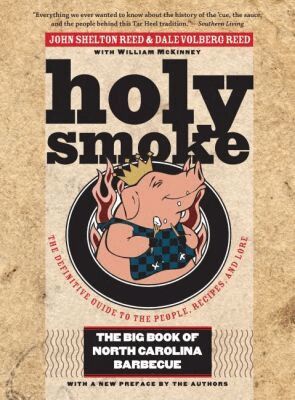
Finally available in paperback — the definitive guide to the people, recipes, and loreNorth Carolina is home to the longest continuous barbecue tradition on the North American mainland. Now available for the first time in paperback, Holy Smoke is a passionate exploration of the lore, recipes, traditions, and people who have helped shape North Carolina’s signature slowfood dish. A new preface by the authors examines the latest news, good and bad, from the world of Tar Heel barbecue, and their updated guide to relevant writing, films, and websites is an essential guide to North Carolina barbecue.
205 kr
Skickas inom 10-15 vardagar
John Shelton Reed's Barbecue celebrates a southern culinary tradition forged in coals and smoke. Since colonial times southerners have held barbecues to mark homecomings, reunions, and political campaigns; today barbecue signifies celebration as much as ever. In a lively and amusing style, Reed traces the history of southern barbecue from its roots in the sixteenth-century Caribbean, showing how this technique of cooking meat established itself in the coastal South and spread inland from there. He discusses how choices of meat, sauce, and cooking methods came to vary from one place to another, reflecting local environments, farming practices, and history.Reed hopes to preserve the South's barbecue traditions by providing the home cook with fifty-one recipes for many classic varieties of barbecue and for the side dishes, breads, and desserts that usually go with it. Featured meats range from Pan-Southern Pork Shoulder to Barbecued Chicken Two Ways to West Texas Beef Ribs, while rubs and sauces include Memphis Pork Rub, Piedmont Dip, and Lone Star Sauce and Mop. Cornbread, hushpuppies, and slaw are featured side dishes, and Dori's Peach Cobbler and Pig-Pickin' Cake provide a sweet finish. This book will put southerners in touch with their heritage and let those who aren't southerners pretend that they are.
199 kr
Skickas inom 10-15 vardagar
Emersion into the society of York was an easy task for Patrick, a native of a nearby Gastonia, North Carolina, and with familial ties to York's elite. But his personal connections proved to be a mixed blessing to the project. His informants were more forthcoming than they might have been with an outsider, but Patrick felt so deep an obligation to protect their privacy that he never published his findings.Established from Patrick's 1954 Harvard dissertation, this first publication of ""Townways of Kent"" invites modern readers to experience mid-century small-town life from the vantage of the white upper and middle classes, and in particular from the viewpoint of ""Old Kent"" families. Often disparaging in their views of the African American and mill village communities, the townfolk prove to be further subdivided along rigorously defined lines of economic status and ancestry - established families versus newer arrivals - but pride in their community's history and in maintaining a particular vision of the town shines through. The introduction by the Reeds places Patrick's work in its historical context and to bring the story of town life in Kent up to the present day.
256 kr
Skickas inom 7-10 vardagar
John Shelton Reed is one of today's most knowledgeable authors on the subject of barbecue. Holy Smoke: The Big Book of North Carolina Barbecue, written with his wife, Dale Volberg Reed, won the National Barbecue Association Award of Excellence in 2017 and was a finalist for the 2009 International Associate of Culinary Professionals Cookbook Award. In this collection, On Barbecue, Reed compiles reviews, essays, magazine articles, op-eds, and book extracts from his many-year obsession with the history and culture of barbecue. Brought together, these pieces constitute a broad look at the cultural, culinary, historical, and social aspects of this American institution.Reed's original and provocative voice carries through this collection, which spans more than twenty years of barbecue lore. A lover of tradition whose study of regional distinctions has made him prize and defend them, Reed writes with conviction on what 'real' barbecue looks, smells, and tastes like. He delves into the history of barbecue and even the origins of the word barbecue itself. Other topics include present-day barbecue, Carolina 'cue and other regional varieties, and recipes daring readers to master their own backyard barbecues.Anyone with an interest in this signature American food will find themselves immersed in this book's accessible, conversational, and frequently tart pages. From one of the wittiest and most knowledgeable authors writing on the subject, On Barbecue is essential reading.