Jonathan Sawday - Böcker
Visar alla böcker från författaren Jonathan Sawday. Handla med fri frakt och snabb leverans.
8 produkter
8 produkter
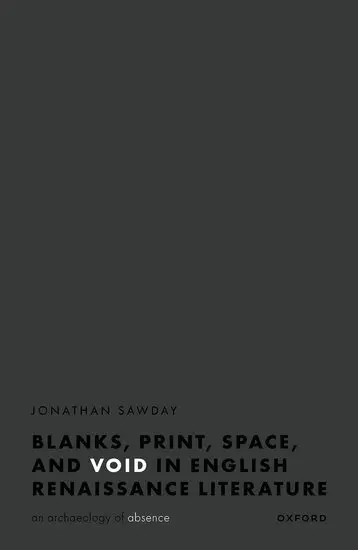
Blanks, Print, Space, and Void in English Renaissance Literature
An Archaeology of Absence
Inbunden, Engelska, 2023
585 kr
Skickas inom 7-10 vardagar
Blanks, Print, Space, and Void in English Renaissance Literature is an inquiry into the empty spaces encountered not just on the pages of printed books in c.1500-1700, but in Renaissance culture more generally. The book argues that print culture in the sixteenth and seventeenth centuries helped to foster the modern idea of the 'gap' (where words, texts, images, and ideas are constructed as missing, lost, withheld, fragmented, or perhaps never devised in the first place). It re-imagines how early modern people reacted not just to printed books and documents of many different kinds, but also how the very idea of emptiness or absence began to be fashioned in a way which still surrounds us. Jonathan Sawday leads the reader through the entire landscape of early modern print culture, discussing topics such as: space and silence; the exploration of the vacuum; the ways in which race and racial identity in early modern England were constructed by the language and technology of print; blackness and whiteness, together with lightness, darkness, and sightlessness; cartography and emptiness; the effect of typography on reading practices; the social spaces of the page; gendered surfaces; hierarchies of information; books of memory; pages constructed as waste or vacant; the genesis of blank forms and early modern bureaucracy; the political and devotional spaces of printed books; the impact of censorship; and the problem posed by texts which lack endings or conclusions. The book itself ends by dwelling on blank or empty pages as a sign of human mortality. Sawday pays close attention to the writings of many of the familiar figures in English Renaissance literary culture - Sidney, Shakespeare, Donne, Jonson, and Milton, for example - as well as introducing readers to a host of lesser-known figures. The book also discusses the work of numerous women writers from the period, including Aphra Behn, Ann Bradstreet, Margaret Cavendish, Lady Jane Gray, Lucy Hutchinson, Æmelia Lanyer, Isabella Whitney, and Lady Mary Wroth.
2 166 kr
Skickas inom 10-15 vardagar
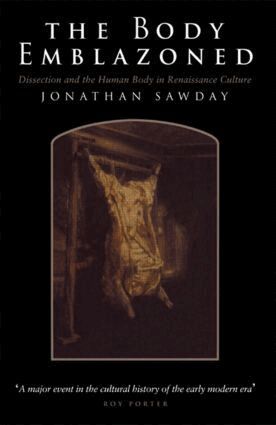
An outstanding piece of scholarship and a fascinating read, The Body Emblazoned is a compelling study of the culture of dissection the English Renaissance, which informed intellectual enquiry in Europe for nearly two hundred years. In this outstanding work, Jonathan Sawday explores the dark, morbid eroticism of the Renaissance anatomy theatre, and relates it to not only the great monuments of Renaissance art, but to the very foundation of the modern idea of knowledge.Though the dazzling displays of the exterior of the body in Renaissance literature and art have long been a subject of enquiry, The Body Emblazoned considers the interior of the body, and what it meant to men and women in early modern culture.A richly interdisciplinary work, The Body Emblazoned re-assesses modern understanding of the literature and culture of the Renaissance and its conceptualization of the body within the domains of the medical and moral, the cultural and political.
654 kr
Skickas inom 10-15 vardagar
An outstanding piece of scholarship and a fascinating read, The Body Emblazoned is a compelling study of the culture of dissection the English Renaissance, which informed intellectual enquiry in Europe for nearly two hundred years. In this outstanding work, Jonathan Sawday explores the dark, morbid eroticism of the Renaissance anatomy theatre, and relates it to not only the great monuments of Renaissance art, but to the very foundation of the modern idea of knowledge.Though the dazzling displays of the exterior of the body in Renaissance literature and art have long been a subject of enquiry, The Body Emblazoned considers the interior of the body, and what it meant to men and women in early modern culture.A richly interdisciplinary work, The Body Emblazoned re-assesses modern understanding of the literature and culture of the Renaissance and its conceptualization of the body within the domains of the medical and moral, the cultural and political.
2 103 kr
Skickas inom 10-15 vardagar
In the fifteenth century the printing press was the 'new technology'. The first ever information revolution began with the advent of the printed book, enabling Renaissance scholars to formulate new ways of organising and disseminating knowledge.As early as 1500 there were already 20 million books in circulation in Europe. How did this rapid explosion of ideas impact upon the evolution of new disciplines?The Renaissance Computer looks at the fascinating development of new methods of information storage and retrieval which took place at the very beginning of print culture. And it asks some crucial questions about the intellectual conditions of our own digital age. A dazzling array of leading experts in Renaissance culture explore topics of urgent significance today, including:* the contribution of knowledge technologies to state formulation and national identity*the effect of multimedia, orality and memory on education*the importance of the visual display of information and how search engines reflect and direct ways of thinking.
598 kr
Skickas inom 10-15 vardagar
In the fifteenth century the printing press was the 'new technology'. The first ever information revolution began with the advent of the printed book, enabling Renaissance scholars to formulate new ways of organising and disseminating knowledge.As early as 1500 there were already 20 million books in circulation in Europe. How did this rapid explosion of ideas impact upon the evolution of new disciplines?The Renaissance Computer looks at the fascinating development of new methods of information storage and retrieval which took place at the very beginning of print culture. And it asks some crucial questions about the intellectual conditions of our own digital age. A dazzling array of leading experts in Renaissance culture explore topics of urgent significance today, including:* the contribution of knowledge technologies to state formulation and national identity*the effect of multimedia, orality and memory on education*the importance of the visual display of information and how search engines reflect and direct ways of thinking.
2 166 kr
Skickas inom 10-15 vardagar
At what point did machines and technology begin to have an impact on the cultural consciousness and imagination of Europe? How was this reflected through the art and literature of the time? Was technology a sign of the fall of humanity from its original state of innocence or a sign of human progress and mastery over the natural world? In his characteristically lucid and captivating style, Jonathan Sawday investigates these questions and more by engaging with the poetry, philosophy, art, and engineering of the period to find the lost world of the machine in the pre-industrial culture of the European Renaissance. The aesthetic and intellectual dimension of these machines appealed to familiar figures such as Shakespeare, Francis Bacon, Montaigne, and Leonardo da Vinci as well as to a host of lesser known writers and artists in the sixteenth and seventeenth centuries. This intellectual engagement with machines in the European Renaissance gave rise to new attitudes towards gender, work and labour, and even fostered the new sciences of artificial life and reason which would be pursued by figures such as Descartes, Hobbes, and Leibniz in the seventeenth century. Writers, philosophers and artists had mixed and often conflicting reactions to technology, reflecting a paradoxical attitude between modern progress and traditional values. Underpinning the enthusiastic creation of a machine-driven world, then, were stories of loss and catastrophe. These contradictory attitudes are part of the legacy of the European Renaissance, just as much as the plays of Shakespeare or the poetry of John Milton. And this historical legacy helps to explain many of our own attitudes towards the technology that surrounds us, sustains us, and sometimes perplexes us in the modern world.
598 kr
Skickas inom 10-15 vardagar
At what point did machines and technology begin to have an impact on the cultural consciousness and imagination of Europe? How was this reflected through the art and literature of the time? Was technology a sign of the fall of humanity from its original state of innocence or a sign of human progress and mastery over the natural world? In his characteristically lucid and captivating style, Jonathan Sawday investigates these questions and more by engaging with the poetry, philosophy, art, and engineering of the period to find the lost world of the machine in the pre-industrial culture of the European Renaissance. The aesthetic and intellectual dimension of these machines appealed to familiar figures such as Shakespeare, Francis Bacon, Montaigne, and Leonardo da Vinci as well as to a host of lesser known writers and artists in the sixteenth and seventeenth centuries. This intellectual engagement with machines in the European Renaissance gave rise to new attitudes towards gender, work and labour, and even fostered the new sciences of artificial life and reason which would be pursued by figures such as Descartes, Hobbes, and Leibniz in the seventeenth century. Writers, philosophers and artists had mixed and often conflicting reactions to technology, reflecting a paradoxical attitude between modern progress and traditional values. Underpinning the enthusiastic creation of a machine-driven world, then, were stories of loss and catastrophe. These contradictory attitudes are part of the legacy of the European Renaissance, just as much as the plays of Shakespeare or the poetry of John Milton. And this historical legacy helps to explain many of our own attitudes towards the technology that surrounds us, sustains us, and sometimes perplexes us in the modern world.
493 kr
Skickas inom 7-10 vardagar
Literature and the English Civil War charts the relationship between literary texts and their historical context during this era of profound change and upheaval for British society and culture. The volume demonstrates that literary texts are not merely passive reflections of the historical events that help to form them. On the contrary, 'history' is fashioned by the way events are named and the language used to describe them. To understand the literature of the English Civil War is to form a vital perspective on this major period of transition. Essays in the volume focus on issues of ideology and genre, often with reference to topical debates about how the events of 1640-1660 can best be characterised. There are pieces on the politics of the masque; lyric and devotional poetry; women's writing and the Civil War; attitudes towards Ireland; colonialism; madness and division; individual writers such as Hobbes, Marvell, and Milton; and other relevant topics. An editorial introduction traces themes and provides a useful overview. This book is a major contribution to our awareness of the conditions of literature during the English Civil War and an important statement in the debate about the relation between literature and history.