Julie A. Buckler - Böcker
Visar alla böcker från författaren Julie A. Buckler. Handla med fri frakt och snabb leverans.
3 produkter
3 produkter
2 635 kr
Skickas inom 5-8 vardagar
The Russian novel remains a subject of enduring interest for scholars, students, and general audiences. Russian novels were initially influenced by the parallel traditions of novel-writing in Britain, France, and Germany, but the Russian novel exists as its own tradition and asserts its own identity as a literary form.To read a Russian novel often requires the fortitude to traverse many hundreds of pages and to consider profound political, philosophical, and metaphysical questions. The best-known Russian novels are also compulsively readable, providing a fascinating window into Russian culture and society at different historical periods. Readers of Russian novels marvel at the fictional world-building of innovative writers who created compelling characters and settings, realized through brilliant storytelling and stylistic virtuosity. Major Russian novelists such as Dostoevsky, Tolstoy, and Nabokov continue to be popular and to carry intellectual prestige. But the tradition of the Russian novel extends well beyond these familiar authors and their works. This Oxford Handbook draws from a valuable tradition of critical commentary dating back to the nineteenth and early twentieth centuries and builds upon important earlier scholarship but significantly updates our understanding of the Russian novel: showcasing newer interpretive paradigms, considering works outside the canon, and extending the story of the Russian novel through Soviet times and up to the varied literary landscape of the present. The chapters also explore an increasingly expansive view of what constitutes a Russian novel, part of ongoing efforts to communicate our evolving understanding of the tradition.
436 kr
Skickas inom 7-10 vardagar
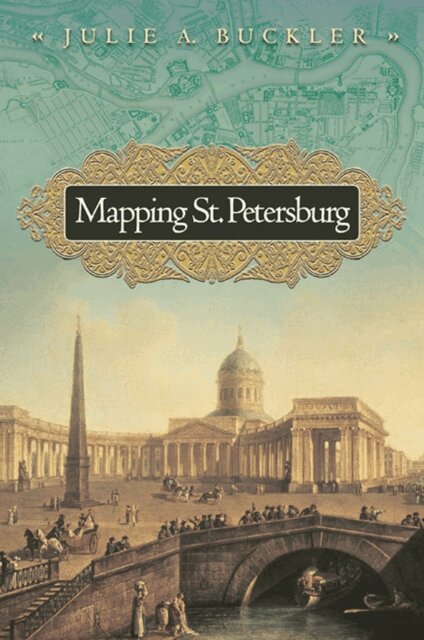
Pushkin's palaces or Dostoevsky's slums? Many a modern-day visitor to St. Petersburg has one or, more likely, both of these images in mind when setting foot in this stage set-like setting for some of the world's most treasured literary masterpieces. What they overlook is the vast uncharted territory in between. In Mapping St. Petersburg, Julie Buckler traces the evolution of Russia's onetime capital from a "conceptual hierarchy" to a living cultural system--a topography expressed not only by the city's physical structures but also by the literary texts that have helped create it. By favoring noncanonical works and "underdescribed spaces," Buckler seeks to revise the literary monumentalization of St. Petersburg--with Pushkin and Dostoevsky representing two traditional albeit opposing perspectives--to offer an off-center view of a richer, less familiar urban landscape. She views this grand city, the product of Peter the Great's ambitious vision, not only as a geographical entity but also as a network of genres that carries historical and cultural meaning.We discover the busy, messy "middle ground" of this hybrid city through an intricate web of descriptions in literary works; nonfiction writings such as sketches, feuilletons, memoirs, letters, essays, criticism; and urban legends, lore, songs, and social practices--all of which add character and depth to this refurbished imperial city.
992 kr
Skickas inom 10-15 vardagar
The "Golden Age" of opera-going in Russia, from the 1840s through the 1880s, coincided with the flourishing of Russian prose realism. During this period, opera and literature exerted a reciprocal influence on one another, each adopting and providing a new context for the other's artistic conventions. Opera permeated the culture of the drawing room so often depicted in literature, and literature simultaneously discovered the opera theater. The relationship between these two artistic genres inspired the use of performative models and conventions in Russian literary art, and led to the interpolation of specific operatic subtexts into literature and life.To many, these genres were antithetical, since opera historically aimed for the high stylistic register, and prose fiction experimented with the low. But the author shows that the attempt to translate opera into prosaic contemporary lives was characteristic of nineteenth-century Russia, since literature provided an alternative cultural theater in Russia to which the opera theater was analogous and parallel. As contested and self-regarding social space, the opera theater offered its visitors a rare public forum. The reception of opera as an art form in Russia resembles the impact of the early cinema on Russian audiences in the early twentieth century, since opera and film both brought about an aesthetic reconfiguring of social space.This book treats opera-going in imperial Russia from multiple perspectives, and discusses such canonical works as Tolstoy's Anna Karenina and Goncharov's Oblomov, major operatic works including Tchaikovsky's Eugene Onegin and Verdi's La Traviata, the impact of Western opera in Russia and the Russian-style prima donna. The book engages with poems, sketches, feuilletons, stories, and rarely-discussed Russian novels, as well as non-fictional reminiscences, reviews, and visual images. Throughout, the book is enriched with examples and anecdotes about performers, spectators, and critics, and reception histories of specific operatic works.