Julie Decker - Böcker
Visar alla böcker från författaren Julie Decker. Handla med fri frakt och snabb leverans.
8 produkter
8 produkter
195 kr
Skickas inom 7-10 vardagar
Alaskans were introduced to the airplane as early as 1913, when town officials in Fairbanks invited stunt flyers James and Lilly Martin to fly over the local baseball park on July 4. Because many areas are only accessible by air, this enormous state is still defined today by aviation so that aviation and Alaska have formed a very special symbiosis that is unique both in the world of geography and flying. This publication celebrates the 100th anniversary of this remarkable relationship. It looks at aviation through artifacts of flight, popular culture and other ephemera; objects that are unique to flying in Alaska and that impressively convey stories of the pioneering spirit, engineering and the North. In an extraordinary fashion, they foreground the changes flying brought to life on the ground, guiding the reader from the early days through times of war and industrialization, to the beginning of the second century in the air.
383 kr
Skickas inom 7-10 vardagar
477 kr
Skickas inom 7-10 vardagar
John Grade’s drawings, sculptures and installations are weathered, marked, worn and disintegrated. Made of reclaimed wood or paper, the works are buried for termites to devour, sunk into a bay to collect barnacles, or hung in forest trees for birds t o eat.Grade’s work represents our changing environment. An attraction to travel and to the land shapes the work, mirroring pattern s found in nature, such as wasp nests, erosion, honeycombs, rocks, trees and the passage of time. Grade invites natural forces to erode and change the work and its material, e x ploring both control and disruption and risk and measured thought. The works beg in from an ex - perience – a reaction to place and history or a trek into the landscape, whether it is the old growth forests of the Pacific Northwest or the hills of Iceland.
372 kr
Skickas inom 7-10 vardagar
Jonathon Keats’ work as an artist and thinker is compelling for our time. Keats poses critical questions, asks us to fundamentally reconsider our assumptions, and proposes radical methods of response. In a time when the environment and human lifeways are experiencing unprecedented change, thought leaders like Keats are needed to encourage us to consider possibilities –from the absurd to the profound.Since the turn of the millennium, Keats has comprehensively extended his academic training in philosophy by prolifically presenting conceptual art projects that he refers to as “thought experiments.”These include installations and performances in museums and galleries around the globe. His motivations are to make space for exploring ideas, offering provocations, and confronting systems we generally take for granted. By prototyping alternative realities –systematically asking what if...? –these projects probe the world in which we live, exploring the potential for societal change.
477 kr
Skickas inom 7-10 vardagar
Mary Mattingly is a visual artist. She founded Swale, an edible landscape on a barge in New York City. Docked at public piers but following waterways common laws, Swale circumnavigates New York's public land laws, allowing anyone to pick free fresh food. Swale instigated and co-created the "foodway" in Concrete Plant Park, the Bronx in 2017. The "foodway" is the first time New York City Parks is allowing people to publicly forage in over 100 years. It's currently considered a pilot project.Mattingly recently launched Public Water with More Art and completed a two-part sculpture “Pull” for the International Havana Biennial with the Museo Nacional de Bellas Artes de la Habana and the Bronx Museum of the Arts, two spherical ecosystems that were pulled across Habana to Parque Central and the museum. In 2018 she received a commission from BRIC Arts Media to build "What Happens After" which involved dismantling a military vehicle (LMTV) that had been to Afghanistan and deconstructing its mineral supply chain. A group of artists including performance artists, veterans, and public space activists re-envisioned the vehicle for BRIC. In 2016 Mattingly led a similar project at the Museum of Modern Art. In 2014, an artist residency on the water called WetLand launched in Philadelphia and traveled to the Parrish Museum. It was employed by the University of Pennsylvania’s Environmental Humanities program until 2017. Mary Mattingly’s work has also been exhibited at Storm King, the International Center of Photography, the Seoul Art Center, the Brooklyn Museum, the New York Public Library, deCordova Museum and Sculpture Park, and the Palais de Tokyo. Her work has been featured in Aperture Magazine, Art in America, Artforum, Art News, Sculpture Magazine, The New York Times, New York Magazine, Financial Times, Le Monde Magazine, Metropolis Magazine, New Yorker, The Wall Street Journal, the Brooklyn Rail, and on BBC News, MSNBC, NPR, WNBC, and on Art21. Her work has been included in books such as the Whitechapel/MIT Press Documents of Contemporary Art series titled “Nature” and edited by Jeffrey Kastner, Triple Canopy’s Speculations, the Future Is... published by Artbook, and Henry Sayre’s A World of Art, 8th edition, published by Pearson Education Inc.
496 kr
Skickas inom 7-10 vardagar
Sonya Kelliher-Combs offers a chronicle of the ongoing struggle for self-definition and identity in the Alaskan context. Her combination of shared iconography with intensely personal imagery demonstrates the generative power that each vocabulary has over the other. Similarly, her use of synthetic, organic, traditional and modern materials moves beyond oppositions between Western/Native culture, self/other and man/nature, to examine their interrelationships and interdependence while also questioning accepted notions of beauty. Kelliher-Combs' process dialogues the relationship of her work to skin, the surface by which an individual is mediated in culture. Sonya Kelliher-Combs was raised in the Northwest Alaska community of Nome. Her Bachelor of Fine Arts degree is from the University of Alaska Fairbanks and Master of Fine Arts is from Arizona State University. Through her mixed media painting and sculpture, Kelliher-Combs offers a chronicle of the ongoing struggle for self-definition and identity in the Alaskan context. Her combination of shared iconography with intensely personal imagery demonstrates the generative power that each vocabulary has over the other. Similarly, her use of synthetic, organic, traditional and modern materials moves beyond oppositions between Western/Native culture, self/other and man/nature, to examine their interrelationships and interdependence while also questioning accepted notions of beauty. Kelliher-Combs' process dialogues the relationship of her work to skin, the surface by which an individual is mediated in culture. Kelliher-Combs' work has been shown in numerous individual and group exhibitions in Alaska, the United States and internationally, including the national exhibition Changing Hands 2: Art without Reservation and SITELINES: Much Wider Than a Line. She is a recipient of the prestigious United States Arts Fellowship, Joan Mitchell Fellowship, Eiteljorg Fellowship for Native American Fine Art, and a Rasmuson Fellowship. Her work is included in the collections of the IAIA Museum of Contemporary Native Art, Anchorage Museum, Alaska State Museum, University of Alaska Museum of the North, Eiteljorg Museum, and The National Museum of the American Indian. Kelliher-Combs currently lives and works in Anchorage, Alaska.
402 kr
Skickas inom 7-10 vardagar
Art, climate change and geopolitics at a time of rapid social and technological change. The Distant Early Warning Line, also known as the DEW Line, was a system of radar stations in the northern Arctic region of Canada, with additional stations along the north coast and Aleutian Islands of Alaska and the Faroe Islands, Greenland and Iceland. It intended to detect incoming bombers of the Soviet Union during the Cold War and provide early warning of any sea and land invasion. Today, the Arctic is seen as a place primed for data storage and vaults – doomsday structures with a utilitarian vernacular of architecture, protecting the “knowledge” of places further south rather than recognising the local presence and expertise of place and Indigenous lifeways and Indigenous science. This book looks at the role of artists as early warning systems and explores the ways we connect and disconnect place and people through technology and the ideas of boundaries. With the DEW Line as a framework, Julie Decker examines ideologies of warning. The DEW Line is a symbol of both past and future. Today, we think about planetary boundaries, the boundaries of survival and other human limits.
545 kr
Kommande
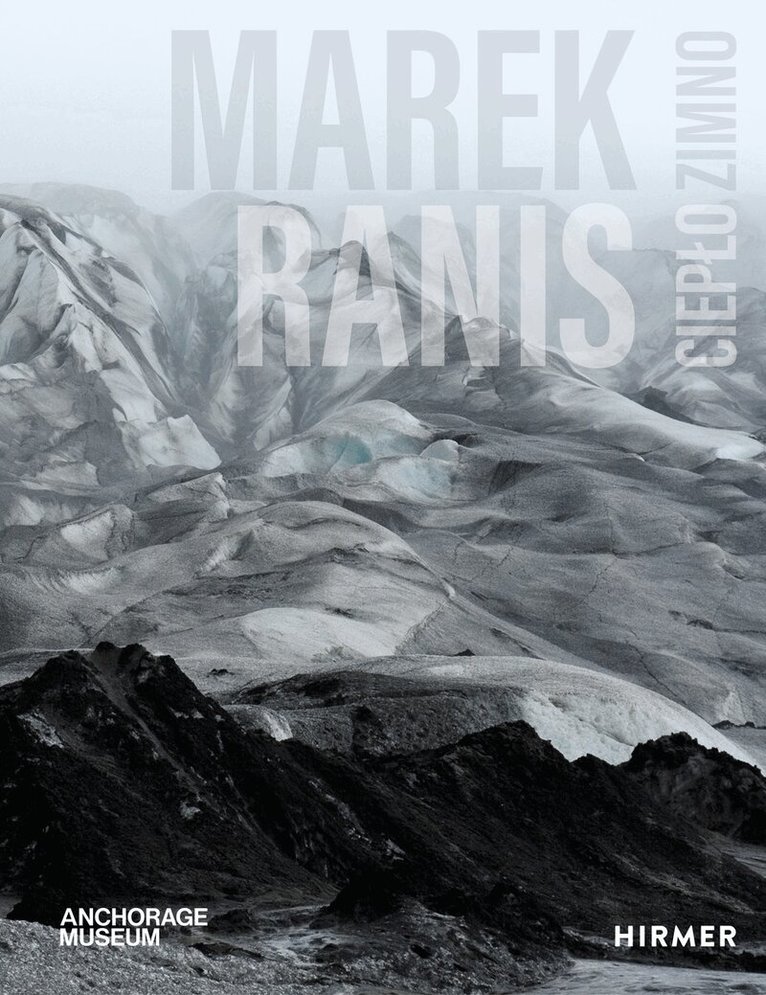
Marek Ranis: Ciepło Zimno surveys over twenty years of the artist’s practice investigating the tensions between warmth and cold, hope and despair, belonging and exile. Contributions by Julie Decker and Jonathon Keats situate Ranis’s poetic yet critical works within a broader meditation on change, displacement, and the delicate balance between human experience and the environments we inhabit.