Jürg Luterbacher - Böcker
Visar alla böcker från författaren Jürg Luterbacher. Handla med fri frakt och snabb leverans.
4 produkter
4 produkter
1 588 kr
Skickas inom 10-15 vardagar
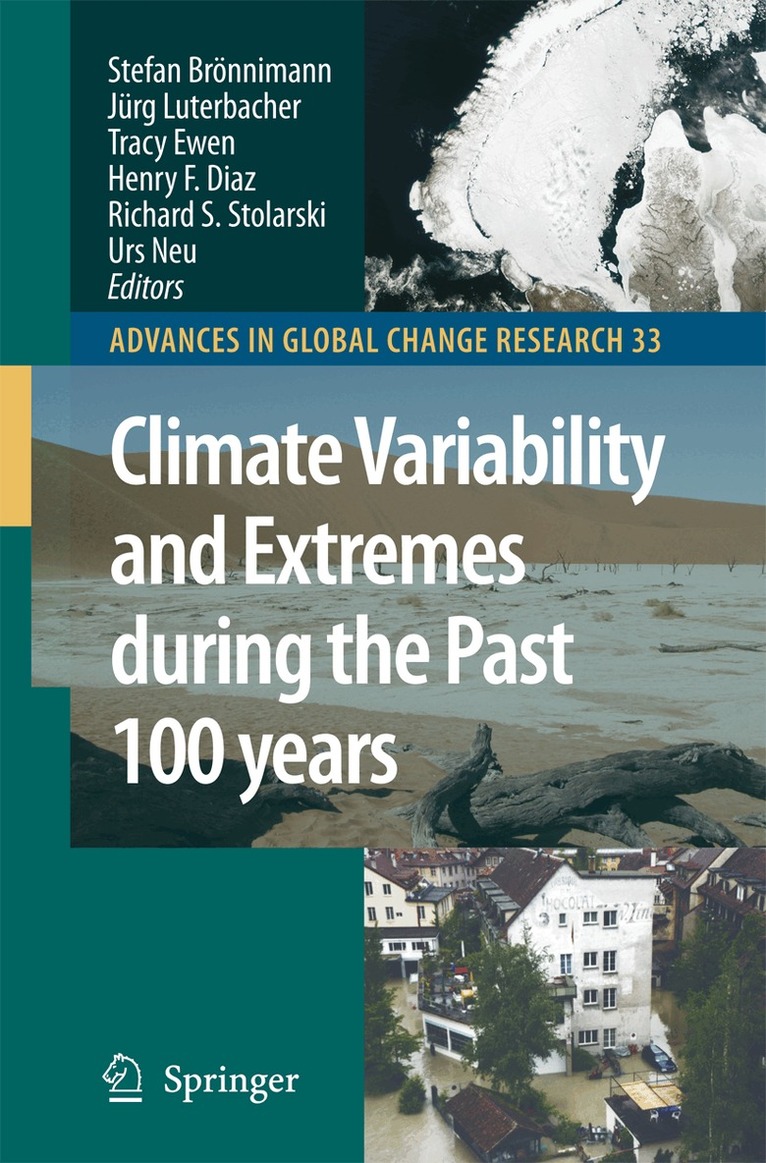
Large progress has been made in the past few years towards quantifying and understanding climate variability during past centuries. At the same time, present-day climate has been studied using state-of-the-art data sets and tools with respect to the physical and chemical mechanisms governing climate variability. Both the understanding of the past and the knowledge of the processes are important for assessing and attributing the anthropogenic effect on present and future climate. The most important time period in this context is the past approximately 100 years, which comprises large natural variations and extremes (such as long droughts) as well as anthropogenic influences, most pronounced in the past few decades. Recent and ongoing research efforts steadily improve the observational record of the 20th century, while atmospheric circulation models are used to underpin the mechanisms behind large climatic variations. Atmospheric chemistry and composition are important for understanding climate variability and change, and considerable progress has been made in the past few years in this field. The evolving integration of these research areas in a more comprehensive analysis of recent climate variability was reflected in the organisation of a workshop “Climate variability and extremes in the past 100 years” in Gwatt near Thun (Switzerland), 24–26 July 2006. The aim of this workshop was to bring together scientists working on data issues together with statistical climatologists, modellers, and atmospheric chemists to discuss gaps in our understanding of climate variability during the past approximately 100 years.
Great Wall of China as a Climate Frontier
Climatic and Historical Perspectives on the Ordos Region
Inbunden, Engelska, 2026
2 251 kr
Kommande
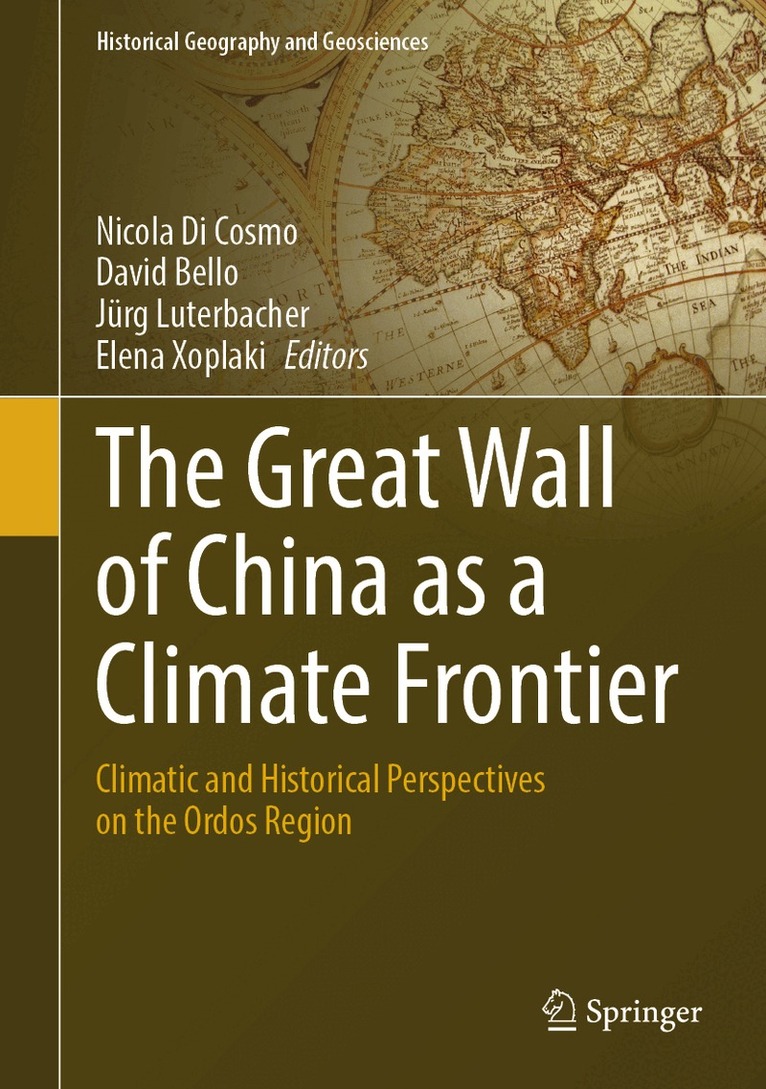
The Great Wall—the most imposing manifestation of Chinese frontier history—crosses a vast territory subject to political, environmental and climatic instabilities that the volume approaches as mutually conditioning, focusing on the Ordos region. This has been a central point of contact between sedentary East Asian and nomadic Inner Asian peoples throughout Chinese premodern history (500 BCE-1800). The contributors emphasize the significance of human-natural interaction affecting environmental and climatological variability central to historical processes on this critical frontier zone. Four case studies are supported by paleoclimatic evidence from documentary information and natural proxies as well as from land-use models showing the complexity of climate-human interplay, in terms of demography, economy, and administrative-military presence. The volume’s interdisciplinary methodology achieves an authoritative integration of both scientific (quantitative) and historical (narrative) approaches to produce a comprehensive history of long-term frontier dynamics.
462 kr
Skickas inom 3-6 vardagar
1 588 kr
Skickas inom 10-15 vardagar
Large progress has been made in the past few years towards quantifying and understanding climate variability during past centuries. At the same time, present-day climate has been studied using state-of-the-art data sets and tools with respect to the physical and chemical mechanisms governing climate variability. Both the understanding of the past and the knowledge of the processes are important for assessing and attributing the anthropogenic effect on present and future climate. The most important time period in this context is the past approximately 100 years, which comprises large natural variations and extremes (such as long droughts) as well as anthropogenic influences, most pronounced in the past few decades. Recent and ongoing research efforts steadily improve the observational record of the 20th century, while atmospheric circulation models are used to underpin the mechanisms behind large climatic variations. Atmospheric chemistry and composition are important for understanding climate variability and change, and considerable progress has been made in the past few years in this field. The evolving integration of these research areas in a more comprehensive analysis of recent climate variability was reflected in the organisation of a workshop “Climate variability and extremes in the past 100 years” in Gwatt near Thun (Switzerland), 24–26 July 2006. The aim of this workshop was to bring together scientists working on data issues together with statistical climatologists, modellers, and atmospheric chemists to discuss gaps in our understanding of climate variability during the past approximately 100 years.