
Justin Lebrun – författare
Visar alla böcker från författaren Justin Lebrun. Handla med fri frakt och snabb leverans.
4 produkter
4 produkter
1 512 kr
Skickas inom 5-8 vardagar
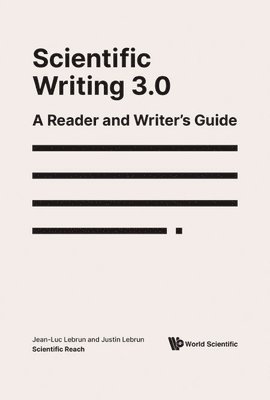
The third edition of this book aims to equip both young and experienced researchers with all the tools and strategy they will need for their papers to not just be accepted, but stand out in the crowded field of academic publishing. It seeks to question and deconstruct the legacy of existing science writing, replacing or supporting historically existing practices with principle- and evidence-driven styles of effective writing. It encourages a reader-centric approach to writing, satisfying reader-scientists at large, but also the paper's most powerful readers, the reviewer and editor. Going beyond the baseline of well-structured scientific writing, this book leverages an understanding of human physiological limitations (memory, attention, time) to help the author craft a document that is optimized for readability.Through real and fictional examples, hands-on exercises, and entertaining stories, this book breaks down the critical parts of a typical scientific paper (Title, Abstract, Introduction, Visuals, Structure, and Conclusions). It shows at great depth how to achieve the essential qualities required in scientific writing, namely being clear, concise, convincing, fluid, interesting, and organized. To enable the writer to assess whether these parts are well written from a reader's perspective, the book also offers practical metrics in the form of six checklists, and even an original Java application to assist in the evaluation.
514 kr
Skickas inom 5-8 vardagar
The third edition of this book aims to equip both young and experienced researchers with all the tools and strategy they will need for their papers to not just be accepted, but stand out in the crowded field of academic publishing. It seeks to question and deconstruct the legacy of existing science writing, replacing or supporting historically existing practices with principle- and evidence-driven styles of effective writing. It encourages a reader-centric approach to writing, satisfying reader-scientists at large, but also the paper's most powerful readers, the reviewer and editor. Going beyond the baseline of well-structured scientific writing, this book leverages an understanding of human physiological limitations (memory, attention, time) to help the author craft a document that is optimized for readability.Through real and fictional examples, hands-on exercises, and entertaining stories, this book breaks down the critical parts of a typical scientific paper (Title, Abstract, Introduction, Visuals, Structure, and Conclusions). It shows at great depth how to achieve the essential qualities required in scientific writing, namely being clear, concise, convincing, fluid, interesting, and organized. To enable the writer to assess whether these parts are well written from a reader's perspective, the book also offers practical metrics in the form of six checklists, and even an original Java application to assist in the evaluation.
Grant Writing And Crowdfunding Guide For Young Investigators In Science, The
Inbunden, Engelska, 2017
781 kr
Skickas inom 5-8 vardagar
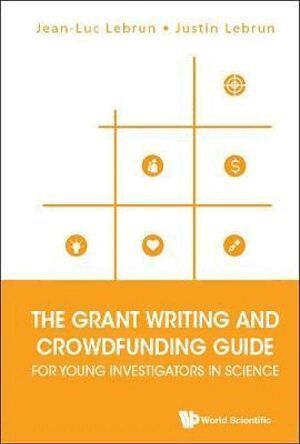
The Grant Writing and Crowdfunding Guide prepares you, the young investigator, to step up to the challenge of funding your own research. And what a challenge. Writing a successful grant demands much more than a first-class inquisitive scientific mind. As you will soon discover, raw talent may keep you from drowning in the new world of grants, but staying afloat and learning how to swim are two very different things. This book presents the best strategies you should adopt prior to taking the grant plunge. It will help you draft a reasonable budget plan, assemble a winning grant team, write a stellar pre-proposal, and reassure the funding agencies that the financial risk they take by investing in you will produce great returns. The book also helps you write a grant title, abstract, and a specific aims section that highlight the significance, impact, and innovativeness of your project. It presents specific tools to catch problems early and avoid rejection. It even covers a source of funding you likely have never considered: the public. Crowdfunding not only helps you collect preliminary data within weeks, but also lets you share your passion with people who want to see you succeed.New investigators are usually lost when attempting to write their first grant application. They need a compass to run through the grant maze. This book is that compass. It supplements the work of your mentor, and reviews the practices of your grantor and grant reviewers. Examples are taken from two of the largest grantors in the world, NIH and NSF, and their practices are applicable to other science funding agencies worldwide.Better to be young and funded than old and unfunded.
382 kr
Skickas inom 5-8 vardagar
The Grant Writing and Crowdfunding Guide prepares you, the young investigator, to step up to the challenge of funding your own research. And what a challenge. Writing a successful grant demands much more than a first-class inquisitive scientific mind. As you will soon discover, raw talent may keep you from drowning in the new world of grants, but staying afloat and learning how to swim are two very different things. This book presents the best strategies you should adopt prior to taking the grant plunge. It will help you draft a reasonable budget plan, assemble a winning grant team, write a stellar pre-proposal, and reassure the funding agencies that the financial risk they take by investing in you will produce great returns. The book also helps you write a grant title, abstract, and a specific aims section that highlight the significance, impact, and innovativeness of your project. It presents specific tools to catch problems early and avoid rejection. It even covers a source of funding you likely have never considered: the public. Crowdfunding not only helps you collect preliminary data within weeks, but also lets you share your passion with people who want to see you succeed.New investigators are usually lost when attempting to write their first grant application. They need a compass to run through the grant maze. This book is that compass. It supplements the work of your mentor, and reviews the practices of your grantor and grant reviewers. Examples are taken from two of the largest grantors in the world, NIH and NSF, and their practices are applicable to other science funding agencies worldwide.Better to be young and funded than old and unfunded.