K. Beyreuther - Böcker
Visar alla böcker från författaren K. Beyreuther. Handla med fri frakt och snabb leverans.
4 produkter
4 produkter
1 635 kr
Skickas inom 10-15 vardagar
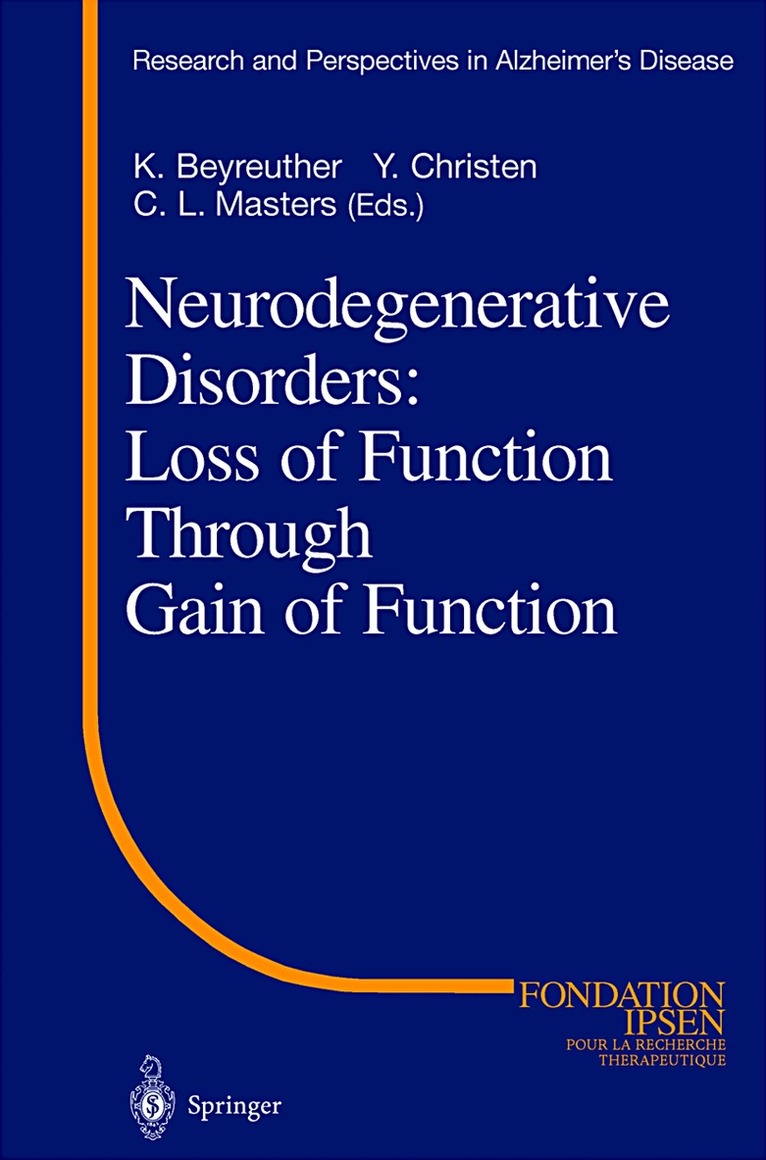
Fondation Ipsen sponsored a meeting in Paris in February 2000 on the emerging paradigm-shift in our understanding of the major degenerative diseases which- affect the aging human brain. This book sumarizes our deliberations on some of these major neurodegenerative diseases that are characterized by protein depos- its, and that are due to the pathogenic gain of function of an otherwise normal neuronal protein. For each of the major human neurodegenerative diseases covered in this book -the most prominent being Alzheimer's disease -experimental models are described, including cell culture systems and animal models which range from the round worm, Caenorhabditis elegans, the fruitfly, Drosophila melanogaster, to rodents. Remarkably, in the sporadic forms of these human diseases, only a minor change in the level of production or turn-over of the relevant proteins is sufficient to cause disease in late adult-hood. Neurodegeneration in Alzheimer's disease, for example, usually results in symptoms and signs in the seventh to eighth decades.In contrast, the development of protein deposits in transgenic mice over-expressing the corresponding disease gene parallels the genetic forms of the human diseases in regard to its manifestation occuring half-way through its normal life-span, i. e. about 50 years in humans (the so-called "presenium") and 9 to 12 months in the mouse. Nevertheless, these models have served to elu- cidate many of the pathways underlying the human disease processes, for instance clarifying the neuronal origin of parenchymal and perivascular amyloid in Alzheimer's disease and Creutzfeldt-Jakob disease.
1 588 kr
Skickas inom 10-15 vardagar
Fondation Ipsen sponsored a meeting in Paris in February 2000 on the emerging paradigm-shift in our understanding of the major degenerative diseases which- affect the aging human brain. This book sumarizes our deliberations on some of these major neurodegenerative diseases that are characterized by protein depos- its, and that are due to the pathogenic gain of function of an otherwise normal neuronal protein. For each of the major human neurodegenerative diseases covered in this book -the most prominent being Alzheimer's disease -experimental models are described, including cell culture systems and animal models which range from the round worm, Caenorhabditis elegans, the fruitfly, Drosophila melanogaster, to rodents. Remarkably, in the sporadic forms of these human diseases, only a minor change in the level of production or turn-over of the relevant proteins is sufficient to cause disease in late adult-hood. Neurodegeneration in Alzheimer's disease, for example, usually results in symptoms and signs in the seventh to eighth decades.In contrast, the development of protein deposits in transgenic mice over-expressing the corresponding disease gene parallels the genetic forms of the human diseases in regard to its manifestation occuring half-way through its normal life-span, i. e. about 50 years in humans (the so-called "presenium") and 9 to 12 months in the mouse. Nevertheless, these models have served to elu- cidate many of the pathways underlying the human disease processes, for instance clarifying the neuronal origin of parenchymal and perivascular amyloid in Alzheimer's disease and Creutzfeldt-Jakob disease.
550 kr
Skickas inom 10-15 vardagar
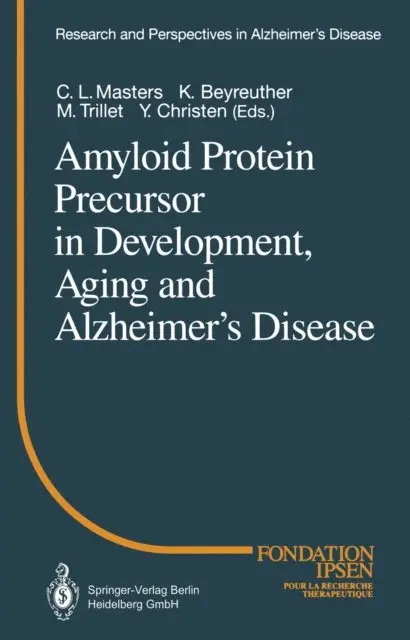
This volume contains the proceedings of the ninth "Colloque medecine et recherche" of the Fondation IPSEN devoted to research on Alzheimer's disease. This symposium was held in Lyon on June 21, 1993, on the topic, "Amyloid Protein Precursors in Development, Aging and Alzheimer's Disease". The choice of this venue and of this particular subject was not a matter of chance. As far as the history of medicine and neurology is concerned, Lyon is doubtless one of the most famous cities in France and the F ondation IPSEN had to organize one of its meetings in this city which has been regarded for centuries as a major crossroads. Regarding the topic, the amyloid story is at the center of the debate in the field of Alzheimer's studies. For nearly 10 years, "alzheimerology" has more or less been intertwined with "amyloidology". The purification and the sequencing of the beta/ A4 peptide in amyloid congophilic angiopathy (Glenner and Wong 1984) and in Alzheimer's disease (Masters et al. 1985) were the first steps toward the numerous successes realised in the last few years.The discovery of the amyloid precursor protein (APP), the localisation of its gene on chromosome 21 and the sequencing of its cDNA in 1987 (Kang et al. 1987; Goldgaber et al. 1987; Robakis et al.
550 kr
Skickas inom 10-15 vardagar
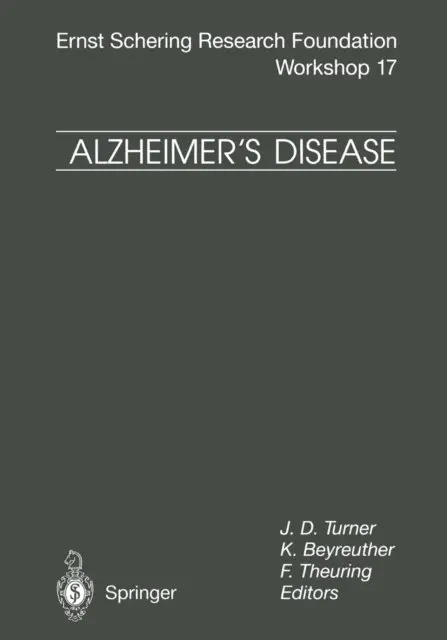
Alzheimer's Disease is a progressive neurodegenerative disorder of late life with devastating consequences for the afflicted and their carers and poses one of the major challenges to medical research. Until recently, little hope of effective therapies capable of slowing the disease process or preventing its occurrence was apparent. With recent advances in the genetics and molecular biology of the disease processes and the demonstration of the involvement of multiple aetiological factors, however, real chances are now appearing for the identification of preventive drugs. In this discussion, experts from disciplines ranging from molecular genetics to the clinic provide review and novel data concerning the aetiology of AD and the establishment of drugfinding screening methods.