Kazuyo Murata – författare
Visar alla böcker från författaren Kazuyo Murata. Handla med fri frakt och snabb leverans.
4 produkter
4 produkter
1 057 kr
Skickas inom 5-8 vardagar
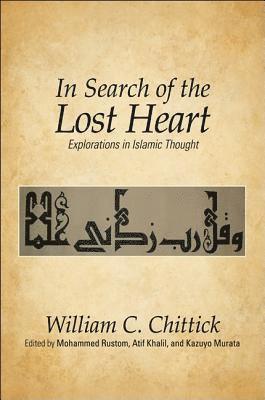
Renowned scholar William C. Chittick explores the worldview of Islam in a series of essays written over thirty-six years.In Search of the Lost Heart brings together twenty-six essays by William C. Chittick, renowned scholar of Sufism and Islamic philosophy. Written between 1975 and 2011, most of these essays are not readily available in Chittick's own books. Although this is a collection, its editors have crafted it to be a book "sufficient unto itself, which, when taken as a whole, can be said to explore the underlying worldview of Islam."Chittick draws upon the writings of towering figures such as Ibn al-'Arabī, Rūmī, and Mullā Ṣadrā, as well as other important, but lesser-known thinkers, as he engages with a wide variety of topics, such as the nature of being and knowledge, the relationship between love and scriptural hermeneutics, the practical and theoretical dimensions of Islamic mysticism, the phenomenon of religious diversity, and the ecological crisis.
416 kr
Tillfälligt slut
Renowned scholar William C. Chittick explores the worldview of Islam in a series of essays written over thirty-six years.In Search of the Lost Heart brings together twenty-six essays by William C. Chittick, renowned scholar of Sufism and Islamic philosophy. Written between 1975 and 2011, most of these essays are not readily available in Chittick's own books. Although this is a collection, its editors have crafted it to be a book "sufficient unto itself, which, when taken as a whole, can be said to explore the underlying worldview of Islam."Chittick draws upon the writings of towering figures such as Ibn al-'Arabī, Rūmī, and Mullā Ṣadrā, as well as other important, but lesser-known thinkers, as he engages with a wide variety of topics, such as the nature of being and knowledge, the relationship between love and scriptural hermeneutics, the practical and theoretical dimensions of Islamic mysticism, the phenomenon of religious diversity, and the ecological crisis.
382 kr
Tillfälligt slut
Analyzes the place of beauty in the Sufi understanding of God, the world, and the human being through the writings of Sufi scholar and saint Rūzbihān Baqlī.According to Muhammad, "God is beautiful and He loves beauty." Yet, Islam is rarely associated with beauty, and today, a politicized Islam dominates many perceptions. This work tells a forgotten story of beauty in Islam through the writings of celebrated but little-studied Sufi scholar and saint Rūzbihān Baqlī (1128–1209). Rūzbihān argued that the pursuit of beauty in the world and in oneself was the goal of Muslim life. One should become beautiful in imitation of God and reclaim the innate human nature created in God's beautiful image. Rūzbihān's theory of beauty is little known, largely because of his convoluted style and eccentric terminology in both Persian and Arabic. In this book, Kazuyo Murata revives Rūzbihān's ideas for modern readers. She provides an overview of Muslim discourse on beauty before Rūzbihān's time; an analysis of key terms related to beauty in the Qur'ān, adīth, and in Rūzbihān's writings; a reconstruction of Rūzbihān's understanding of divine, cosmic, and human beauty; and a discussion of what he regards as the pinnacle of beauty in creation, the prophets, especially Adam, Abraham, Joseph, Moses, and Muhammad.
1 057 kr
Tillfälligt slut
Analyzes the place of beauty in the Sufi understanding of God, the world, and the human being through the writings of Sufi scholar and saint Rūzbihān Baqlī.According to Muhammad, "God is beautiful and He loves beauty." Yet, Islam is rarely associated with beauty, and today, a politicized Islam dominates many perceptions. This work tells a forgotten story of beauty in Islam through the writings of celebrated but little-studied Sufi scholar and saint Rūzbihān Baqlī (1128–1209). Rūzbihān argued that the pursuit of beauty in the world and in oneself was the goal of Muslim life. One should become beautiful in imitation of God and reclaim the innate human nature created in God's beautiful image. Rūzbihān's theory of beauty is little known, largely because of his convoluted style and eccentric terminology in both Persian and Arabic. In this book, Kazuyo Murata revives Rūzbihān's ideas for modern readers. She provides an overview of Muslim discourse on beauty before Rūzbihān's time; an analysis of key terms related to beauty in the Qur'ān, adīth, and in Rūzbihān's writings; a reconstruction of Rūzbihān's understanding of divine, cosmic, and human beauty; and a discussion of what he regards as the pinnacle of beauty in creation, the prophets, especially Adam, Abraham, Joseph, Moses, and Muhammad.