Keith A. Crandall - Böcker
Visar alla böcker från författaren Keith A. Crandall. Handla med fri frakt och snabb leverans.
2 produkter
2 produkter
524 kr
Skickas
The HIV epidemic has spawned a scientific effort unprecedented in the history of infectious disease research. This effort has merged aspects of clinical research, basic molecular biology, immunology, cell biology, epidemiology, and mathematical biology in ways that have not been seen before. In The Evolution of HIV Keith A. Crandall brings together researchers from these disciplines to present perspectives on both the molecular biology and molecular evolution of HIV. The book is organized into three sections: "Introduction to HIV" explores the fundamentals of the virus's molecular biology and its global diversity. "Molecular Methods for Studying HIV Diversity" looks at such topics as HIV phylogenetics, modeling the molecular evolution of HIV sequences, the use of phylogenetic inference to test an HIV transmission hypothesis, and coalescent approaches to HIV population genetics. The third section,"Case Studies of HIV Evolution" examines the levels of diversity within and among host individuals, the phylogenetics of known transmission histories, and HIV evolution and disease progression via longitudinal studies.The book will be of interest to researchers and clinicians working on HIV, as well as scientists studying molecular evolution, population genetics, and evolutionary biology. Contributors are John M. Coffin, Keith A. Crandall, Joseph Felsenstein, Walter M. Fitch, Brian Foley, Esther Guzman, Paul H. Harvey, David M. Hillis, Edward C. Holmes, Marcia L. Kalish, Bette T. M. Korber, Julia Krushkal, Carla L. Kuiken, Gerald H. Learn, Thomas Leitner, Wen-Hsiung Li, Francine E. McCutchan, Spencer V. Muse, Oliver G. Pylons, Allen G. Rodrigo, Raj Shankarappa, Richard W. Steketee, Alan R. Templeton, Donald M. Thea, Raphael P. Viscidi, Steven M. Wolinsky.
2 707 kr
Skickas inom 10-15 vardagar
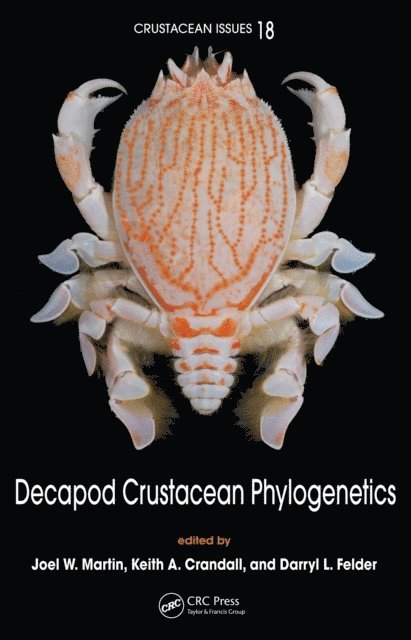
Decapod crustaceans are of tremendous interest and importance evolutionarily, ecologically, and economically. There is no shortage of publications reflecting the wide variety of ideas and hypotheses concerning decapod phylogeny, but until recently, the world’s leading decapodologists had never assembled to elucidate and discuss relationships among the major decapod lineages and between decapods and other crustaceans. Based on the findings presented by an international group of scientists at a symposium supported by the Society for Integrative and Comparative Biology, The Crustacean Society, and several other societies, and with major funding from the National Science Foundation, Decapod Crustacean Phylogenetics provides a comprehensive synopsis of the current knowledge of this vast and important group of animals.This volume contains state-of-the-art reviews of literature and methodologies for elucidating decapod phylogeny. The contributions include studies on the fossil origin of decapods, morphological and molecular phylogenetic analyses, the evolution of mating and its bearing on phylogeny, decapod "evo-devo" studies, decapod spermiocladistics, and phylogenetic inference. The experts also present research on preliminary attempts to construct the first known phylogenetic tree for various groups of decapods. Several contributions offer the most comprehensive analyses to date on major clades of decapods, and others introduce data or approaches that could be used in the future to help resolve the phylogeny of the Decapoda.Currently, the Decapoda contain an estimated 15,000 species, some of which support seafood and marine industries worth billions of dollars each year to the world’s economy. This volume is a fascinating overview of where we are currently in our understanding of these important creatures and their phylogeny and also provides a window into the future of decapod research. This work will be of great interest to researchers, instructors, and students in marine biology, evolutionary biology, crustacean biology, resource management, and biodiversity database management.