Keith Gaddie - Böcker
Visar alla böcker från författaren Keith Gaddie. Handla med fri frakt och snabb leverans.
5 produkter
5 produkter
993 kr
Skickas inom 7-10 vardagar
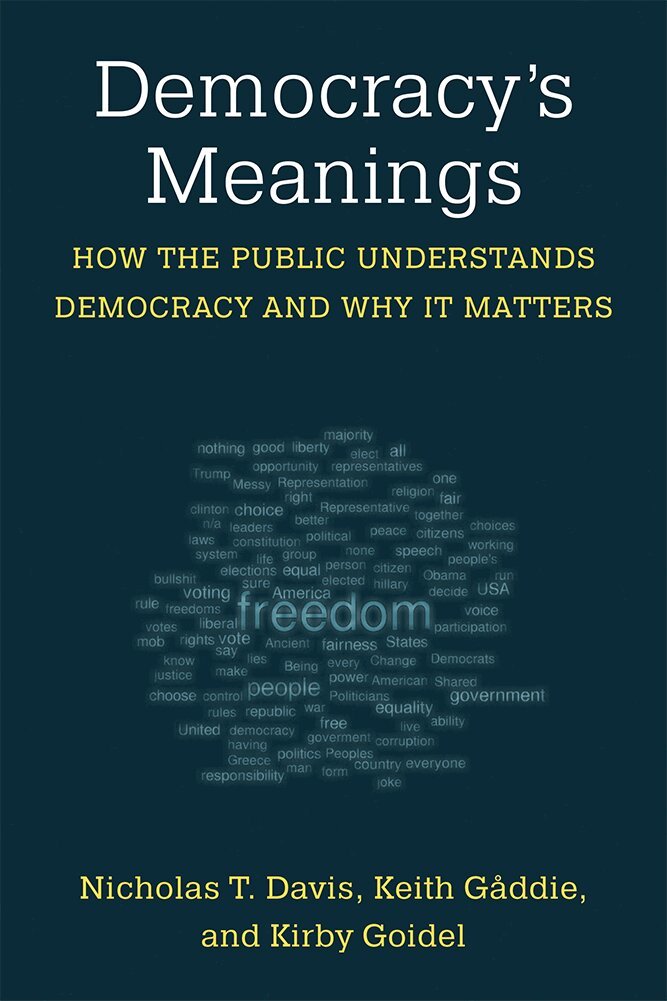
Democracy’s Meanings challenges conventional wisdom regarding how the public thinks about and evaluates democracy. Mining both political theory and more than 75 years of public opinion data, the book argues that Americans think about democracy in ways that go beyond voting or elected representation. Instead, citizens have rich and substantive views about the material conditions that democracy should produce, which draw from their beliefs about equality, fairness, and justice.The authors construct a typology of views about democracy. Procedural views of democracy take a minimalistic quality. While voting and fair treatment are important to this vision of democracy, ideas about equality are mostly limited to civil liberties. In contrast, social views of democracy incorporate both civil and economic equality; according to people with these views, democracy ought to meet the basic social and material needs of citizens. Complementing these two groups are moderate and indifferent views about democracy. While moderate views sit somewhere in between procedural and social perspectives regarding the role of democracy in producing social and economic equality, indifferent views of democracy involve disaffection toward it. For a small group of apathetic citizens, democracy is an ambiguous and ill-defined concept.
323 kr
Skickas inom 10-15 vardagar
Atop broad stone stairs flanked by statues of ancient lawgivers, the U.S. Supreme Court building stands as a shining temple to the American idea of justice. As solidly as the building occupies a physical space in the nation’s capital, its architecture defines a cultural, social, and political space in the public imagination. Through these spaces, this book explores the home of the most revered institution of U.S. politics—its origin, history, and meaning as an expression of democratic principles.The U.S. Supreme Court building opened its doors in 1935. Although it is a latecomer to the capital, the Court shares the neoclassical style of the older executive mansion and capitol building, and thus provides a coherent architectural representation of governmental power in the capital city. More than the story of the construction of one building or its technical architectural elements, The U.S. Supreme Court’s Democratic Spaces is the story of the Court’s evolution and its succession of earlier homes in Washington, D.C., Philadelphia, and New York.This timely study of how the Supreme Court building shapes Washington as a space and a place for political action and meaning yields a multidimensional view and deeper appreciation of the ways that our physical surroundings manifest who we are as a people and what we value as a society.
256 kr
Skickas inom 3-6 vardagar
Oklahoma Sooners IQ: The Ultimate Test of True Fandom (OU Football History & Trivia)
Häftad, Engelska
225 kr
Skickas inom 3-6 vardagar
1 314 kr
Skickas inom 10-15 vardagar
At the very beginning of the interwar period, a small collection of formally trained architects created a distinctive residential type which can undoubtedly be recognized as a Philadelphia landmark. They surpassed the conventional pseudo-classic or neo-Gothic eclectic solution by a unique adaptation of the principles and criteria of design to suit the expression of the exclusive cultural tradition of the clients and to respond to the natural environment. The works of three Philadelphia architectural firms -- Mellor, Meigs and Howe, McGoodwin, and Willing and Sims -- are analyzed to explore this proposition, using six houses constructed between 1917 and 1928 as a basis. These homes and others located in the historic Chestnut Hill neighborhood are aesthetically pleasing. But they also represent a break with the past, the emergence of a new ‘type’ which is among the architectural design innovations of the last century generally conceived as ‘organic’ architecture. This work, which contains over 200 photographs and drawings, considers the houses, the training and development of the architects, the creation and development of Chestnut Hill itself, and the larger, distinct culture of Philadelphia in contributing to the emergence of this distinctive and lasting style.