Kenneth A. Kriz - Böcker
Visar alla böcker från författaren Kenneth A. Kriz. Handla med fri frakt och snabb leverans.
4 produkter
4 produkter
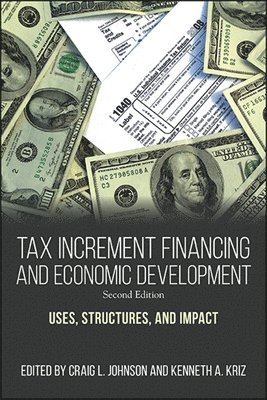
Tax Increment Financing and Economic Development
Uses, Structures, and Impact
Inbunden, Engelska, 2019
972 kr
Tillfälligt slut
Examines the many issues raised by TIF, the most widely used tool of local economic and community development.This book brings together leading experts to examine the evolving nature of tax increment financing (TIF), the most widely used tool of local economic and community development. Originally designed as an innovative approach to the redevelopment of blighted areas, it has become a more general-purpose tool of economic and community development. Contributors offer case studies of the uses, structures, and impacts of TIF projects alongside more general discussions on the theoretical, financial, and legal bases for the use of TIF. They also explore its effect on overlapping jurisdictions such as cities, counties, and school districts. Some of the case studies capture TIF at its best-redeveloping areas that would likely never develop without substantial incentives. Other cases highlight questionable uses, especially where it has been used in new ways that those who developed the tool never envisioned.Originally published in 2001, the book was called "…a major contribution to the debate on the efficacy of such economic development financing tools as TIF…" by the journal Public Budgeting & Finance. Clear, comprehensive, and timely, this new edition features the latest research and thinking on TIF, including the political, legal, and even ethical issues surrounding its use.
546 kr
Skickas inom 3-6 vardagar
Examines the many issues raised by TIF, the most widely used tool of local economic and community development.This book brings together leading experts to examine the evolving nature of tax increment financing (TIF), the most widely used tool of local economic and community development. Originally designed as an innovative approach to the redevelopment of blighted areas, it has become a more general-purpose tool of economic and community development. Contributors offer case studies of the uses, structures, and impacts of TIF projects alongside more general discussions on the theoretical, financial, and legal bases for the use of TIF. They also explore its effect on overlapping jurisdictions such as cities, counties, and school districts. Some of the case studies capture TIF at its best-redeveloping areas that would likely never develop without substantial incentives. Other cases highlight questionable uses, especially where it has been used in new ways that those who developed the tool never envisioned.Originally published in 2001, the book was called "…a major contribution to the debate on the efficacy of such economic development financing tools as TIF…" by the journal Public Budgeting & Finance. Clear, comprehensive, and timely, this new edition features the latest research and thinking on TIF, including the political, legal, and even ethical issues surrounding its use.
1 209 kr
Skickas inom 10-15 vardagar
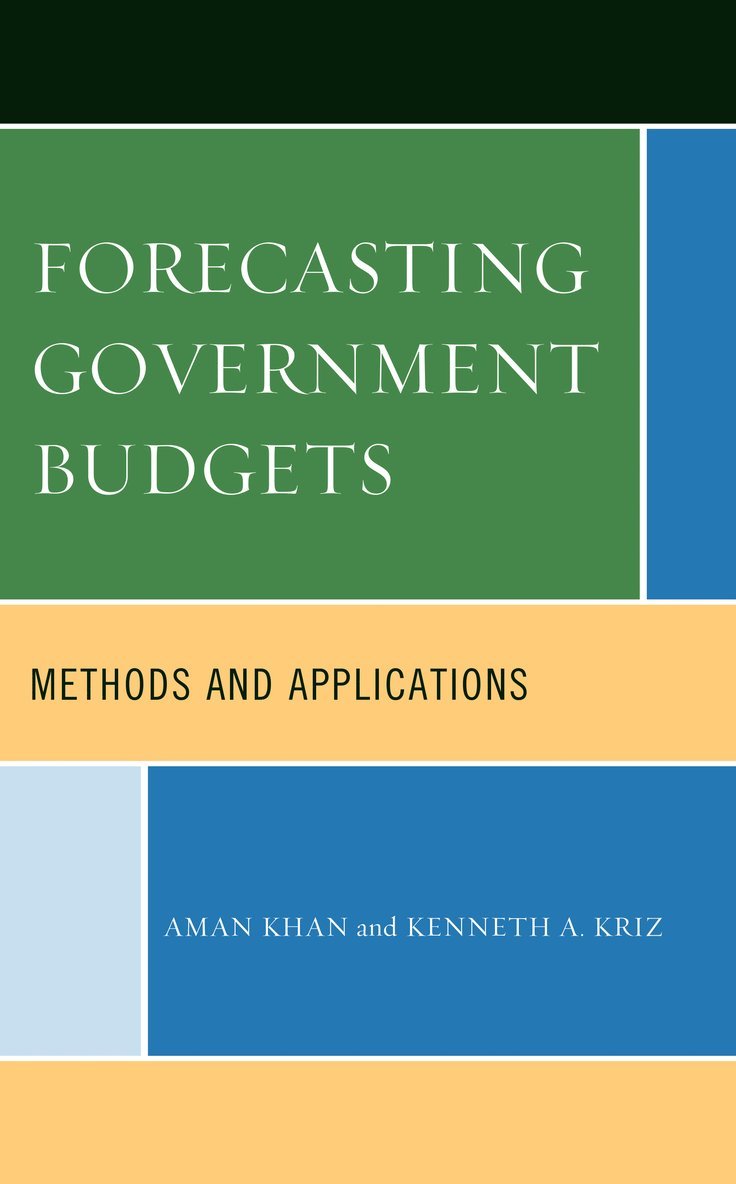
Forecasting is integral to all governmental activities, especially budgetary activities. Without good and accurate forecasts, a government will not only find it difficult to carry out its everyday operations but will also find it difficult to cope with the increasingly complex environment in which it has to operate. This book presents, in a simple and easy to understand manner, some of the commonly used methods in budget forecasting, simple as well as advanced. The book is divided into three parts: It begins with an overview of forecasting background, forecasting process, and forecasting methods, followed by a detailed discussion of the actual methods in Parts I, II, and III. Part I discusses a combination of basic time series models such as percentage average, simple moving average, double moving average, exponential moving average, double as well as triple, simple trend line, time-series with cyclical variation, and time-series regression, with single and multiple independent variables. Part II discusses some of the more advanced, but frequently used time series models, such as ARIMA, regular as well as seasonal, Vector Autoregression (VAR), and Vector Error Correction (VEC). Part III provides an overview of three of the more recent advances in time series models, namely ensemble forecasting, state-space forecasting, and neural network. The book concludes with a brief discussion of some practical issues in budget forecasting.
408 kr
Skickas inom 10-15 vardagar
Forecasting is integral to all governmental activities, especially budgetary activities. Without good and accurate forecasts, a government will not only find it difficult to carry out its everyday operations but will also find it difficult to cope with the increasingly complex environment in which it has to operate. This book presents, in a simple and easy to understand manner, some of the commonly used methods in budget forecasting, simple as well as advanced. The book is divided into three parts: It begins with an overview of forecasting background, forecasting process, and forecasting methods, followed by a detailed discussion of the actual methods in Parts I, II, and III. Part I discusses a combination of basic time series models such as percentage average, simple moving average, double moving average, exponential moving average, double as well as triple, simple trend line, time-series with cyclical variation, and time-series regression, with single and multiple independent variables. Part II discusses some of the more advanced, but frequently used time series models, such as ARIMA, regular as well as seasonal, Vector Autoregression (VAR), and Vector Error Correction (VEC). Part III provides an overview of three of the more recent advances in time series models, namely ensemble forecasting, state-space forecasting, and neural network. The book concludes with a brief discussion of some practical issues in budget forecasting.