Kenneth F. Schaffner – författare
Visar alla böcker från författaren Kenneth F. Schaffner. Handla med fri frakt och snabb leverans.
4 produkter
4 produkter
1 322 kr
Skickas inom 5-8 vardagar
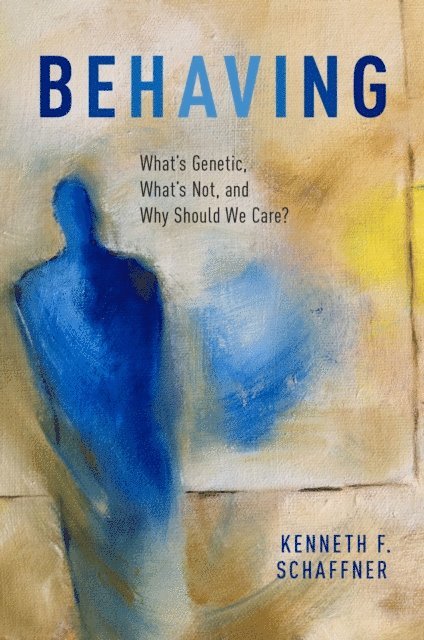
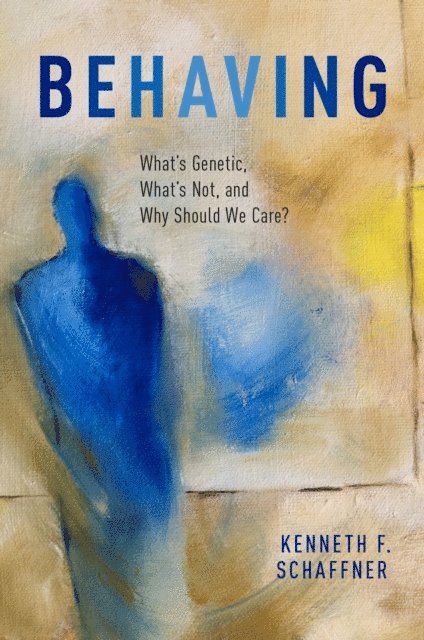
Behaving presents an overview of the recent history and methodology of behavioral genetics and psychiatric genetics, informed by a philosophical perspective. Kenneth F. Schaffner addresses a wide range of issues, including genetic reductionism and determinism, "free will," and quantitative and molecular genetics. The latter covers newer genome-wide association studies (GWAS) that have produced a paradigm shift in the subject, and generated the problem of "missing heritability." Schaffner also presents cases involving pro and con arguments for genetic testing for IQ and for Attention Deficit Hyperactivity Disorder (ADHD).Schaffner examines the nature-nurture controversy and Developmental Systems Theory using C. elegans or "worm" studies as a test case, concluding that genes are special and provide powerful tools, including "deep homology," for investigating behavior. He offers a novel account of biological knowledge emphasizing the importance of models, mechanisms, pathways, and networks, which clarifies how partial reductions provide explanations of traits and disorders.The book also includes examinations of personality genetics and of schizophrenia and its etiology, alongside interviews with prominent researchers in the area, and discusses debates about psychosis that led to changes in the DSM-5 in 2013.Schaffner concludes by discussing additional philosophical implications of the genetic analyses in the book, some major worries about "free will," and arguments pro and con about why genes and DNA are so special. Though genes are special, newer perspectives presented in this book will be needed for progress in behavioral genetics- perspectives that situate genes in complex multilevel prototypic pathways and networks. With a mix of optimism and pessimism about the state of the field and the subject, Schaffner's book will be of interest to scholars in the history and philosophy of science, medicine, and psychiatry.
512 kr
Skickas inom 7-10 vardagar
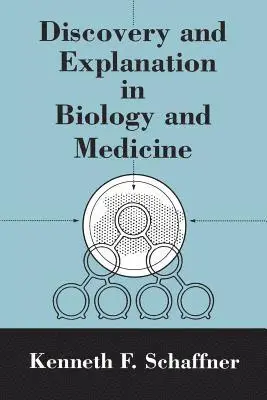
Kenneth F. Schaffner compares the practice of biological and medical research and shows how traditional topics in philosophy of science—such as the nature of theories and of explanation—can illuminate the life sciences. While Schaffner pays some attention to the conceptual questions of evolutionary biology, his chief focus is on the examples that immunology, human genetics, neuroscience, and internal medicine provide for examinations of the way scientists develop, examine, test, and apply theories. Although traditional philosophy of science has regarded scientific discovery—the questions of creativity in science—as a subject for psychological rather than philosophical study, Schaffner argues that recent work in cognitive science and artificial intelligence enables researchers to rationally analyze the nature of discovery. As a philosopher of science who holds an M.D., he has examined biomedical work from the inside and uses detailed examples from the entire range of the life sciences to support the semantic approach to scientific theories, addressing whether there are "laws" in the life sciences as there are in the physical sciences. Schaffner's novel use of philosophical tools to deal with scientific research in all of its complexity provides a distinctive angle on basic questions of scientific evaluation and explanation.
684 kr
Skickas inom 3-6 vardagar
Logic of Discovery and Diagnosis in Medicine provides an interdisciplinary exploration of the interplay between philosophy of science, artificial intelligence (AI), and clinical diagnostic processes. Stemming from a conference held at the University of Pittsburgh, this volume unites contributions from philosophers, physicians, and AI theorists to investigate the foundational and practical aspects of medical reasoning. The discussions center around "problem solving" and "heuristic search" as frameworks for understanding discovery and diagnosis in medicine. By integrating developments in AI, such as the INTERNIST-I program, and philosophical inquiries into logic and reasoning, the book aims to illuminate the complexities and evolving methodologies of medical diagnosis.Key highlights include Herbert Simon's application of AI-based problem-solving theories to clinical diagnosis, with an emphasis on heuristic methods that optimize decision-making in complex scenarios. The book also delves into the limitations of branching logic and Bayesian probability models, advocating for innovative approaches such as causal linkages and adaptive classification systems. Through critiques and discussions of diagnostic tools like INTERNIST-I and its successor, CADUCEUS, contributors explore the challenges of modeling human reasoning and integrating pathophysiological data into AI systems. Ultimately, this volume is both a theoretical and practical resource for advancing the integration of AI in medicine while reflecting on the broader implications for scientific discovery and diagnostic reasoning.This title is part of UC Press's Voices Revived program, which commemorates University of California Press’s mission to seek out and cultivate the brightest minds and give them voice, reach, and impact. Drawing on a backlist dating to 1893, Voices Revived makes high-quality, peer-reviewed scholarship accessible once again using print-on-demand technology. This title was originally published in 1985.
1 513 kr
Skickas inom 3-6 vardagar
Logic of Discovery and Diagnosis in Medicine provides an interdisciplinary exploration of the interplay between philosophy of science, artificial intelligence (AI), and clinical diagnostic processes. Stemming from a conference held at the University of Pittsburgh, this volume unites contributions from philosophers, physicians, and AI theorists to investigate the foundational and practical aspects of medical reasoning. The discussions center around "problem solving" and "heuristic search" as frameworks for understanding discovery and diagnosis in medicine. By integrating developments in AI, such as the INTERNIST-I program, and philosophical inquiries into logic and reasoning, the book aims to illuminate the complexities and evolving methodologies of medical diagnosis.Key highlights include Herbert Simon's application of AI-based problem-solving theories to clinical diagnosis, with an emphasis on heuristic methods that optimize decision-making in complex scenarios. The book also delves into the limitations of branching logic and Bayesian probability models, advocating for innovative approaches such as causal linkages and adaptive classification systems. Through critiques and discussions of diagnostic tools like INTERNIST-I and its successor, CADUCEUS, contributors explore the challenges of modeling human reasoning and integrating pathophysiological data into AI systems. Ultimately, this volume is both a theoretical and practical resource for advancing the integration of AI in medicine while reflecting on the broader implications for scientific discovery and diagnostic reasoning.This title is part of UC Press's Voices Revived program, which commemorates University of California Press’s mission to seek out and cultivate the brightest minds and give them voice, reach, and impact. Drawing on a backlist dating to 1893, Voices Revived makes high-quality, peer-reviewed scholarship accessible once again using print-on-demand technology. This title was originally published in 1985.