Kenneth Gilhooly - Böcker
Visar alla böcker från författaren Kenneth Gilhooly. Handla med fri frakt och snabb leverans.
3 produkter
3 produkter
623 kr
Skickas inom 3-6 vardagar
Societies have always depended upon humanity’s ability to correctly perceive situations and determine suitable subsequent actions. Since this requires us to accurately deal with information, it is important to understand not only how we (mostly) do this, but also how errors may arise. This is the focus of the new, second edition of Cognitive Psychology, one of the most dynamic areas in its field. Accessible yet comprehensive, this text aims to overcome the gap that arises between real life and laboratory studies, by providing an appropriate balance of research versus application.Key Features:• A new structure to better reflect the content and align with teaching• A brand-new standalone chapter on Consciousness• Fully updated pedagogy, including When Things Go Wrong and Research Close Up• Practical Application boxes to highlight the real-world implications of discoveries• Discussion Questions at the end of every chapter to encourage reflection and critical thinking• New chapter links to demonstrate topic connections and signpost readers• A retained emphasis on the critical evaluation of researchCognitive Psychology is available with McGraw Hill’s Connect®, the powerful online learning platform which features our award-winning adaptive reading experience, as well as resources to help faculty and institutions improve student outcomes and course delivery efficiency. To learn more, visit our website.
1 649 kr
Skickas inom 10-15 vardagar
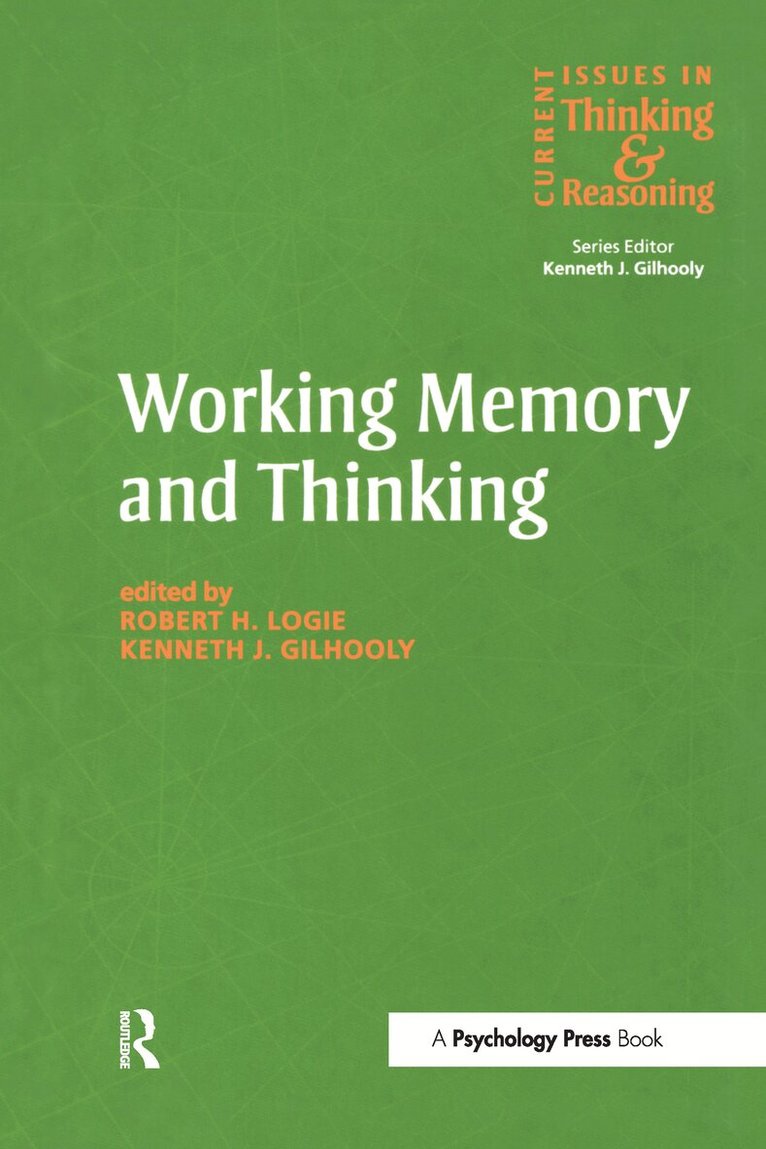
Thinking and memory are inextricably linked. However, a "divide and rule" approach has led cognitive psychologists to study these two areas in relative isolation. With contributions from some of the leading international researchers on working memory and thinking, the present volume aims to break down the scientific divisions and foster scientific integration in the connections between these two core functions of cognition. Broadly defined, thinking comprises mentally driven change in current representations. The processes involved in such change include application of logical rules, heuristics, problem solving strategies, decision making, planning and comprehension of complex material. Memory involves the encoding, retention and retrieval of information, and the retention may be temporary or in a long-term knowledge base.; Thinking cannot occur in a vacuum; it relies on the long-term memory base and a temporary mental workspace. Despite the apparent limitations on mental workspace, humans can drive a car and hold a conversation, or store partial solutions while tackling other aspects of a problem. So too, some aspects of thinking are relatively resilient in the face of quite extensive brain damage, yet other aspects are remarkably vulnerable to neuroanatomical insults. Humans can solve complex problems with many alternative choice points and yet seem to be able to consider only a few hypotheses at any one time. These apparent paradoxes present significant scientific challenges as to how humans can be such successful thinkers despite their very limited working memory. The chapters herein represent a diversity of views as regards the nature or working memory and forms of human thinking. The links between working memory and thinking are directly addressed and made explicit, and in so doing this volume offers an increasingly integrated understanding of human thinking and memory.
468 kr
Skickas inom 10-15 vardagar
Thinking and memory are inextricably linked. However, a "divide and rule" approach has led cognitive psychologists to study these two areas in relative isolation. With contributions from some of the leading international researchers on working memory and thinking, the present volume aims to break down the scientific divisions and foster scientific integration in the connections between these two core functions of cognition. Broadly defined, thinking comprises mentally driven change in current representations. The processes involved in such change include application of logical rules, heuristics, problem solving strategies, decision making, planning and comprehension of complex material. Memory involves the encoding, retention and retrieval of information, and the retention may be temporary or in a long-term knowledge base.; Thinking cannot occur in a vacuum; it relies on the long-term memory base and a temporary mental workspace. Despite the apparent limitations on mental workspace, humans can drive a car and hold a conversation, or store partial solutions while tackling other aspects of a problem. So too, some aspects of thinking are relatively resilient in the face of quite extensive brain damage, yet other aspects are remarkably vulnerable to neuroanatomical insults. Humans can solve complex problems with many alternative choice points and yet seem to be able to consider only a few hypotheses at any one time. These apparent paradoxes present significant scientific challenges as to how humans can be such successful thinkers despite their very limited working memory. The chapters herein represent a diversity of views as regards the nature or working memory and forms of human thinking. The links between working memory and thinking are directly addressed and made explicit, and in so doing this volume offers an increasingly integrated understanding of human thinking and memory.