Kenneth Lange - Böcker
Visar alla böcker från författaren Kenneth Lange. Handla med fri frakt och snabb leverans.
11 produkter
11 produkter
1 313 kr
Skickas inom 10-15 vardagar
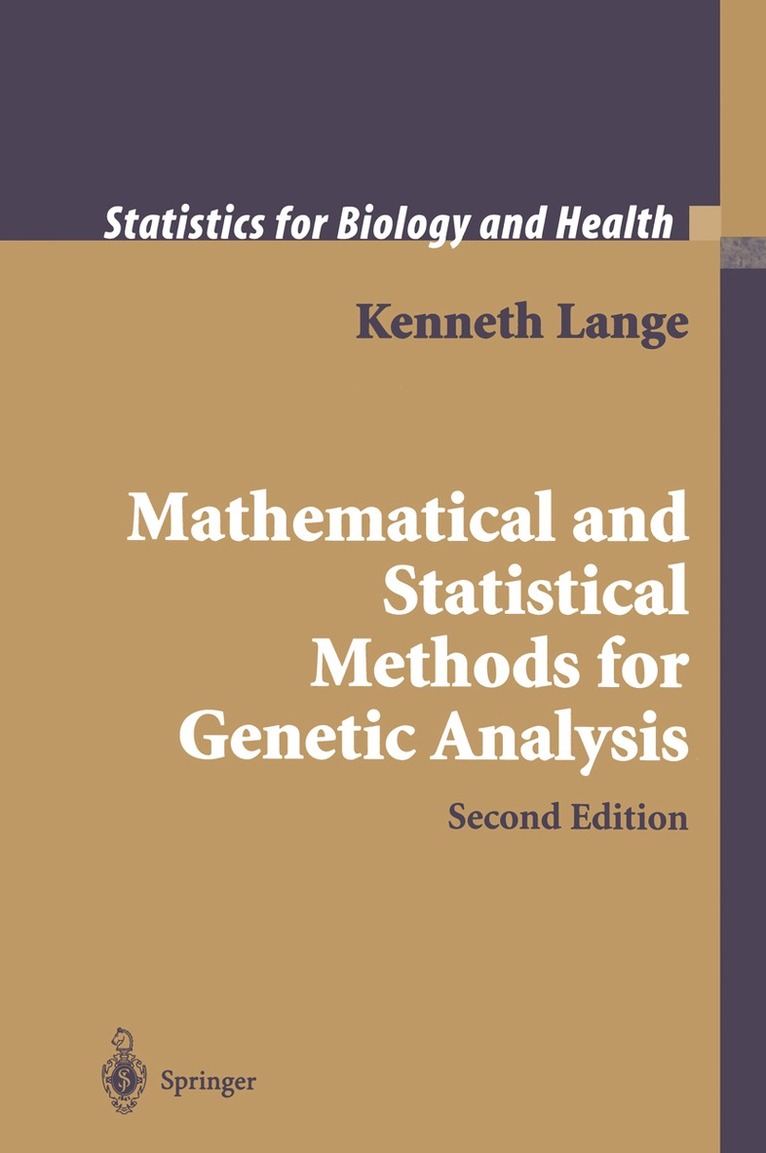
Written to equip students in the mathematical siences to understand and model the epidemiological and experimental data encountered in genetics research. This second edition expands the original edition by over 100 pages and includes new material. Sprinkled throughout the chapters are many new problems.
1 577 kr
Skickas inom 7-10 vardagar
Chapters 6 through 11 present core material on stochastic processes.If supplemented with appropriate sections from Chapters 1 and 2, there is sufficient material for a traditional semester-long course in stochastic processes covering the basics of Poisson processes, Markov chains, branching processes, martingales, and diffusion processes.
1 682 kr
Skickas inom 10-15 vardagar
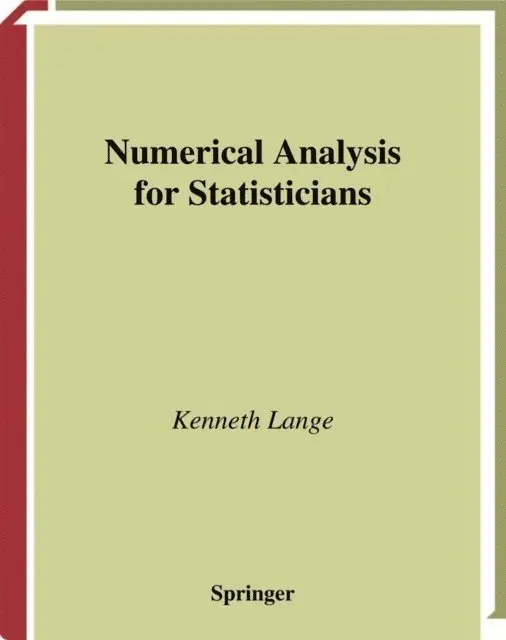
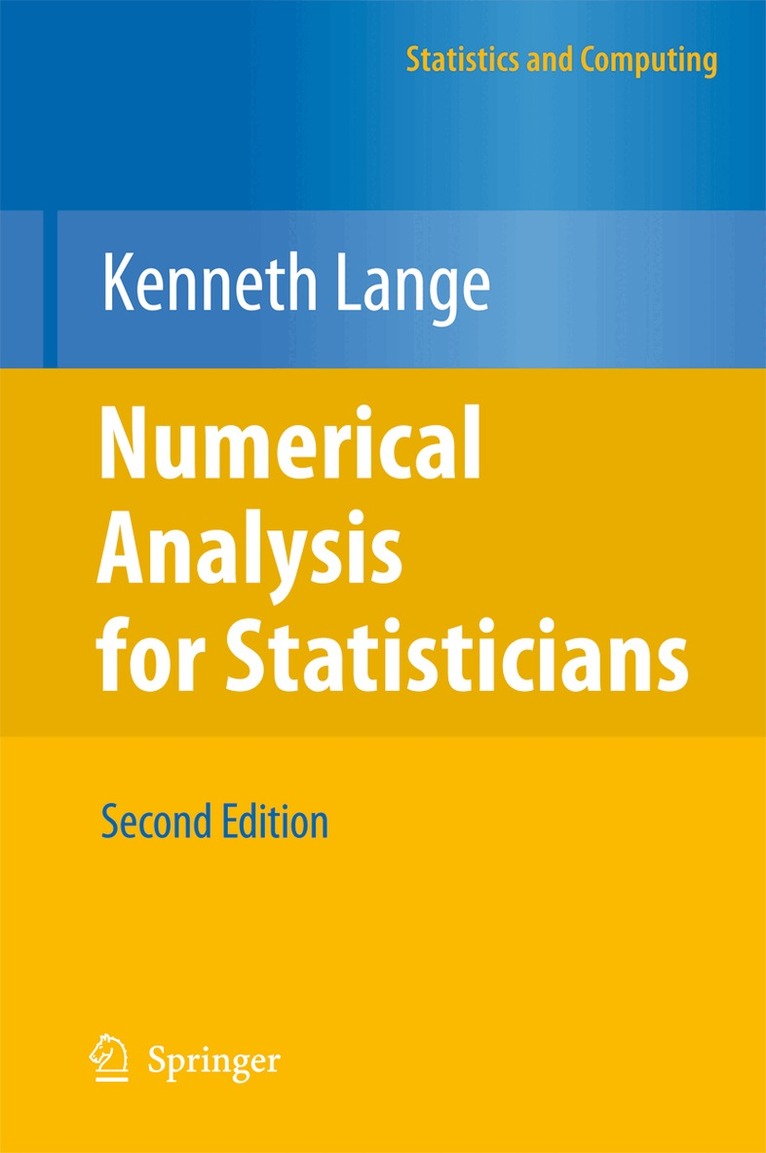
Issues of numerical stability, accurate approximation, computational complexity, and mathematical modeling share the limelight in a broad yet rigorous overview of those parts of numerical analysis most relevant to statisticians.
1 222 kr
Skickas inom 10-15 vardagar
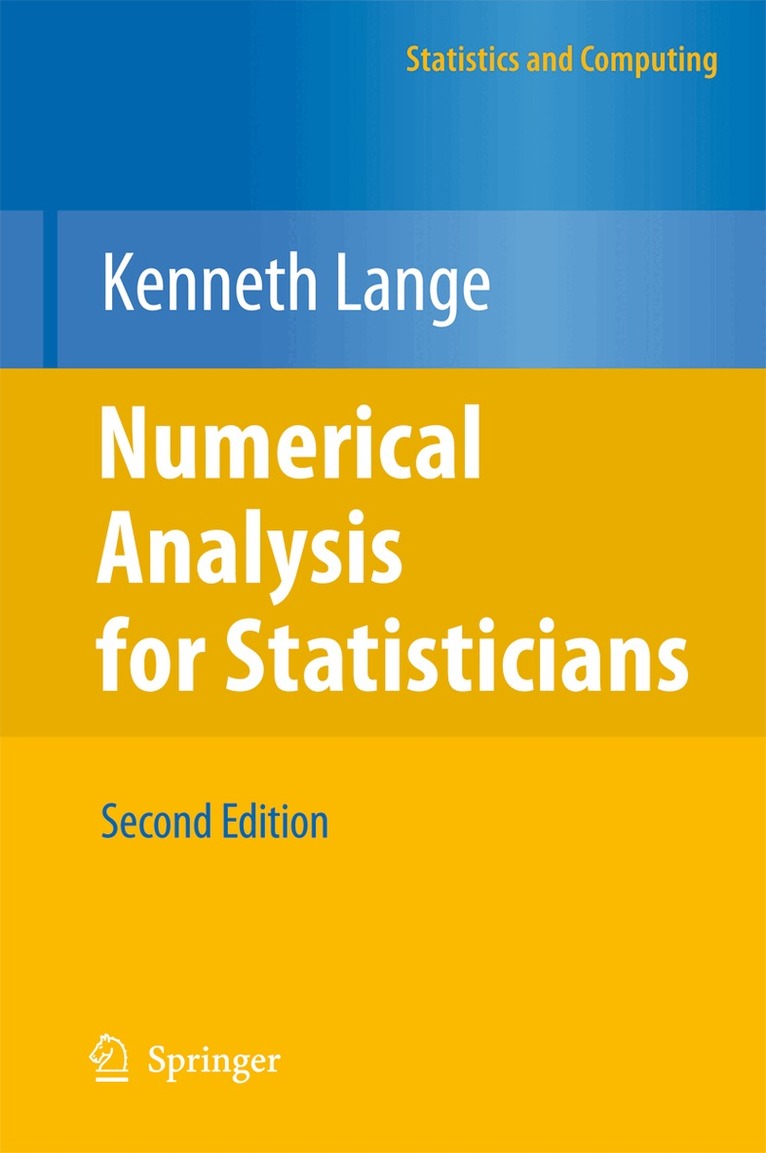
Every advance in computer architecture and software tempts statisticians to tackle numerically harder problems. To do so intelligently requires a good working knowledge of numerical analysis. This book equips students to craft their own software and to understand the advantages and disadvantages of different numerical methods. Issues of numerical stability, accurate approximation, computational complexity, and mathematical modeling share the limelight in a broad yet rigorous overview of those parts of numerical analysis most relevant to statisticians.In this second edition, the material on optimization has been completely rewritten. There is now an entire chapter on the MM algorithm in addition to more comprehensive treatments of constrained optimization, penalty and barrier methods, and model selection via the lasso. There is also new material on the Cholesky decomposition, Gram-Schmidt orthogonalization, the QR decomposition, the singular value decomposition, and reproducing kernel Hilbert spaces. The discussions of the bootstrap, permutation testing, independent Monte Carlo, and hidden Markov chains are updated, and a new chapter on advanced MCMC topics introduces students to Markov random fields, reversible jump MCMC, and convergence analysis in Gibbssampling.Numerical Analysis for Statisticians can serve as a graduate text for a course surveying computational statistics. With a careful selection of topics and appropriate supplementation, it can be used at the undergraduate level. It contains enough material for a graduate course on optimization theory. Because many chapters are nearly self-contained, professional statisticians will also find the book useful as a reference.
1 472 kr
Skickas inom 10-15 vardagar
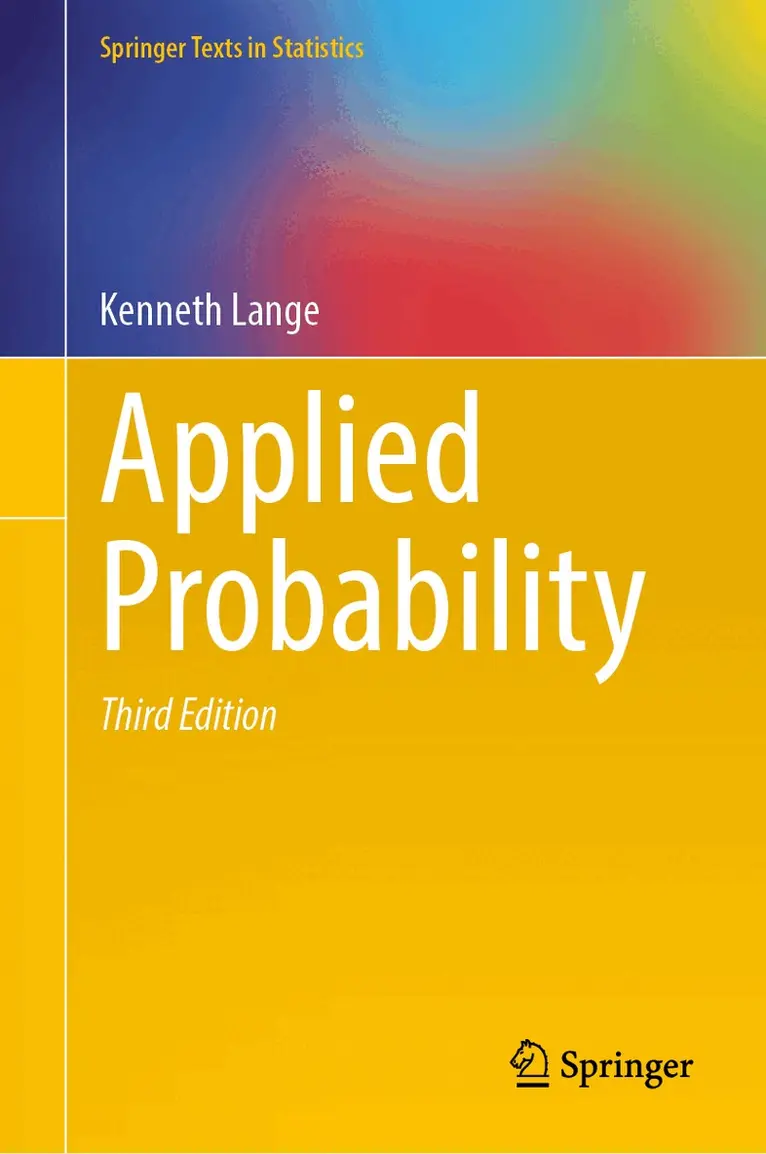
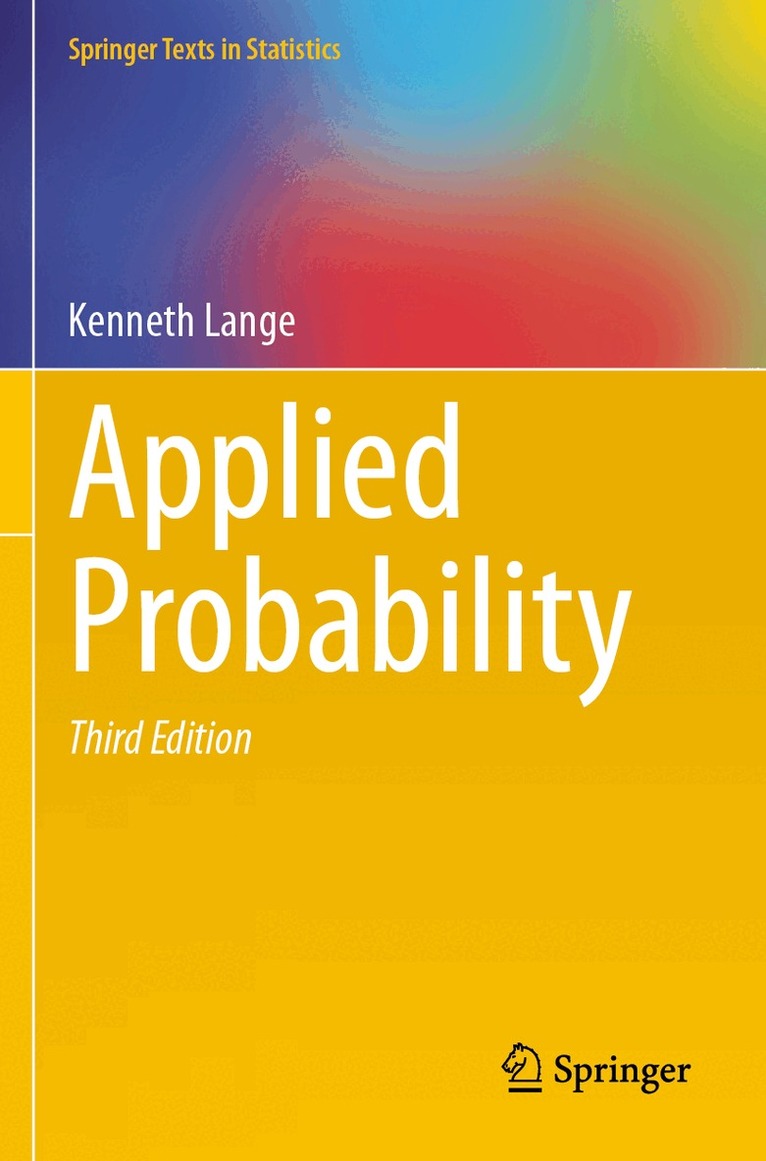
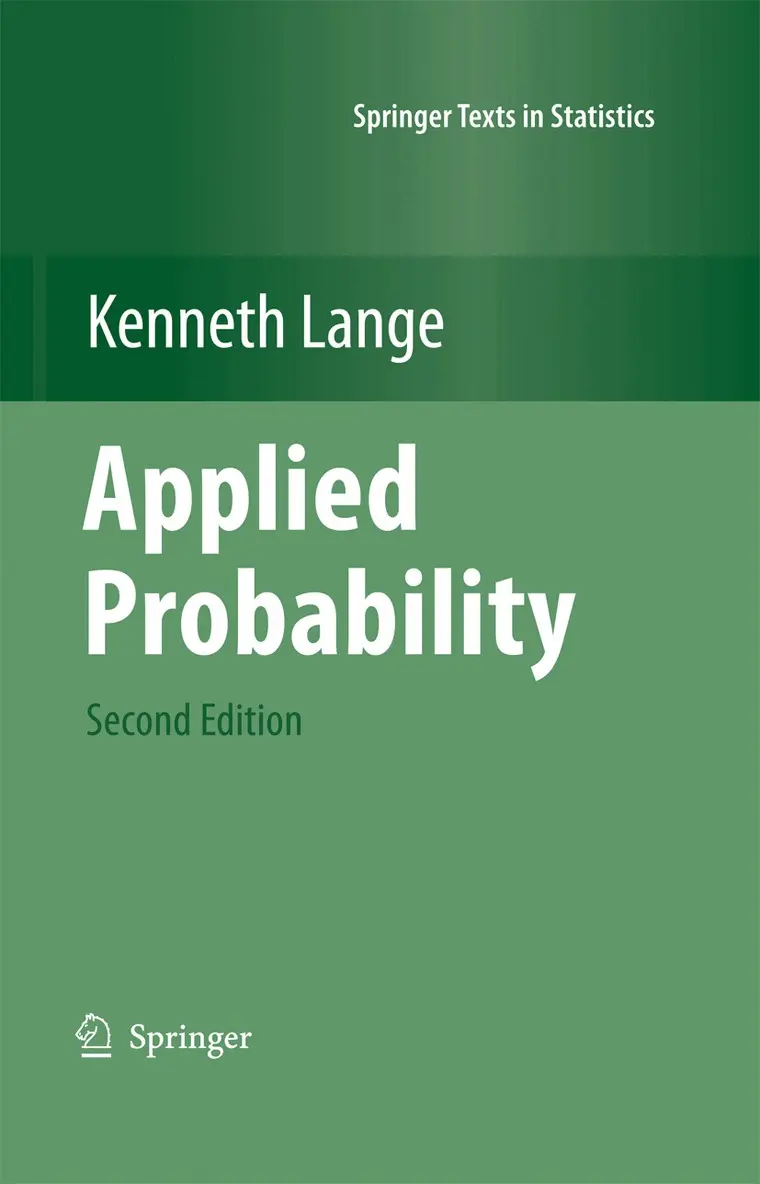
Applied Probability presents a unique blend of theory and applications, with special emphasis on mathematical modeling, computational techniques, and examples from the biological sciences. It can serve as a textbook for graduate students in applied mathematics, biostatistics, computational biology, computer science, physics, and statistics. Readers should have a working knowledge of multivariate calculus, linear algebra, ordinary differential equations, and elementary probability theory. Chapter 1 reviews elementary probability and provides a brief survey of relevant results from measure theory. Chapter 2 is an extended essay on calculating expectations. Chapter 3 deals with probabilistic applications of convexity, inequalities, and optimization theory. Chapters 4 and 5 touch on combinatorics and combinatorial optimization. Chapters 6 through 11 present core material on stochastic processes. If supplemented with appropriate sections from Chapters 1 and 2, there is sufficient material for a traditional semester-long course in stochastic processes covering the basics of Poisson processes, Markov chains, branching processes, martingales, and diffusion processes. The second edition adds two new chapters on asymptotic and numerical methods and an appendix that separates some of the more delicate mathematical theory from the steady flow of examples in the main text. Besides the two new chapters, the second edition includes a more extensive list of exercises, many additions to the exposition of combinatorics, new material on rates of convergence to equilibrium in reversible Markov chains, a discussion of basic reproduction numbers in population modeling, and better coverage of Brownian motion. Because many chapters are nearly self-contained, mathematical scientists from a variety of backgrounds will find Applied Probability useful as a reference
1 891 kr
Skickas inom 10-15 vardagar
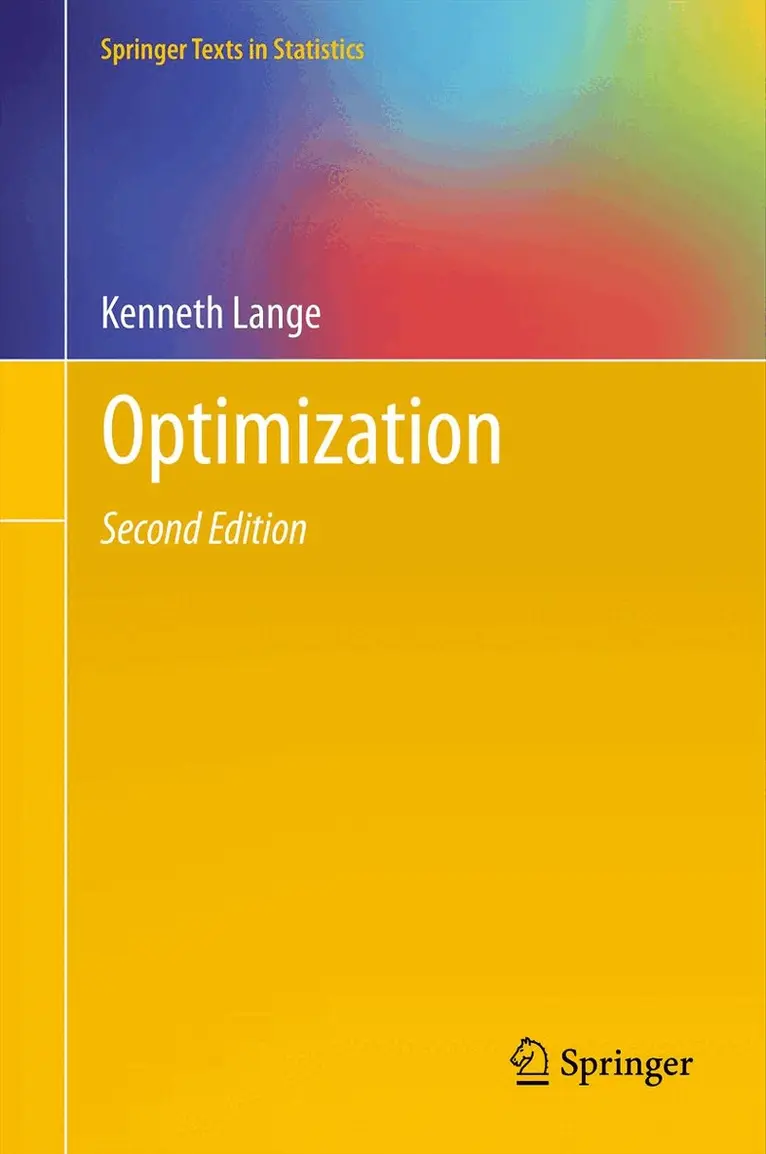
The intended audience also includes students in applied mathematics, computational biology, computer science, economics, and physics who want to see rigorous mathematics combined with real applications.In this second edition the emphasis remains on finite-dimensional optimization.
932 kr
Skickas inom 10-15 vardagar
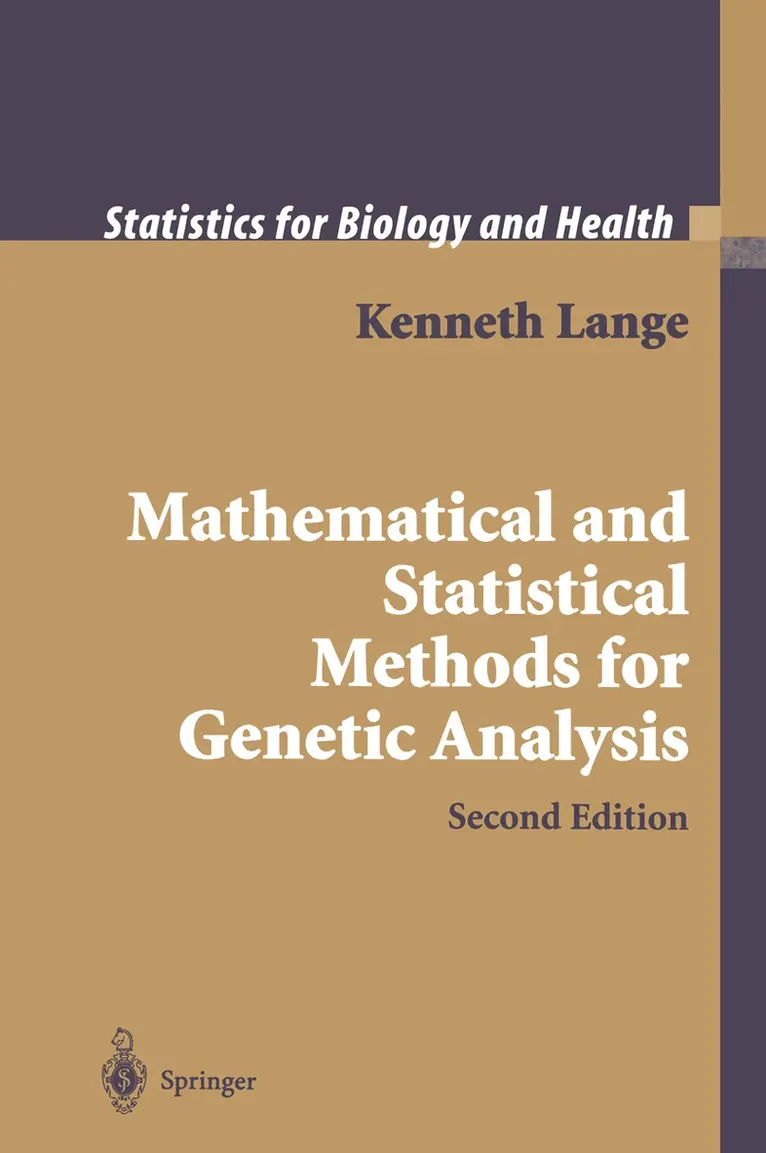
During the past decade, geneticists have cloned scores of Mendelian disease genes and constructed a rough draft of the entire human genome. The unprecedented insights into human disease and evolution offered by mapping, cloning, and sequencing will transform medicine and agriculture. This revolution depends vitally on the contributions of applied mathematicians, statisticians, and computer scientists. Mathematical and Statistical Methods for Genetic Analysis is written to equip students in the mathematical sciences to understand and model the epidemiological and experimental data encountered in genetics research. Mathematical, statistical, and computational principles relevant to this task are developed hand in hand with applications to population genetics, gene mapping, risk prediction, testing of epidemiological hypotheses, molecular evolution, and DNA sequence analysis. Many specialized topics are covered that are currently accessible only in journal articles. This second edition expands the original edition by over 100 pages and includes new material on DNA sequence analysis, diffusion processes, binding domain identification, Bayesian estimation of haplotype frequencies, case-control association studies, the gamete competition model, QTL mapping and factor analysis, the Lander-Green-Kruglyak algorithm of pedigree analysis, and codon and rate variation models in molecular phylogeny. Sprinkled throughout the chapters are many new problems.
653 kr
Skickas inom 5-8 vardagar
1 381 kr
Skickas inom 10-15 vardagar
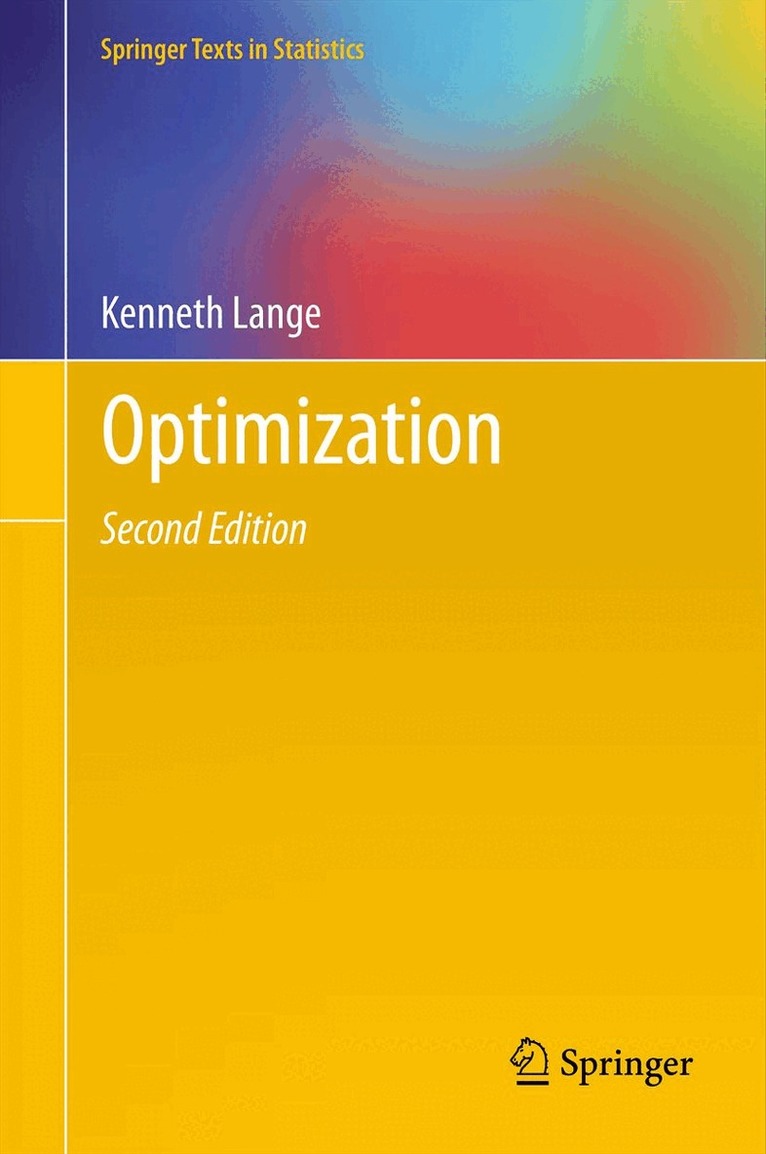
The intended audience also includes students in applied mathematics, computational biology, computer science, economics, and physics who want to see rigorous mathematics combined with real applications.In this second edition the emphasis remains on finite-dimensional optimization.
928 kr
Skickas inom 7-10 vardagar
Offers an overview of the MM principle, a device for deriving optimization algorithms satisfying the ascent or descent property. These algorithms can:Separate the variables of a problem.Avoid large matrix inversions.Linearize a problem.Restore symmetry.Deal with equality and inequality constraints gracefully.Turn a non-differentiable problem into a smooth problem.The author:Presents the first extended treatment of MM algorithms, which are ideal for high-dimensional optimization problems in data mining, imaging, and genomics. Derives numerous algorithms from a broad diversity of application areas, with a particular emphasis on statistics, biology, and data mining.Summarizes a large amount of literature that has not reached book form before.
849 kr
Skickas inom 7-10 vardagar
Most books on algorithms are narrowly focused on a single field of application. This unique book cuts across discipline boundaries, exposing readers to the most successful algorithms from a variety of fields. Algorithm derivation is a legitimate branch of the mathematical sciences driven by hardware advances and the demands of many scientific fields. The best algorithms are undergirded by beautiful mathematics. This book enables readers to look under the hood and understand how some basic algorithms operate and how to assemble complex algorithms from simpler building blocks. In Algorithms from THE BOOK, Second EditionJulia code for experimentation accompanies most algorithms, a large number of classroom-tested exercises at the end of each chapter make it suitable as a textbook, andappendices contain background material often missing in undergraduate education as well as solutions to selected problems.