Kevin N. Laland - Böcker
Visar alla böcker från författaren Kevin N. Laland. Handla med fri frakt och snabb leverans.
5 produkter
5 produkter
888 kr
Skickas inom 7-10 vardagar
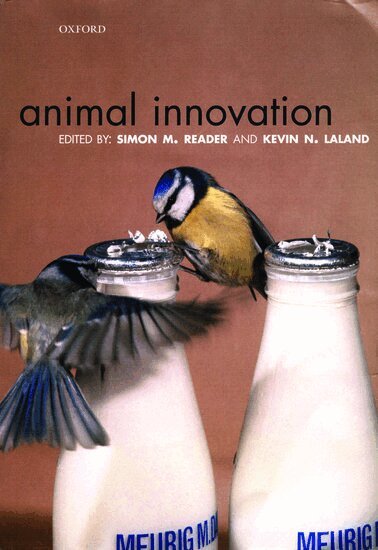
In 1953 a young female Japanese macaque called Imo began washing sweet potatoes before eating them, presumably to remove dirt and sand grains. Soon other monkeys had adopted this behaviour, and potato washing gradually spread throughout the troop. When, three years after her first invention, Imo devised a second novel foraging behaviour, that of separating wheat from sand by throwing mixed handfuls into water and scooping out the floating grains, she was almost instantly heralded around the world as a 'monkey genius'. Imo is probably the most celebrated of animal innovators. In fact, many animals will invent new behaviour patterns, adjust established behaviours to a novel context, or respond to stresses in an appropriate and novel manner.Innovation is an important component of behavioural flexibility, vital to the survival of individuals in species with generalist or opportunistic lifestyles, and potentially of critical importance to those endangered or threatened species forced to adjust to changed or impoverished environments. Innovation may also have played a central role in avian and primate brain evolution. Yet until recently animal innovation has been subject to almost complete neglect by behavioural biologists, psychologists, social learning researchers, and conservation-minded biologists.This collection of stimulating and readable articles by leading scientific authorities is the first ever book on 'animal innovation', designed to put the topic of animal innovation on the map and heighten awareness of this developing field.
602 kr
Skickas inom 5-8 vardagar
Evolutionary theory is one of the most wide-ranging and inspiring of scientific ideas. It offers a battery of methods that can be used to interpret human behaviour. But the legitimacy of this exercise is at the centre of a heated controversy that has raged for over a century. Many evolutionary biologists, anthropologists and psychologists are optimistic that evolutionary principles can be applied to human behaviour, and have offered evolutionary explanations for a wide range of human characteristics, such as homicide, religion and sex differences in behaviour. Others are sceptical of these interpretations. Moreover, researchers disagree as to the best ways to use evolution to explore humanity, and a number of schools have emerged. Sense and Nonsense provides an introduction to the ideas, methods and findings of five such schools, namely, sociobiology, human behavioural ecology, evolutionary psychology, cultural evolution, and gene-culture co-evolution. In this revised and updated edition of their successful monograph, Laland and Brown provide a balanced, rigorous analysis that scrutinizes both the evolutionary arguments and the allegations of the critics, carefully guiding the reader through the mire of confusing terminology, claim and counter-claim, and polemical statements. This readable and informative introductory book will be of use to undergraduate and postgraduate students (for example, in psychology, anthropology and zoology), to experts on one approach who would like to know more about the other perspectives, and to lay-persons interested in evolutionary explanations of human behaviour. Having completed this book, the reader should feel better placed to assess the legitimacy of claims made about human behaviour under the name of evolution, and to make judgements as to what is sense and what is nonsense.
1 837 kr
Skickas inom 7-10 vardagar
Culture - broadly defined as all we learn from others that endures for long enough to generate customs and traditions - shapes vast swathes of our lives and has allowed the human species to dominate the planet in an evolutionarily unique way. Culture and cultural evolution are uniquely significant phenomena in evolutionary biology: they are products of biological evolution, yet they supplement genetic transmission with social transmission, thus achieving a certain independence from natural selection. However, cultural evolution nevertheless expresses key Darwinian processes itself and also interacts with genetic evolution. Just how culture fits into the grander framework of evolution is a big issue though, yet one that has received relatively little scientific attention compared to, for example, genetic evolution. Our 'capacity for culture' appears so distinctive among animals that it is often thought to separate we cultural beings from the rest of nature and the Darwinian forces that shape it. 'Culture Evolves' presents a different view arising from the recent discoveries of a diverse range of disciplines, that focus on evolutionary continuities. First, recent studies reveal that learning from others and the transmission of traditions are more widespread and significant across the animal kingdom than earlier recognized, helping us understand the evolutionary roots of culture. Second, archaeological discoveries have pushed back the origins of human culture to much more ancient times than traditionally thought. These developments together suggest important continuities between animal and human culture. A third new array of discoveries concerns the later diversification of human cultures, where the operations of Darwinian-like, cultural evolutionary processes are increasingly identified. Finally, surprising discoveries have been made about the imprint of cultural evolution in children's predisposition to acquire culture.The result of a major interdisciplinary meeting held by he Royal Society and the British Academy, this book presents the work of leading experts from the fields of ethology, behavioural ecology, primatology, comparative psychology, archaeology, anthropology, evolutionary biology and developmental psychology.
639 kr
Tillfälligt slut
705 kr
Skickas inom 10-15 vardagar
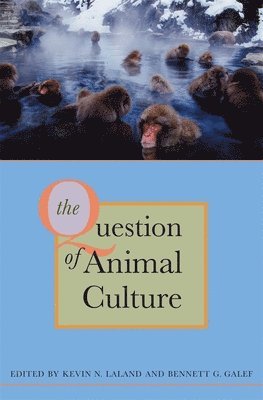
Fifty years ago, a troop of Japanese macaques was observed washing sandy sweet potatoes in a stream, sending ripples through the fields of ethology, comparative psychology, and cultural anthropology. The issue of animal culture has been hotly debated ever since. Now Kevin Laland and Bennett Galef have gathered key voices in the often rancorous debate to summarize the views along the continuum from “Culture? Of course!” to “Culture? Of course not!” The result is essential reading for anyone interested in the validity of animal culture, and what it might say about our own.