Tobias Uller – författare
716 kr
Läs direkt efter köp
A comprehensive treatment of the concept of causation in evolutionary biology that makes clear its central role in both historical and contemporary debates.
Most scientific explanations are causal. This is certainly the case in evolutionary biology, which seeks to explain the diversity of life and the adaptive fit between organisms and their surroundings. The nature of causation in evolutionary biology, however, is contentious. How causation is understood shapes the structure of evolutionary theory, and historical and contemporary debates in evolutionary biology have revolved around the nature of causation. Despite its centrality, and differing views on the subject, the major conceptual issues regarding the nature of causation in evolutionary biology are rarely addressed. This volume fills the gap, bringing together biologists and philosophers to offer a comprehensive, interdisciplinary treatment of evolutionary causation.
Contributors first address biological motivations for rethinking evolutionary causation, considering the ways in which development, extra-genetic inheritance, and niche construction challenge notions of cause and process in evolution, and describing how alternative representations of evolutionary causation can shed light on a range of evolutionary problems. Contributors then analyze evolutionary causation from a philosophical perspective, considering such topics as causal entanglement, the commingling of organism and environment, and the relationship between causation and information.
ContributorsJohn A. Baker, Lynn Chiu, David I. Dayan, Renée A. Duckworth, Marcus W Feldman, Susan A. Foster, Melissa A. Graham, Heikki Helanterä, Kevin N. Laland, Armin P. Moczek, John Odling-Smee, Jun Otsuka, Massimo Pigliucci, Arnaud Pocheville, Arlin Stoltzfus, Karola Stotz, Sonia E. Sultan, Christoph Thies, Tobias Uller, Denis M. Walsh, Richard A. Watson
527 kr
Läs direkt efter köp
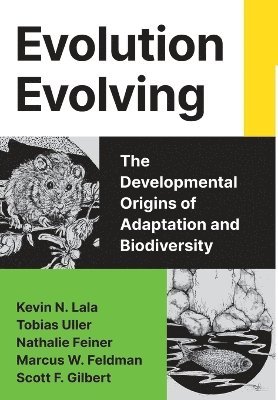
A new account of the central role developmental processes play in evolutionA new scientific view of evolution is emerging—one that challenges and expands our understanding of how evolution works. Recent research demonstrates that organisms differ greatly in how effective they are at evolving. Whether and how each organism adapts and diversifies depends critically on the mechanistic details of how that organism operates—its development, physiology, and behavior. That is because the evolutionary process itself has evolved over time, and continues to evolve. The scientific understanding of evolution is evolving too, with groundbreaking new ways of explaining evolutionary change. In this book, a group of leading biologists draw on the latest findings in evolutionary genetics and evo-devo, as well as novel insights from studies of epigenetics, symbiosis, and inheritance, to examine the central role that developmental processes play in evolution.Written in an accessible style, and illustrated with fascinating examples of natural history, the book presents recent scientific discoveries that expand evolutionary biology beyond the classical view of gene transmission guided by natural selection. Without undermining the central importance of natural selection and other Darwinian foundations, new developmental insights indicate that all organisms possess their own characteristic sets of evolutionary mechanisms. The authors argue that a consideration of developmental phenomena is needed for evolutionary biologists to generate better explanations for adaptation and biodiversity. This book provides a new vision of adaptive evolution.
381 kr
Skickas inom 5-8 vardagar
319 kr
Kommande
1 096 kr
Skickas inom 7-10 vardagar
431 kr
Skickas inom 7-10 vardagar
523 kr
Läs direkt efter köp
523 kr
Läs direkt efter köp
639 kr
Tillfälligt slut