Kirsten Fermaglich - Böcker
Visar alla böcker från författaren Kirsten Fermaglich. Handla med fri frakt och snabb leverans.
3 produkter
3 produkter
211 kr
Skickas inom 7-10 vardagar
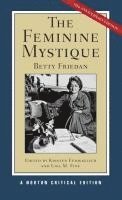
The Feminine Mystique (1963) is a powerful critique of women’s roles in contemporary American society. Drawing on new scholarship in the social sciences, Betty Friedan attacked a wide range of institutions—among them women’s magazines, women’s colleges, and advertisers—for promoting a one-dimensional image of women as happy housewives. This image, Friedan suggested, created a “feminine mystique,” a belief that “fulfillment as a woman had only one definition for American women after 1949—the housewife-mother.” The book soon became a national best seller, with over a million copies sold.This Norton Critical Edition of Friedan’s phenomenal book traces its cultural and historical significance over its first fifty years. The text of The Feminine Mystique is accompanied by an introduction and is fully annotated.Friedan’s book is the product of her early life as an activist, a student, and an intellectual while also drawing on her own experiences as a wife and mother. “Origins and Influences” includes writings that helped shape the author’s ideas about women and society. These works are topically organized: “Childhood World,” “Intellectual Influences,” “Domesticity and ‘Momism’ during the Cold War,” “Popular-Front Feminism,” “The Power of the Feminine Mystique on Betty Friedan?,” and finally, “Female Labor Force Participation Trends in the Twentieth Century.” Among the authors included are Robert S. and Helen Merrell Lynd, Friedrich Engels, Margaret Mead, Amram Scheinfeld, and Simone de Beauvoir.The 1960s was a time of great upheaval in America with sweeping changes throughout society including women’s rights, civil rights, peace movements, environmental movements, student activism, and the sexual revolution. It was also a time when a number of American Jewish intellectuals, including Friedan, made comparisons between American life and Nazi destruction. “The Turn of the Sixties: Political, Intellectual, and Cultural Ferment” provides readers with an understanding of The Feminine Mystique’s contemporary context through relevant U.S. government documents and through the voices of, among others, Eleanor Roosevelt, Reverend Martin Luther King Jr., Helen Gurley Brown, and Bruno Bettelheim.More impressive than even The Feminine Mystique’s best-seller status and the debate it sparked in the national press is its broader cultural significance. Hundreds of women wrote to Friedan about how the book affected them personally. “Impact” includes a selection of these letters from the Betty Friedan Papers, along with feminist writings from the second (Pauli Murray, Robin Morgan, Bella Abzug) and third (Rebecca Walker, Naomi Wolf, Jennifer Baumgardner and Amy Richards) waves of feminism, and the backlash against the movement and The Feminine Mystique (Phyllis Schlafly).The book also includes a section on the scholarship on The Feminine Mystique, with excerpts from scholars such as Daniel Horowitz, Joanne Meyerowitz, Ruth Rosen, and Stephanie Coontz. Analyses of Betty Friedan as a historian, the evolution of her ideas, and the legacy of The Feminine Mystique on its fiftieth anniversary are included.A Chronology of Betty Friedan’s life and work and a Selected Bibliography are also included.
354 kr
Skickas inom 10-15 vardagar
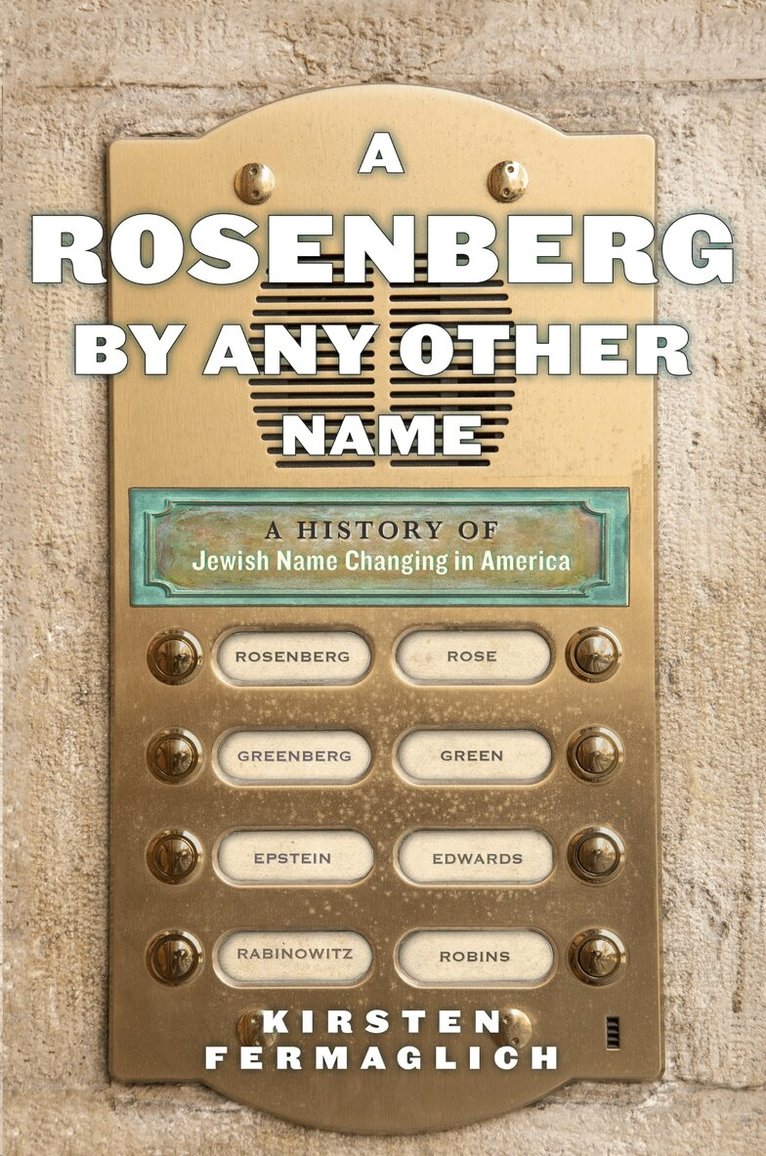
Winner, 2019 Saul Viener Book Prize, given by the American Jewish Historical SocietyA groundbreaking history of the practice of Jewish name changing in the 20th century, showcasing just how much is in a nameOur thinking about Jewish name changing tends to focus on clichés: ambitious movie stars who adopted glamorous new names or insensitive Ellis Island officials who changed immigrants' names for them. But as Kirsten Fermaglich elegantly reveals, the real story is much more profound. Scratching below the surface, Fermaglich examines previously unexplored name change petitions to upend the clichés, revealing that in twentieth-century New York City, Jewish name changing was actually a broad-based and voluntary behavior: thousands of ordinary Jewish men, women, and children legally changed their names in order to respond to an upsurge of antisemitism. Rather than trying to escape their heritage or "pass" as non-Jewish, most name-changers remained active members of the Jewish community. While name changing allowed Jewish families to avoid antisemitism and achieve white middle-class status, the practice also created pain within families and became a stigmatized, forgotten aspect of American Jewish culture. This first history of name changing in the United States offers a previously unexplored window into American Jewish life throughout the twentieth century. A Rosenberg by Any Other Name demonstrates how historical debates about immigration, antisemitism and race, class mobility, gender and family, the boundaries of the Jewish community, and the power of government are reshaped when name changing becomes part of the conversation. Mining court documents, oral histories, archival records, and contemporary literature, Fermaglich argues convincingly that name changing had a lasting impact on American Jewish culture. Ordinary Jews were forced to consider changing their names as they saw their friends, family, classmates, co-workers, and neighbors do so. Jewish communal leaders and civil rights activists needed to consider name changers as part of the Jewish community, making name changing a pivotal part of early civil rights legislation. And Jewish artists created critical portraits of name changers that lasted for decades in American Jewish culture. This book ends with the disturbing realization that the prosperity Jews found by changing their names is not as accessible for the Chinese, Latino, and Muslim immigrants who wish to exercise that right today.
483 kr
Skickas inom 3-6 vardagar
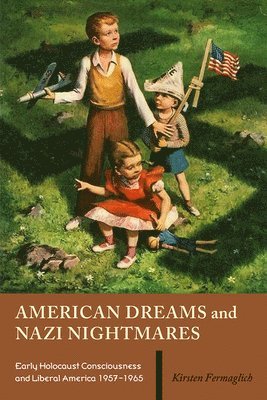
To a great extent, Holocaust consciousness in the contemporary United States has become intertwined with American Jewish identity and with support for right-wing Israeli politics -- but this was not always the case. In this illuminating study, Kirsten Fermaglich demonstrates that in the late 1950s and early 1960s, many American Jewish writers and academics viewed the Nazi extermination of European Jewry as a subject of universal interest, with important lessons to be learned for the liberal reform of American politics. Fermaglich analyzes the lives and writings of Stanley M. Elkins, Betty Friedan, Stanley Milgram, and Robert Jay Lifton, four social scientific thinkers whose work was shaped by a liberal perspective. For them, the Holocaust served as a critical frame of reference for a particular issue: Elkins on slavery's legacy, Friedan on the oppressions of domesticity, Milgram on the willingness to obey, and Lifton on war's survivors. In each case, these thinkers were deeply influenced by their Jewish backgrounds, whether by early encounters with antisemitism or by the profound sense that only fate and an ocean had spared them death in Hitler's Europe. Thus, each chose imagery from the concentration camps, albeit utterly devoid of a particular Jewish association, to illuminate themes that advanced liberal politics, including civil rights, the nuclear test ban, feminism, and Vietnam veterans' rights.Rather than being offended by these authors' comparisons between American institutions and Nazi concentration camps, American audiences of all ethnic and religious backgrounds during the late 1950s and early 1960s generally cheered these authors' Nazi imagery and adopted it as part of their own political ideology. Fermaglich demonstrates that liberalism in the United States in the 1960s was more substantially shaped by the Holocaust than we have previously recognized.