Klaus H. Ecker – författare
Visar alla böcker från författaren Klaus H. Ecker. Handla med fri frakt och snabb leverans.
10 produkter
Handbook on Scheduling
From Theory to Practice
Av Jacek Blazewicz, Klaus H. Ecker m. fl.
Inbunden, 2019
2722 kr
Lägg i varukorg
This handbook provides a comprehensive introduction to the theory and applications of scheduling in advanced planning and computer systems. It addresses a broad audience including practitioners and researchers interested in scheduling, as well as graduate and advanced undergraduate students in the …
Handbook on Scheduling
From Theory to Practice
Av Jan Weglarz, Malgorzata Sterna m. fl.
E-bok, 2019
3500 kr
Lägg i varukorg
This handbook provides a comprehensive introduction to the theory and applications of scheduling in advanced planning and computer systems. It addresses a broad audience including practitioners and researchers interested in scheduling, as well as graduate and advanced undergraduate students in the …
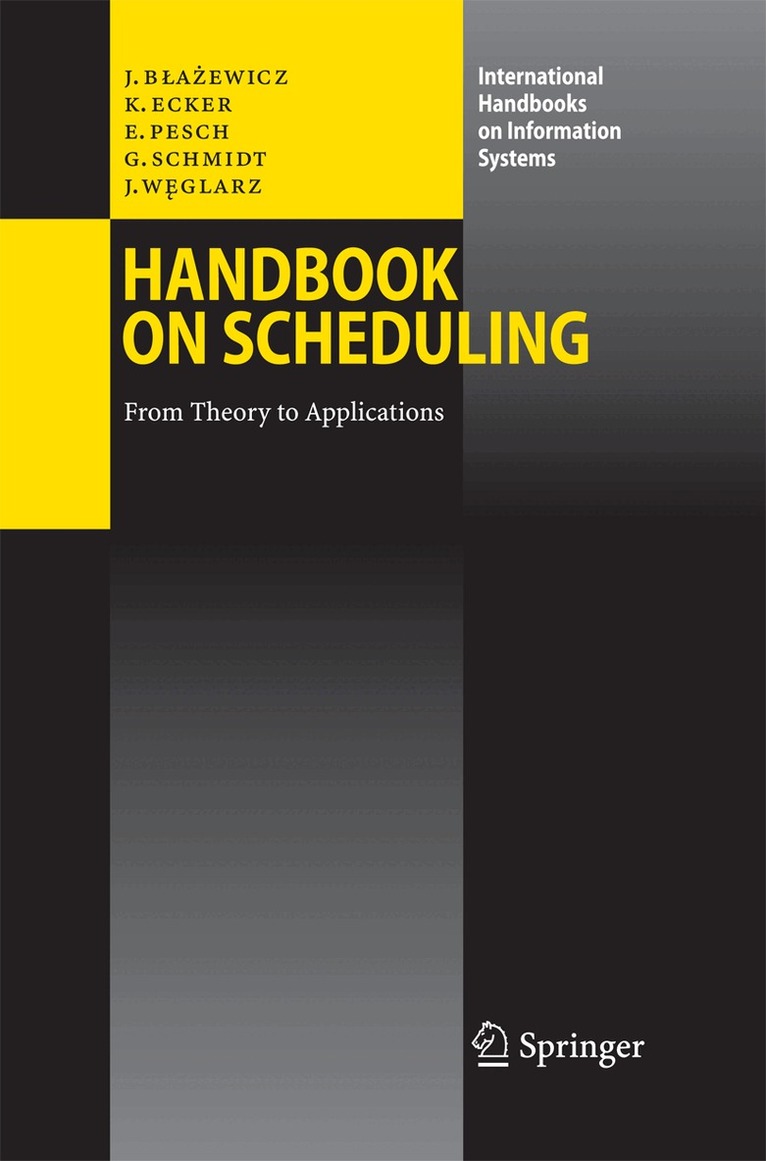
Handbook on Scheduling
From Theory to Applications
Av Jan Weglarz, Gunter Schmidt m. fl.
E-bok, 2007
2727 kr
Lägg i varukorg
This handbook is in a sense a continuation of Scheduling Computer and Manu facturing Processes [1], two editions of which have received kind acceptance of a wide readership. As the previous volume, it is the result of a long lasting Ger man-Polish collaboration. However, due to important reasons, …
Scheduling Computer and Manufacturing Processes
Av Jacek Blazewicz, Klaus H. Ecker m. fl.
Inbunden, 2001
1636 kr
Lägg i varukorg
Let us first describe the purpose of this book, starting with the explanation of its title. In general, scheduling problems can be understood very broadly as the problems of allocating resources over time to perform a set of tasks being parts of some processes, among which computational and …
Scheduling Computer and Manufacturing Processes
Av Jacek Blazewicz, Klaus H. Ecker m. fl.
Häftad, 2010
1636 kr
Lägg i varukorg
Let us first describe the purpose of this book, starting with the explanation of its title. In general, scheduling problems can be understood very broadly as the problems of allocating resources over time to perform a set of tasks being parts of some processes, among which computational and …
Scheduling in Computer and Manufacturing Systems
Av Jan Weglarz, Gunter Schmidt m. fl.
E-bok, 2012
1502 kr
Lägg i varukorg
Let us start with the description of the purpose of this book. First we should explain how we understand its tide. In general, scheduling problems can be understood very broadly as the problems of the allocation of resources over time to perform a set of tasks. By resources we understand arbitrary …
Scheduling in Computer and Manufacturing Systems
Av Jacek Blazewicz, Klaus H. Ecker m. fl.
Häftad, 2011
1126 kr
Lägg i varukorg
Let us start with the description of the purpose of this book. First we should explain how we understand its tide. In general, scheduling problems can be understood very broadly as the problems of the allocation of resources over time to perform a set of tasks. By resources we understand arbitrary …
Scheduling Computer and Manufacturing Processes
Av Jan Weglarz, Gunter Schmidt m. fl.
E-bok, 2013
1148 kr
Lägg i varukorg
This book is a continuation of Scheduling in Computer and Manufacturing Sys tems 1, two editions of which have received kind acceptance of a wide readership. As the previous position, it is the result of a collaborative German-Polish project which has been partially supported by Committee for …
Scheduling Computer and Manufacturing Processes
Av Jan Weglarz, Gunter Schmidt m. fl.
E-bok, 2013
2111 kr
Lägg i varukorg
Let us first describe the purpose of this book, starting with the explanation of its title. In general, scheduling problems can be understood very broadly as the problems of allocating resources over time to perform a set of tasks being parts of some processes, among which computational and …
Handbook on Scheduling
From Theory to Applications
Av Jacek Blazewicz, Klaus H. Ecker m. fl.
Häftad, 2014
2823 kr
Tillfälligt slut
This handbook is in a sense a continuation of Scheduling Computer and Manu facturing Processes [1], two editions of which have received kind acceptance of a wide readership. As the previous volume, it is the result of a long lasting Ger man-Polish collaboration. However, due to important reasons, …