Kuniyoshi Kataoka – Författare
Visar alla böcker från författaren Kuniyoshi Kataoka. Handla med fri frakt och snabb leverans.
3 produkter
3 produkter
1 383 kr
Skickas inom 10-15 vardagar
Drawing on the author’s experience as a sociolinguist and a mountain climber, this open access book shows how the expertise and affect-laden experience of Japanese rock climbers can be illuminated through linguistic methods and theories. Through a detailed investigation of multimodal interaction among climbers, the book explores a number of significant sociolinguistic and linguistic anthropological themes, including spatial frames of reference, intersubjectivity, chronotopic configurations, and poetic formations of talk. In doing so, it presents climbing as a condensed locus of human interactions in which the integrated analysis of semiotic processes brings to light a new set of relationships between humans and their surroundings.Grounded in an extended and focused participation in rock climbing activities and interviews with other climbers, Kuniyoshi Kataoka examines the assemblage of semiotic resources including the language, the body, and the space mediated by their climbing equipment and the surrounding environment. The result is a showcase of interdisciplinary multimodal approaches to climbing discourse analysis in and around the gravity-sensitive zone, ranging from expert climbers’ instruction to novices, gossip and narratives on near-death experiences, to a multi-participant discussion of a critical accident. As well as demonstrating how language reflects extraordinary experiences on the vertical plane, the findings also offer a chance to learn more about climbing, which is attracting a growing number of participants and competitors worldwide.The ebook editions of this book are available open access under a CC BY-NC-ND 4.0 licence on bloomsburycollections.com. Open access was funded by Aichi University, Japan.
406 kr
Skickas inom 10-15 vardagar
Drawing on the author’s experience as a sociolinguist and a mountain climber, this open access book shows how the expertise and affect-laden experience of Japanese rock climbers can be illuminated through linguistic methods and theories. Through a detailed investigation of multimodal interaction among climbers, the book explores a number of significant sociolinguistic and linguistic anthropological themes, including spatial frames of reference, intersubjectivity, chronotopic configurations, and poetic formations of talk. In doing so, it presents climbing as a condensed locus of human interactions in which the integrated analysis of semiotic processes brings to light a new set of relationships between humans and their surroundings.Grounded in an extended and focused participation in rock climbing activities and interviews with other climbers, Kuniyoshi Kataoka examines the assemblage of semiotic resources including the language, the body, and the space mediated by their climbing equipment and the surrounding environment. The result is a showcase of interdisciplinary multimodal approaches to climbing discourse analysis in and around the gravity-sensitive zone, ranging from expert climbers’ instruction to novices, gossip and narratives on near-death experiences, to a multi-participant discussion of a critical accident. As well as demonstrating how language reflects extraordinary experiences on the vertical plane, the findings also offer a chance to learn more about climbing, which is attracting a growing number of participants and competitors worldwide.The ebook editions of this book are available open access under a CC BY-NC-ND 4.0 licence on bloomsburycollections.com. Open access was funded by Aichi University, Japan.
1 314 kr
Skickas inom 10-15 vardagar
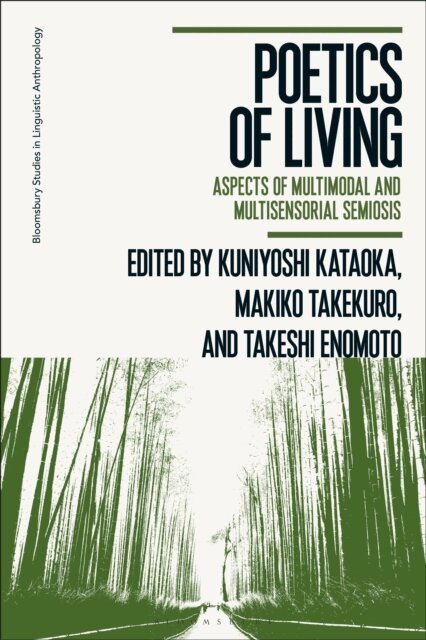
This book provides empirical and theoretical accounts of poetics from a sociolinguistic and linguistic anthropological perspective, highlighting the poesis of everyday living. The authors not only regard poetry as a literary genre or a form of aesthetic performance, but also aim to clarify how everyday practices, such as casual conversation, radio broadcasting, sightseeing tours, classroom instruction, and reciprocal singing, are imbued with poetic (inter)actions achieved through senses, bodies, materials, and the environment. Such mediums are shown to be appropriated here and now in accordance with the ongoing social actions gleaned from the contributors’ fields of research and expertise. Examples include classroom instruction and local festivals in Japan, music contests in China, rock climbing and public demonstrations in the USA, radio/TV broadcasts in Hawai’i and the USA, and tourist guidance in New Zealand, among others.Building on major poetic theories in sociolinguistics, linguistic anthropology, and pragmatics, such as ethnopoetics, ritual poetics, and dialogic resonance, this book offers a showcase of highly interdisciplinary, cutting-edge approaches to poetic analysis that range from micro-interactional exchanges to macro-sociocultural issues surrounding poetic ‘texts’. With such a diversity of activity, language, and approach, the authors cultivate novel ways in which multiple senses and modalities contribute to various forms of poesis, as well as to often-consequential social relations associated with the practices. The findings present students and researchers of language with an opportunity to re-evaluate the width and depth of poetic practice, as well as clues to enhance analytic sophistication through the multi/crossmodal engagement with dynamic poesis that seeps into everyday life.