Ladina Bezzola Lambert - Böcker
Visar alla böcker från författaren Ladina Bezzola Lambert. Handla med fri frakt och snabb leverans.
2 produkter
2 produkter
Del 32 - Cultural Studies
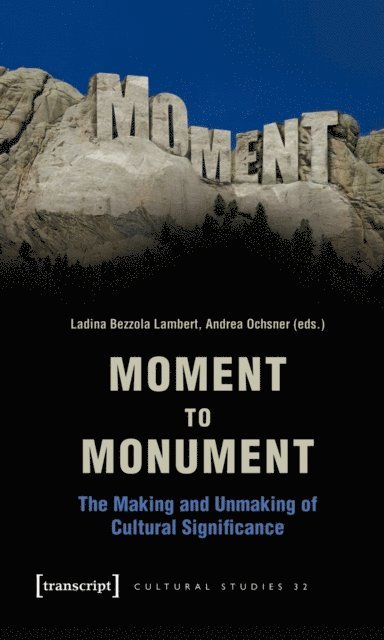
Moment to Monument – The Making and Unmaking of Cultural Significance (in collaboration with Regula Hohl Trillini, Jennifer Jermann and Markus
Häftad, Engelska, 2021
383 kr
Skickas
Why do certain works of art make it into the canon while others just enjoy a brief moment of recognition, if at all? How do moments produce monuments, and why are monuments erased from our cultural memory in only a moment? - Taking into account these cultural processes of creating, storing, remembering and forgetting that are omnipresent and have an immense influence on how we perceive artefacts and cultural events, the articles in this collection analyze the phenomenon of cultural production, transmission and reception from various angles, drawing on approaches from both literary and cultural studies. With its transdisciplinary approach, this book uniquely responds to an everyday cultural phenomenon that so far has not received such wide-ranging attention.
Del 58 - Internationale Forschungen zur Allgemeinen und Vergleichenden Literaturwissenschaft
imagining the unimaginable
The Poetics of Early Modern Astronomy
Häftad, Engelska, 2002
833 kr
Skickas inom 5-8 vardagar
How is it possible to imagine what is unknown and therefore unimaginable? How can the unimaginable be represented? On what materials do such representations rely? These questions lie at the heart of this book.Copernican theory redefined the role and importance of the imagination even as it implied the moment of its crisis. Based on this claim, Ladina Bezzola Lambert analyzes seventeenth-century astronomical texts – particularly descriptions of the moon and treatises written in support of the theory of the plurality of worlds – to show how early modern astronomers questioned the role of the imagination as a tool to visualize the unknown, but also how, pressed by the need to support their theories with convincing descriptions of other potential worlds, they sought to overcome the limitations of the imagination with a sophisticated rhetoric and techniques more commonly associated with poetic writing. The limitations of the imagination are at once a problem that all of the texts discussed struggle with and their recurrent theme.In the first and last chapter, the focus shifts to a more explicitly literary context: Ariosto’s Orlando furioso and the work of Italo Calvino. The change of focus from science to literature and from the narratives of the past to contemporary ones serves to emphasize that the issues relating to the imagination, its limitations and creative means, are basically the same both in science and literature and that they are still relevant today.