• Fri frakt över 249 kr
  • •
  • Snabba leveranser
  • •
  • Billiga böcker
Kundservice

Du är på sajten för privatpersoner.

Företag, bibliotek eller offentlig verksamhet?

Du handlar på classic.bokus.com, där alla dina funktioner finns intakta.
Till classic.bokus.com
Bokus logotyp. Gå till startsidan.
  • Erbjudanden
  • Nyheter
  • Student
  • Topplistor
  • Barn & ungdom
  • Bokus Play
  • E-böcker
  • Pocketböcker
  • Spel & pussel

10% rabatt på allt med kod NYSTART10 →

Sidfot

Mina sidor

    Hjälp

    • Kundservice
    • Vanliga frågor och svar
    • Frakt och leverans
    • Retur vid ångerrätt
    • Reklamera vara
    • Betalning
    • Köpvillkor
    • Allmänna villkor
    • Information om webbplatsens tillgänglighet

    Om Bokus

    • Om oss
    • Pressrum
    • För studenter
    • För företag
    • För bibliotek och offentlig verksamhet
    • För leverantörer
    • Hållbarhet

    Populärt

    • Aktuella erbjudanden
    • Presentkort
    • Studentlitteratur
    • Nya böcker
    • Topplistor
    • Signerade böcker
    • Engelska böcker

    Inspiration

    • Boktips
    • BookTok
    • Populära bokserier
    • Barnbokskaraktärer
    • Populära författare
    Logotyp för Bokus
    Följ oss på Facebook (extern länk)Följ oss på Instagram (extern länk)Följ oss på YouTube (extern länk)Följ oss på TikTok (extern länk)
    bokus @ CookiesAnpassa cookiesIntegritetspolicyKöpvillkor
    Till Citymail hemsida (extern länk)Till Budbee hemsida (extern länk)Till Postnord hemsida (extern länk)Till Schenker hemsida (extern länk)Till Early Bird hemsida (extern länk)Till Walleys hemsida (extern länk)
    1. Naturvetenskap och teknik
    2. Matematik och naturvetenskap
    3. Astronomi

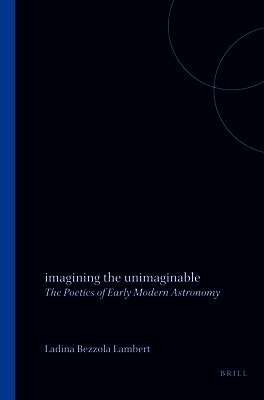
    imagining the unimaginable

    The Poetics of Early Modern Astronomy

    AvLadina Bezzola Lambert

    Häftad, Engelska, 2002

    Del 58 i serien Internationale Forschungen zur Allgemeinen und Vergleichenden Literaturwissenschaft

    848 kr

    Beställningsvara. Skickas inom 5-8 vardagar. Fri frakt över 249 kr.

    Beskrivning

    How is it possible to imagine what is unknown and therefore unimaginable? How can the unimaginable be represented? On what materials do such representations rely? These questions lie at the heart of this book.Copernican theory redefined the role and importance of the imagination even as it implied the moment of its crisis. Based on this claim, Ladina Bezzola Lambert analyzes seventeenth-century astronomical texts – particularly descriptions of the moon and treatises written in support of the theory of the plurality of worlds – to show how early modern astronomers questioned the role of the imagination as a tool to visualize the unknown, but also how, pressed by the need to support their theories with convincing descriptions of other potential worlds, they sought to overcome the limitations of the imagination with a sophisticated rhetoric and techniques more commonly associated with poetic writing. The limitations of the imagination are at once a problem that all of the texts discussed struggle with and their recurrent theme.In the first and last chapter, the focus shifts to a more explicitly literary context: Ariosto’s Orlando furioso and the work of Italo Calvino. The change of focus from science to literature and from the narratives of the past to contemporary ones serves to emphasize that the issues relating to the imagination, its limitations and creative means, are basically the same both in science and literature and that they are still relevant today.

    Produktinformation

    • Utgivningsdatum:2002-01-01
    • Mått:170 x 240 x 11 mm
    • Vikt:417 g
    • Format:Häftad
    • Språk:Engelska
    • Serie:Internationale Forschungen zur Allgemeinen und Vergleichenden Literaturwissenschaft
    • Antal sidor:182
    • Förlag:Brill
    • ISBN:9789042015784

    Utforska kategorier

    • Astronomi inom Naturvetenskap och teknik

    Recensioner i media

    "Lambert’s impressive book is certain to greatly influence later studies of early modern science. Her methodology and careful attention to rhetorical figures contribute to a more complete understanding of this important period in science history." - in: Revue d’Histoire des Sciences, No. 25, Vol. 12 (2005)"…rich in detail and […] very useful…" - in: The British Journal for the History of Science, Vol. 38, No. 1 (March 2005), pp. 105-6

    Innehållsförteckning

    • IllustrationsAcknowledgementsIntroduction1 How Metaphors Matter: Astolfo’s Lunar Journey in the Orlando furioso2 Images Proposed in Jest: Galileo’s Sidereus nuncius and the Dialogue3 The Stuff that Dreams are Made of: Kepler’s Somnium4 Worlds of Words: Cyrano de Bergerac’s Lune and Soleil5 Metaphors as Systems of Thought: Fontenelle, Cyrano, Wilkins and Huygens6 Representing the Unimaginability of the Imaginable: Italo Calvino’s Castello dei destini incrociati and Le città invisibiliBibliography