Lara Schrijver - Böcker
Visar alla böcker från författaren Lara Schrijver. Handla med fri frakt och snabb leverans.
3 produkter
3 produkter
911 kr
Skickas inom 3-6 vardagar
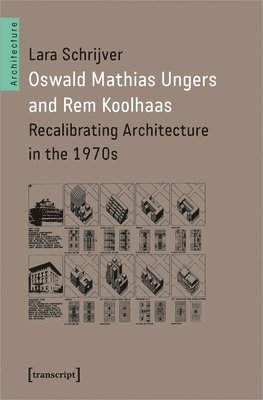
Lara Schrijver examines the work of Oswald Mathias Ungers and Rem Koolhaas as intellectual legacy of the 1970s for architecture today. Particularly in the United States, this period focused on the autonomy of architecture as a correction to the social orientation of the 1960s. Yet, these two architects pioneered a more situated autonomy, initiating an intellectual discourse on architecture that was inherently design-based. Their work provides room for interpreting social conditions and disciplinary formal developments, thus constructing a `plausible' relationship between the two that allows the life within to flourish and adapt. In doing so, they provide a foundation for recalibrating architecture today.
Autonomous Architecture in Flanders
The Early Works of Marie-José Van Hee, Christian Kieckens, Marc Dubois, and Paul Robbrecht & Hilde Daem
Häftad, Engelska, 2016
497 kr
Tillfälligt slut
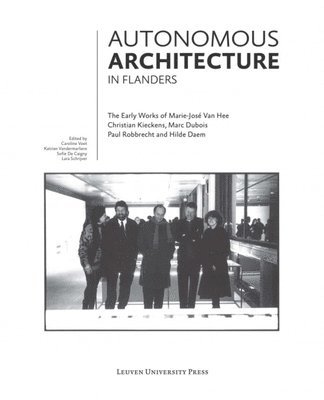
The influence and position of the ‘Generation 74’ in Flemish and international architecture. Five well-known architects who studied together in Ghent, Marie-José Van Hee, Christian Kieckens, Marc Dubois, Paul Robbrecht and Hilde Daem, can be considered as leading protagonists of their generation. From their education at Sint-Lucas Institute and the Academy of Fine Arts to the present day, their professional careers and legacy have been of great importance to the development of Flemish architecture. In their early works and writings, they established a distinct architectural language, rooted in historical knowledge and with a reflection to art and craftsmanship. Architecture was singled out as a spatial phenomenon with an autonomous logic grounded in inhabitation and experience. This generation represents a significant turn towards architectural autonomy in Flanders which resonated with similar international developments in the late 1970s. Moreover they played a decisive role in the emancipation and professionalization of the architectural culture in Flanders. This publication is GPRC-labeled (Guaranteed Peer-Reviewed Content). Contributors: Birgit Cleppe (Ghent University), Sofie De Caigny (CVAa), Maarten Delbeke (Ghent University), Fredie Floré (KU Leuven / Ghent University), William Mann, Yves Schoonjans (KU Leuven), Eireen Schreurs (TU Delft), Lara Schrijver (University of Antwerp), Dirk Somers (Ghent University), Sven Sterken (KU Leuven), Mechthild Stuhlmacher (TU Delft), Hera van Sande (VUB / KU Leuven), Katrien Vandermarliere, Caroline Voet (KU Leuven) With statements of Kristoffel Boghaert, Patrick Van Caeckenbergh, Adam Caruso, Els Claessens and Tania Vandenbussche, An Fonteyne, Tony Fretton, Pieter D’haeseleer, Hilde Heynen, Cristina Iglesias, Francis Strauven, Peter Swinnen, Koen Van Synghel, Paul Vermeulen, Jacques De Visscher.

414 kr
Skickas inom 3-6 vardagar
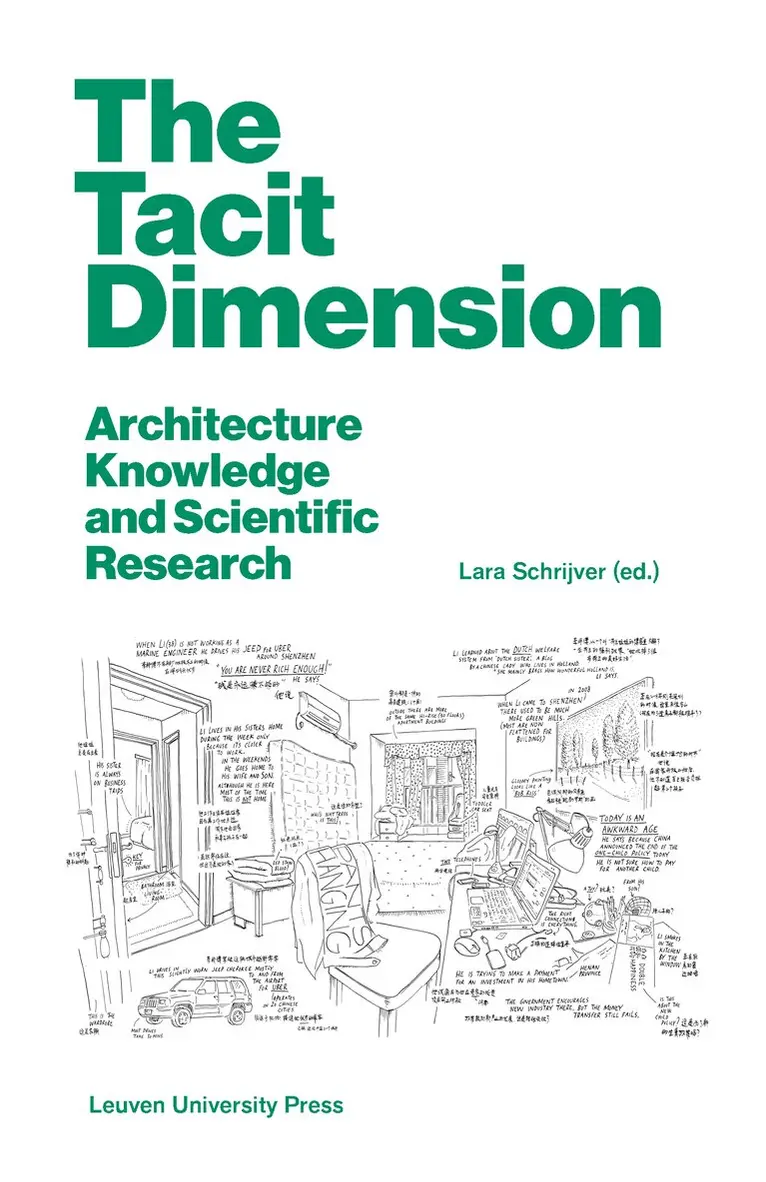
Within architecture, tacit knowledge plays a substantial role both within the design process and its reception. This book explores the tacit dimension of architecture in its aesthetic, material, cultural, design-based, and reflexive understanding of what we build. Much of architecture's knowledge resides beneath the surface, in nonverbal instruments such as drawings and models that articulate the spatial imagination of the design process. Tacit knowledge, described in 1966 by Michael Polanyi as what we 'can know but cannot tell', often denotes knowledge that escapes quantifiable dimensions of research. Beginning in the studio, where students are guided into becoming architects, the book follows a path through the tacit knowledge present in models, materials, conceptual structures, and the design process, revealing how the tacit dimension leads to craftsmanship and the situated knowledge of architecture-in-the-world. Awareness of the tacit dimension helps to understand the many facets of the spaces we inhabit, from the ideas of the architect to the more hidden assumptions of our cultures.Contributors: Tom Avermaete (ETH Zurich), Margitta Buchert (Leibniz-Universitat Hannover), Christoph Grafe (Bergische Universitat Wuppertal), Mari Lending (The Oslo School of Architecture and Design), Angelika Schnell (Academy of Fine Arts Vienna), Eireen Schreurs (Delft University of Technology), Lara Schrijver (University of Antwerp)Free ebook available at OAPEN Library, JSTOR and Project Muse.