Lars Borin - Böcker
Visar alla böcker från författaren Lars Borin. Handla med fri frakt och snabb leverans.
10 produkter
10 produkter
Vaccine Hesitancy in the Nordic Countries
Trust and Distrust During the COVID-19 Pandemic
Inbunden, Engelska, 2024
2 151 kr
Skickas inom 10-15 vardagar
Bringing together studies from across the Nordic region, this book examines the challenges brought by the COVID-19 pandemic, with a particular focus on vaccine hesitancy. Shedding light on the political tensions that emerged as a result of the pandemic and the debates that ensued both within and between the Nordic nations, it investigates the vociferous discussions surrounding the COVID-19 vaccines and their presumed negative side effects through the lens of trust; trust in and between the neighbouring countries, in healthcare systems, fellow citizens, and experts; in public authorities, politicians, researchers, journalists, and pharmaceutical companies. The first volume to explore vaccine hesitancy in the Scandinavian context, this ground-breaking volume offers fresh perspectives on vaccine scepticism not as a form of ignorance or lack of knowledge, but as a manifestation of a more fundamental lack of faith in modern government and science. As such, it will appeal to scholars of sociology, politics, anthropology, media studies, communication and cultural studies with interests in public health, popular and political discourse and questions of public trust.The Open Access version of this book, available at http://www.taylorfrancis.com, has been made available under a Creative Commons [Attribution-Non Commercial-No Derivatives (CC-BY-NC-ND)] 4.0 license.
Vaccine Hesitancy in the Nordic Countries
Trust and Distrust During the COVID-19 Pandemic
Häftad, Engelska, 2025
649 kr
Skickas inom 10-15 vardagar
Bringing together studies from across the Nordic region, this book examines the challenges brought by the COVID-19 pandemic, with a particular focus on vaccine hesitancy. Shedding light on the political tensions that emerged as a result of the pandemic and the debates that ensued both within and between the Nordic nations, it investigates the vociferous discussions surrounding the COVID-19 vaccines and their presumed negative side effects through the lens of trust; trust in and between the neighbouring countries, in healthcare systems, fellow citizens, and experts; in public authorities, politicians, researchers, journalists, and pharmaceutical companies. The first volume to explore vaccine hesitancy in the Scandinavian context, this ground-breaking volume offers fresh perspectives on vaccine scepticism not as a form of ignorance or lack of knowledge, but as a manifestation of a more fundamental lack of faith in modern government and science. As such, it will appeal to scholars of sociology, politics, anthropology, media studies, communication and cultural studies with interests in public health, popular and political discourse and questions of public trust.The Open Access version of this book, available at http://www.taylorfrancis.com, has been made available under a Creative Commons [Attribution-Non Commercial-No Derivatives (CC-BY-NC-ND)] 4.0 license.
239 kr
Skickas inom 5-8 vardagar
Lesser-Known Languages of South Asia
Status and Policies, Case Studies and Applications of Information Technology
Inbunden, Engelska, 2006
2 783 kr
Skickas inom 5-8 vardagar
The increasing globalization and centralization in the world is threatening the existence of a large number of smaller languages. In South Asia some locally dominant languages (e.g., Hindi, Urdu, Nepali) are gaining ground beside English at the expense of the lesser-known languages. Despite a long history of stable multilingualism, language death is not uncommon in the South Asian context. We do not know how the language situation in South Asia will be affected by modern information and communication technologies: Will cultural and linguistic diversity be strengthened or weakened as they become increasingly prevalent in all walks of life?This volume brings together areas of research that so far do not interact to any significant extent: traditional South Asian descriptive linguistics and sociolinguistics, documentary linguistics, issues of intellectual and cultural property and fieldwork ethics, and language technology. Researchers working in the areas of documentary linguistics and language technology have become aware of each other in the last few years, and of how work in the other area could be potentially useful in furthering their own aims. Similarly, the insights of documentary linguistics are making their way into descriptive linguistics and sociolinguistics. However, the potential for synergy among these areas of research is almost limitless. This volume provides the reader, not so much with a do-it-yourself recipe for applying modern technology to the problem of language shift in South Asia today, but rather with some basic knowledge about the problems involved and some directions from which solutions could be forthcoming, a toolbox rather than a blueprint, for helping to shape the linguistic future of South Asia.
2 272 kr
Skickas inom 5-8 vardagar
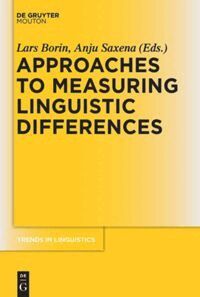
The present volume collects contributions addressing different aspects of the measurement of linguistic differences, a topic which probably is as old as language itself but at the same time has acquired renewed interest over the last decade or so, reflecting a rapid development of data-intensive computing in all fields of research, including linguistics.
344 kr
Skickas inom 3-6 vardagar
TRENDS IN LINGUISTICS is a series of books that open new perspectives in our understanding of language. The series publishes state-of-the-art work on core areas of linguistics across theoretical frameworks, as well as studies that provide new insights by approaching language from an interdisciplinary perspective. TRENDS IN LINGUISTICS considers itself a forum for cutting-edge research based on solid empirical data on language in its various manifestations, including sign languages. It regards linguistic variation in its synchronic and diachronic dimensions as well as in its social contexts as important sources of insight for a better understanding of the design of linguistic systems and the ecology and evolution of language. TRENDS IN LINGUISTICS publishes monographs and outstanding dissertations as well as edited volumes, which provide the opportunity to address controversial topics from different empirical and theoretical viewpoints. High quality standards are ensured through anonymous reviewing. To discuss your book idea or submit a proposal, please contact Birgit Sievert.
2 161 kr
Skickas inom 5-8 vardagar
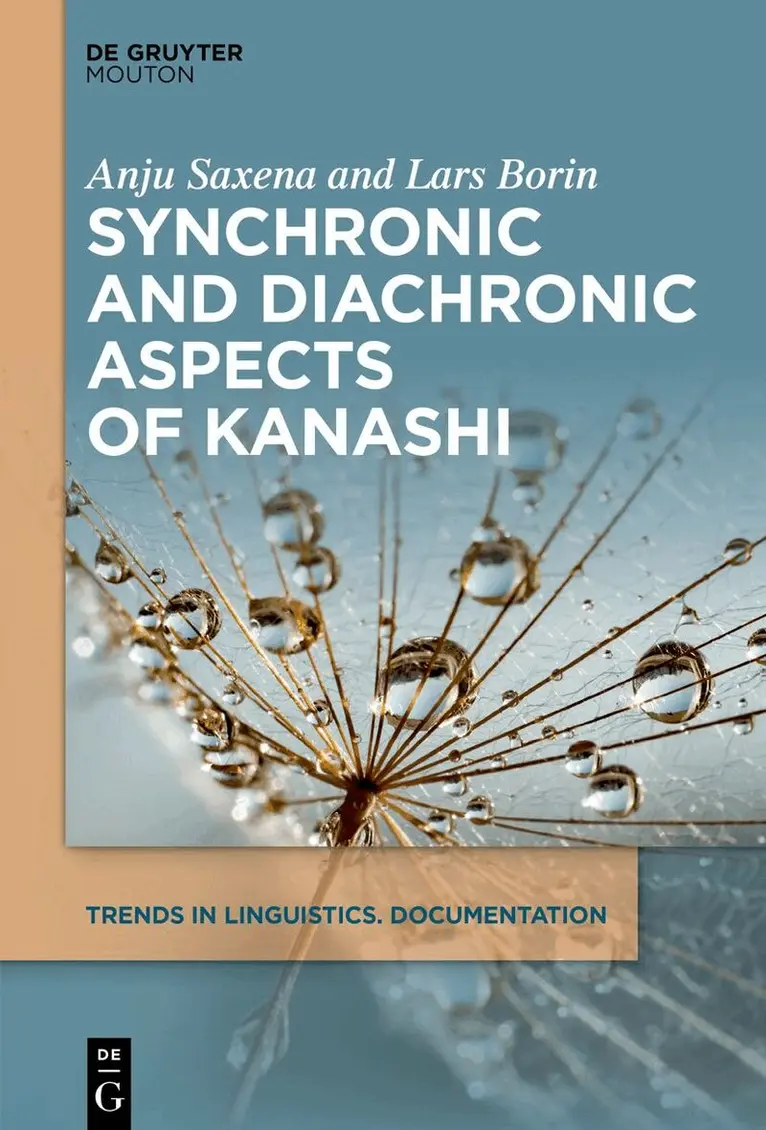
Kanashi, a Sino-Tibetan (ST) language belonging to the West Himalayish (WH) subbranch of this language family, is spoken in one single village (Malana in Kullu district, Himachal Pradesh state, India), which is surrounded by villages where – entirely unrelated – Indo-Aryan (IA) languages are spoken. Until we started working on Kanashi, very little linguistic material was available. Researchers have long speculated about the prehistory of Kanashi: how did it happen that it ended up spoken in one single village, completely cut off from its closest linguistic relatives? Even though suggestions have been made of a close genealogical relation between Kanashi and Kinnauri (another WH language), at present separated by over 200 km of rugged mountainous terrain, their shared linguistic features have not been discussed in the literature. Based on primary fieldwork, this volume presents some synchronic and diachronic aspects of Kanashi. The synchronic description of Kanashi includes a general introduction on Malana and the Kanashi language community (chapter 1), linguistic descriptions of its sound system (chapter 2), of phonological variation in Kanashi (chapter 4), of its grammar (chapter 3) and of its intriguing numeral systems (chapter 5), as well as basic vocabulary lists (Kanashi-English, English-Kanashi) (chapter 9). As for the diachronic and genealogical aspects (chapters 6–8), we compare and contrast Kanashi with other ST languages of this region (in particular languages of Kinnaur, notably Kinnauri), thereby uncovering some intriguing linguistic features common to Kanashi and Kinnauri which provide insights into their common history. For instance: a subset of borrowed IA nouns and adjectives in both languages end in -(a)ŋ or -(a)s, elements which do not otherwise appear in Kanashi or Kinnauri, nor in the IA donor languages (chapter 6); and both languages have a valency changing mechanism where the valency increasing marker -jaː alternates with the intransitive marker -e(d) in borrowed IA verbs (again: elements without an obvious provenance in the donor or recipient language) (chapter 7). These features are neither found in IA languages nor in the WH languages geographically closest to Kanashi (Pattani, Bunan, Tinani), but only in Kinnauri, which is spoken further away. Intriguingly, traces of some of these features are also found in some ST languages belonging to different ST subgroups (both WH and non-WH), spoken in Uttarakhand in India and in western Nepal (e.g. Rongpo, Chaudangsi, Raji and Raute). This raises fundamental questions regarding genealogical classification, language contact and prehistory of the WH group of languages and of this part of the Indian Himalayas, which are also discussed in the volume (chapter 8).
265 kr
Skickas inom 5-8 vardagar
Kanashi, a Sino-Tibetan (ST) language belonging to the West Himalayish (WH) subbranch of this language family, is spoken in one single village (Malana in Kullu district, Himachal Pradesh state, India), which is surrounded by villages where – entirely unrelated – Indo-Aryan (IA) languages are spoken. Until we started working on Kanashi, very little linguistic material was available. Researchers have long speculated about the prehistory of Kanashi: how did it happen that it ended up spoken in one single village, completely cut off from its closest linguistic relatives? Even though suggestions have been made of a close genealogical relation between Kanashi and Kinnauri (another WH language), at present separated by over 200 km of rugged mountainous terrain, their shared linguistic features have not been discussed in the literature. Based on primary fieldwork, this volume presents some synchronic and diachronic aspects of Kanashi. The synchronic description of Kanashi includes a general introduction on Malana and the Kanashi language community (chapter 1), linguistic descriptions of its sound system (chapter 2), of phonological variation in Kanashi (chapter 4), of its grammar (chapter 3) and of its intriguing numeral systems (chapter 5), as well as basic vocabulary lists (Kanashi-English, English-Kanashi) (chapter 9). As for the diachronic and genealogical aspects (chapters 6–8), we compare and contrast Kanashi with other ST languages of this region (in particular languages of Kinnaur, notably Kinnauri), thereby uncovering some intriguing linguistic features common to Kanashi and Kinnauri which provide insights into their common history. For instance: a subset of borrowed IA nouns and adjectives in both languages end in -(a)ŋ or -(a)s, elements which do not otherwise appear in Kanashi or Kinnauri, nor in the IA donor languages (chapter 6); and both languages have a valency changing mechanism where the valency increasing marker -jaː alternates with the intransitive marker -e(d) in borrowed IA verbs (again: elements without an obvious provenance in the donor or recipient language) (chapter 7). These features are neither found in IA languages nor in the WH languages geographically closest to Kanashi (Pattani, Bunan, Tinani), but only in Kinnauri, which is spoken further away. Intriguingly, traces of some of these features are also found in some ST languages belonging to different ST subgroups (both WH and non-WH), spoken in Uttarakhand in India and in western Nepal (e.g. Rongpo, Chaudangsi, Raji and Raute). This raises fundamental questions regarding genealogical classification, language contact and prehistory of the WH group of languages and of this part of the Indian Himalayas, which are also discussed in the volume (chapter 8).
1 517 kr
Skickas inom 7-10 vardagar
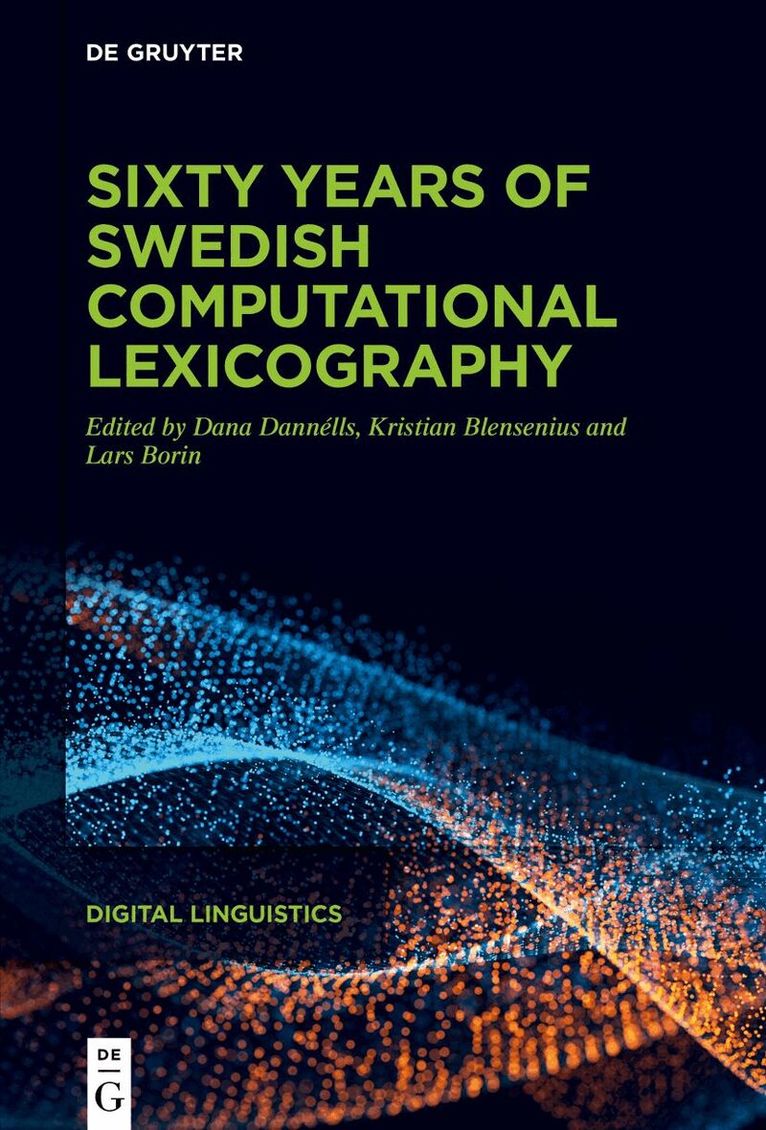
Swedish computational lexicography has a long history at the University of Gothenburg, both in its primary role as a central aspect of the scientific study of vocabulary and also as an infrastructural component for conducting research based on language data. Starting in the 1960s, the Språkdata research group pioneered corpus-supported lexicography for Swedish, forming the basis for successive editions of two main descriptive dictionaries of contemporary Swedish, SAOL and SO. Language technological lexical resources for Swedish have been developed by the research unit/research infrastructure Språkbanken Text since the turn of the millennium, most recently in the framework of the Swedish FrameNet++ initiative. After two decades of separation, these two largely mutually independently developed strands of computational lexicography have now joined forces under the umbrella of Språkbanken’s lexical research infrastructure to advance the field technically, methodologically, and scientifically. The result is a vibrant and multifaceted research environment intertwined with and supported by a closely integrated cutting-edge computational infrastructure for working with lexical data
713 kr
Skickas inom 5-8 vardagar