Laura M. Jewett - Böcker
Visar alla böcker från författaren Laura M. Jewett. Handla med fri frakt och snabb leverans.
2 produkter
2 produkter
Del 28 - Complicated Conversation
Delicate Dance
Autoethnography, Curriculum, and the Semblance of Intimacy
Häftad, Engelska, 2008
317 kr
Tillfälligt slut
Drawing on data gathered through a three-year autoethnography, A Delicate Dance couples the author’s experiences teaching multicultural education and learning to zydeco dance in order to explore semblances of intimacy across self and other. More specifically, the book looks at semblances of intimacy embodied on the dance floor and the implications such intimacy might have for thinking about curriculum and qualitative research. This lively narrative encourages readers to consider what it might mean to envision curriculum as an embodied locale – much like zydeco dancing – where the play of epistemological forces replaces technocratic force; and where students experience the relative weight of desire, fear, and knowledge, the reciprocal touch of self and other, and the mysterious momentum of the semblance of intimacy.
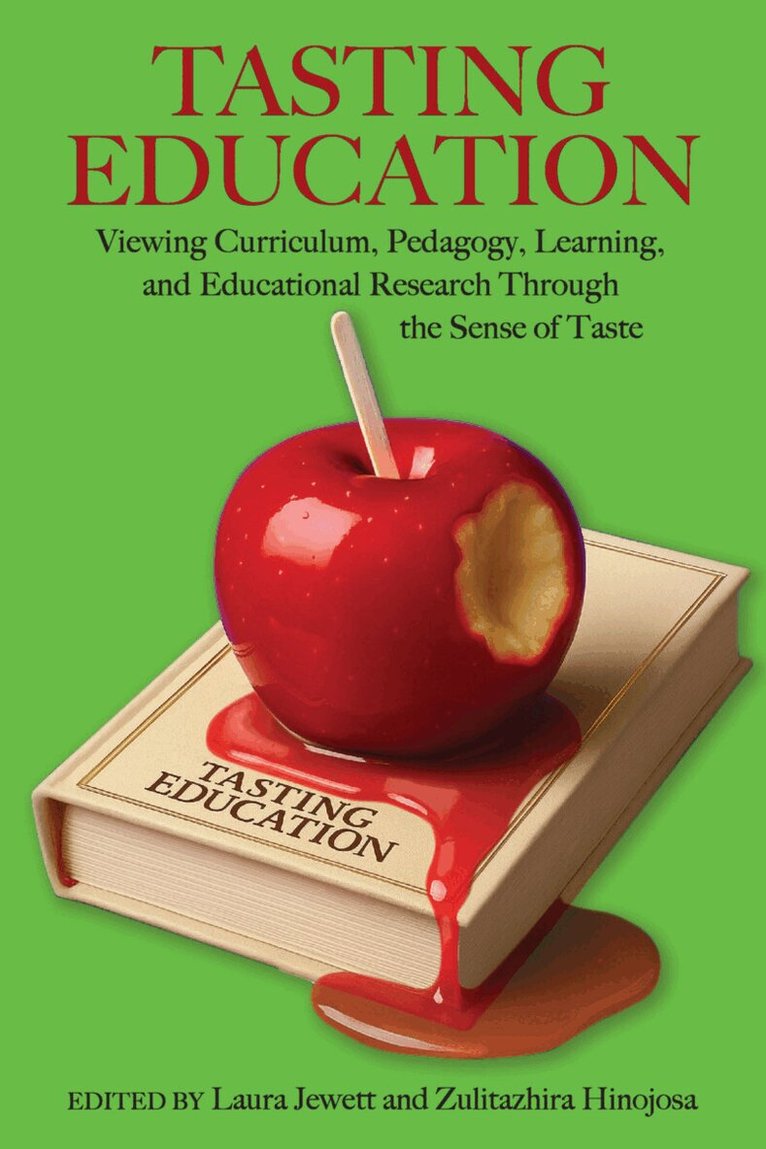
Tasting Education
Viewing Curriculum, Pedagogy, Learning, and Educational Research Through the Sense of Taste
Häftad, Engelska, 2026
487 kr
Skickas inom 11-20 vardagar
Why is the sense of taste so conspicuously absent from contemporary educational research and so severely rationed in the ways it is lived in universities and schools? After all, in the world, taste is a perceptual and epistemological powerhouse in the complicated process of staying alive as well as living a life. Taste is also a process of world making. It's a way of reading, naming, mapping, imagining, remembering, and making worlds and connecting to the worlds of others—therefore it is curricular. In attending to how taste matters and matters of taste, chapters in Tasting Education: Viewing Curriculum, Pedagogy, Learning, and Educational Research Through the Sense of Taste invite participants to think about taste as a sense, and/or the sense of taste, as it plays out in the thinking and doing of education and its inquiry. This book takes up taste as an embodied set of meanings that are sensuous, pragmatic, and political: as a key part of the sensorium, and as engagement with the sensuosity of the olfactory, the nose, the mouth, the tongue as a way of making meaning of food, but also ways for making meaning from the food for thought and action that theory can provide. It also asks us to take into account the culture of food as it relates to education; whose palates are catered to and whose remain marginalized, deliberately destroyed, or are left-unfed? Taste, then, also becomes a way of resisting, challenging, and reimagining such modes as they play themselves out in curriculum and pedagogy and reveal collective commitments that include shared pleasure alongside political and social action (Siniscalchi, 2018). This book offers a space for deeper conversations around taste in curriculum and elsewhere, and how taste is being used to dismantle oppression in these spaces. The slow-food movement argues that "taste and pleasure" must return to the table (Siniscalchi, 2018). Tasting Education invites the mixed pleasures and problematics of taste to the table of educational research as well. Tasting Education will appeal to faculty and students in graduate-level courses related to curriculum, instruction, social foundations and leadership studies, as well as those involved with food studies courses.