Lee Morgenbesser – författare
Visar alla böcker från författaren Lee Morgenbesser. Handla med fri frakt och snabb leverans.
3 produkter
3 produkter
234 kr
Skickas inom 7-10 vardagar
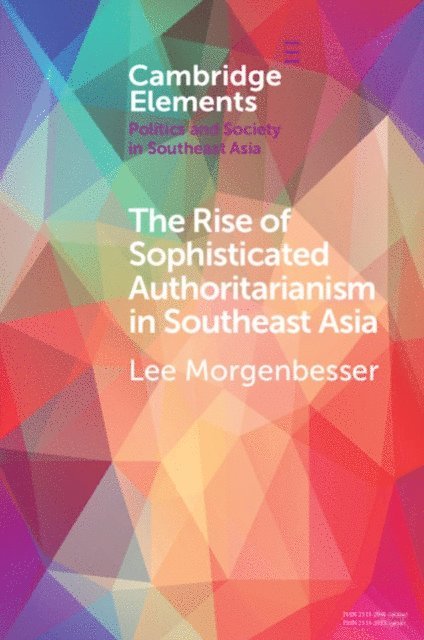
This Element offers a way to understand the evolution of authoritarian rule in Southeast Asia. The theoretical framework is based on a set of indicators (judged for their known advantages and mimicry of democratic attributes) as well as a typology (conceptualized as two discreet categories of 'retrograde' and 'sophisticated' authoritarianism). Working with an original dataset, the empirical results reveal vast differences within and across authoritarian regimes in Southeast Asia, but also a discernible shift towards sophisticated authoritarianism over time. The Element concludes with a reflection of its contribution and a statement on its generalizability.
1 057 kr
Skickas inom 5-8 vardagar
Explores why authoritarian regimes bother to hold elections.Behind the Façade examines the question of why authoritarian regimes in Southeast Asia bother holding elections. Using comprehensive case studies of Cambodia, Myanmar, and Singapore, Lee Morgenbesser argues that elections allow authoritarian regimes to collect information, pursue legitimacy, manage political elites, and sustain neopatrimonial domination. He demonstrates how these functions are employed to manage the complex strategic interaction that occurs between dictators, political elites, and citizens. Far from being mere window dressing or even a precursor to democracy, flawed elections, Morgenbesser concludes, are paramount to the maintenance of authoritarian rule.
489 kr
Tillfälligt slut
Explores why authoritarian regimes bother to hold elections.Behind the Façade examines the question of why authoritarian regimes in Southeast Asia bother holding elections. Using comprehensive case studies of Cambodia, Myanmar, and Singapore, Lee Morgenbesser argues that elections allow authoritarian regimes to collect information, pursue legitimacy, manage political elites, and sustain neopatrimonial domination. He demonstrates how these functions are employed to manage the complex strategic interaction that occurs between dictators, political elites, and citizens. Far from being mere window dressing or even a precursor to democracy, flawed elections, Morgenbesser concludes, are paramount to the maintenance of authoritarian rule.