Leszek Balcerowicz - Böcker
Visar alla böcker från författaren Leszek Balcerowicz. Handla med fri frakt och snabb leverans.
9 produkter
9 produkter
144 kr
Tillfälligt slut
The post-communist transition in Europe and the former Soviet Union is one of the most important transformations in modern history. Changes were exceptionally large and it was not only political and economic systems which were affected: there were changes in social structures, new territorial boundaries in some cases had to be established and new institutions had to be constructed. Moreover, market-oriented reforms were introduced under democratic regimes. Leszek Balcerowicz, President of the National Bank of Poland and former Deputy Prime Minister of Poland, one of the leading reformers in eastern Europe, discusses the varying outcomes of transitions in different countries, showing that it was policies, more than initial conditions, which produced the differences. He argues that the larger the scope of market-oriented reforms the better the performance in terms of growth, low inflation and environmental improvement. The presence of competent and determined reformers has also been a crucial factor in successful transformations.
Living Standards and the Wealth of Nations
Successes and Failures in Real Convergence
Inbunden, Engelska, 2006
121 kr
Tillfälligt slut
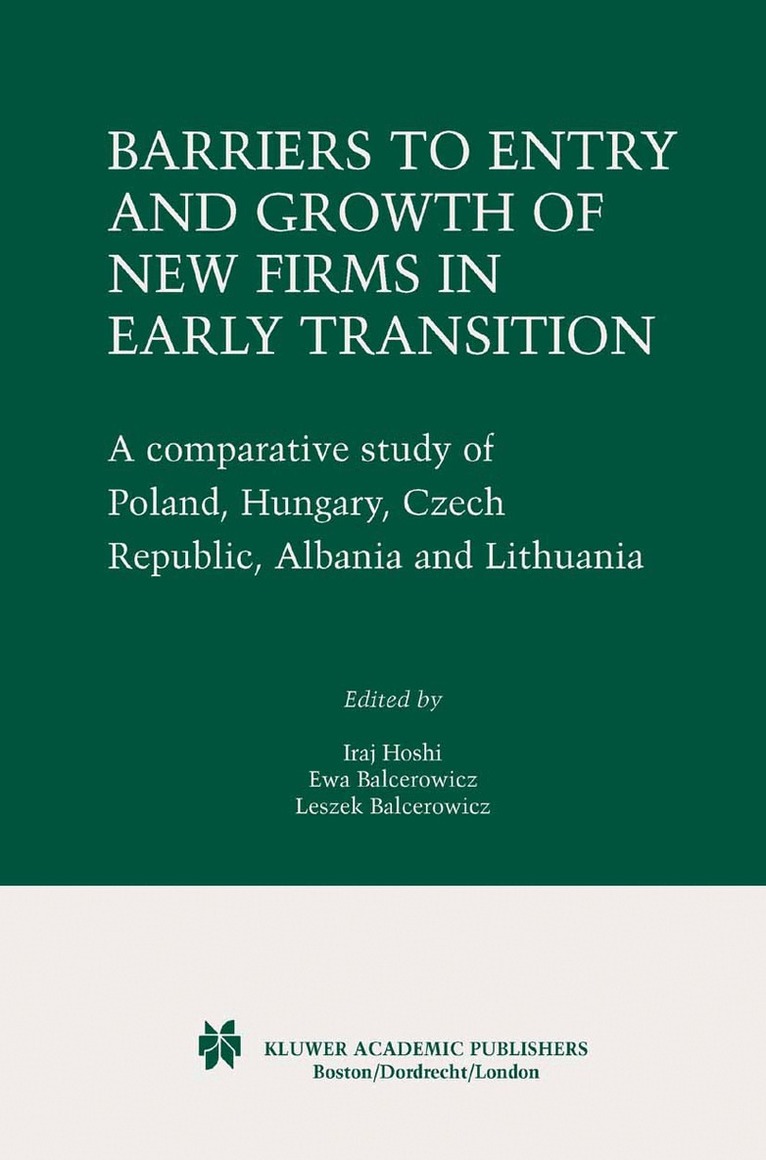
Barriers to Entry and Growth of New Firms in Early Transition
A Comparative Study of Poland, Hungary, Czech Republic, Albania and Lithuania
Inbunden, Engelska, 2002
1 632 kr
Skickas inom 10-15 vardagar
This text analyses the barriers faced by new private firms in five countries at different stages of transition: the Czech Republic, Hungary and Poland as the front-runners of the process, and Albania and Lithuania which followed them later. It is well established that the new private firm sector is the engine of growth in transition economies. But the entry of new firms is closely related to the nature of the existing regulatory and fiscal framework, specifically the registration and licensing requirements, rules on sale or lease of real estate, export and import regulations, and taxes and contributions. These barriers invariably lead entrepreneurs to conduct some or all of their business outside the official economy or, in some cases, discourage them from entry altogether. Contributors to the book are academic economists and policy makers with wide ranging experiences of the transition process. They have been closely involved in formulating economic policies, advising governments of transitions countries, and conducting research on different aspects of market oriented reforms.They provide comprehensive reviews of the existing rules and regulations affecting entry and their impact on private sector development in each country. They also draw on the results of a survey of 400 enterprises in five transition economies, highlighting the range of government-imposed barriers affecting new firms.
Barriers to Entry and Growth of New Firms in Early Transition
A Comparative Study of Poland, Hungary, Czech Republic, Albania and Lithuania
Häftad, Engelska, 2012
1 578 kr
Skickas inom 10-15 vardagar
inefficient and uncompetitive enterprises especially from the over-grown industrial sector. These initial conditions meant that, in the early stages of transition, the volume of entries and exits will be, by necessity, very high reflecting the large scale changes that had to take place before these economies attain a macroeconomic structure consistent with their level of development and with the needs of a market-based economy open to internationalcompetition. One of the main elements of the reform programme in all economies in transition was the liberalisation of entry conditions. Along with the liberalisation of prices and foreign trade, appropriate measures facilitating the establishment of new enterprises were approved in the very early phase of reforms in all of these countries. The effectiveness of liberalised entry conditions, of course, depends on the presence of appropriate legal and institutional framework in which new firms will operate. The establishment of a conducive legal and institutional environment, however, takes much longer. In practice, new firms come into existence before the rules of the game are properly established. These rules develop gradually and are not always, and everywhere, consistent with the aim of liberalising the entry conditions. The conditions facing new firms, therefore, have fluctuated in some countries in accordance with changes in the political environment and in line with the strength of different lobbies and interest groups.
392 kr
Skickas inom 10-15 vardagar
Looking at the economic growth of seemingly similar countries one can find striking differences. Why has Australia gotten so much ahead of New Zealand, in spite of the latter being held up as a paragon of free market reform? How is it possible that Austria, with its persistently oversized state enterprise sector, has managed to (nearly) catch up with Switzerland? How can we account for the differences in economic growth between Estonia and Slovenia, and which of these two countries has been more successful at systemic transformation? Why is Mexico so much poorer than Spain, despite having been wealthier all the way into the 1960s? Why has Venezuela, which in 1950 had a per capita income higher than that of Norway and remains a major exporter of oil, slipped behind Chile? Why is Costa Rica lagging behind Puerto Rico, even though in the 1970s the U.S. territory's fast development slowed to a crawl and is now far below other comparable island economies? Why has 'communist' China outstripped 'capitalist' India? Why has Pakistan's growth lagged behind that of Indonesia, even though the latter suffered one of the deepest crises in world economic history in the years 1997-98? Why, even before the 2010 earthquake, the Dominican Republic has been visited by several dozen times more tourists than Haiti, despite being situated on the same island?This book strives to answer these (and many other) questions. They are all part of a broader question that we wish to address: how do differences in economic growth arise?
1 846 kr
Skickas inom 10-15 vardagar
This volume gathers together essays on the theme of economic transition in Central and Eastern Europe, written by the former Polish Minister of Finance. In it, the author summarizes the research on institutions, institutional change and human behaviour that he has undertaken since the late 1970s. He addresses such issues as the socialist market economy, reformability of the Soviet-type economic system, democratization and market-orientated reform in Central and Eastern Europe, and the Polish model of economic reform.
Innovationsdynamik im Systemvergleich
Theorie und Praxis unternehmerischer, gesamtwirtschaftlicher und politischer Neuerung
Häftad, Tyska, 1988
567 kr
Skickas inom 10-15 vardagar
In vier Themenblocken geben die Beitrage A bis Z einen Einblick in Stand, Entwicklung und Perspektiven der systemvergleichenden Innovationsanalyse. Es wird ein umfassender Einstieg geboten in systemindifferente und -spezifische Aspekte der Innovationsdynamik. Ebenso prasentiert der Band fur Wissenschaft, Wirtschaftspraxis und Wirtschaftspolitik neuere Entwicklungen aus Ost und West: Theoretische Aspekte, empirische Befunde und landerorientierte Einzelbeitrage zur Innovationspolitk (USA, BRD, Japan, Frankreich, Spanien, Grossbritannien, Polen, DDR, UdSSR).
Enterprise Exit Processes in Transition Economies
Downsizing, Workouts, and Liquidation
Inbunden, Engelska, 1998
1 725 kr
Skickas inom 10-15 vardagar
This text examines the significant phenomenon of enterprise downsizing and market exit during the early transition from socialism to capitalism in the Czech Republic, Hungary, and Poland, analyzing the reasons, methods, and extent of this widespread business contraction following the rebirth of competition after Communism's collapse.
Enterprise Exit Processes in Transition Economies
Downsizing, Workouts, and Liquidation
Häftad, Engelska, 1998
886 kr
Skickas inom 10-15 vardagar
The rebirth of competition and the extensive exit that has resulted are among the most important developments in Central Europe since the demise of Communism. This text examines why, how, and to what extent enterprises have reduced their size or left the market altogether during the first years of the transition from socialism to capitalism in the Czech Republic, Hungary and Poland.