Lieven Danckaert - Böcker
Visar alla böcker från författaren Lieven Danckaert. Handla med fri frakt och snabb leverans.
3 produkter
3 produkter
Del 24 - Oxford Studies in Diachronic and Historical Linguistics
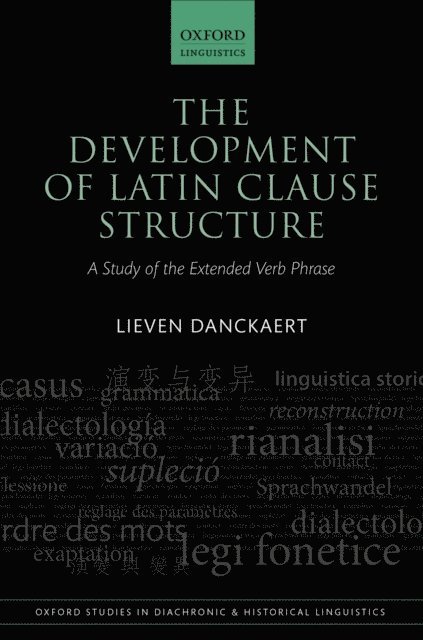
The Development of Latin Clause Structure
A Study of the Extended Verb Phrase
Inbunden, Engelska, 2017
1 899 kr
Skickas inom 5-8 vardagar
This book examines Latin word order, and in particular the relative ordering of i) lexical verbs and direct objects (OV vs VO) and ii) auxiliaries and non-finite verbs (VAux vs AuxV). In Latin these elements can freely be ordered with respect to each other, whereas the present-day Romance languages only allow for the head-initial orders VO and AuxV. Lieven Danckaert offers a detailed, corpus-based description of these two word order alternations, focusing on their diachronic development in the period from c. 200 BC until 600 AD. The corpus data reveal that some received wisdom needs to be reconsidered: there is in fact no evidence for any major increase in productivity of the order VO during the eight centuries under investigation, and the order AuxV only becomes more frequent in clauses with a modal verb and an infinitive, not in clauses with a BE-auxiliary and a past participle. The book also explores a more fundamental question about Latin syntax, namely whether or not the language is configurational, in the sense that a phrase structure grammar (with 'higher-order constituents' such as verb phrases) is needed to describe and analyse Latin word order patterns. Four pieces of evidence are presented that suggest that Latin is indeed a fully configurational language, despite its high degree of word order flexibility. Specifically, it is shown that there is ample evidence for the existence of a verb phrase constituent. The book thus contributes to the ongoing debate regarding the status of configurationality as a language universal.
Del 37 - Oxford Studies in Diachronic and Historical Linguistics
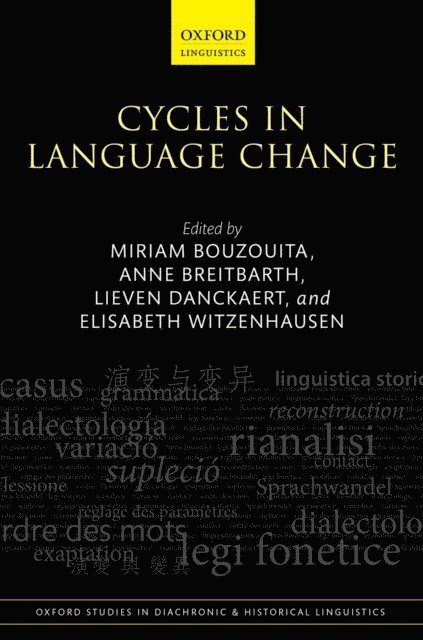
Cycles in Language Change
Inbunden, Engelska, 2019
1 271 kr
Skickas inom 5-8 vardagar
This volume explores the multiple aspects of cyclical syntactic change from a wide range of empirical perspectives. The notion of 'linguistic cycle' has long been recognized as being relevant to the description of many processes of language change. In grammaticalization, a given linguistic form loses its lexical meaning - and sometimes some of its phonological content - and then gradually weakens until it ultimately vanishes. This change becomes cyclical when the grammaticalized form is replaced by an innovative item, which can then develop along exactly the same pathway. But cyclical changes have also been observed in language change outside of grammaticalization proper.The chapters in this book reflect the growing interest in the phenomenon of grammaticalization and cyclicity in generative syntax, with topics including the diachrony of negation, the syntax of determiners and pronominal clitics, the internal structure of wh-words and logical operators, cyclical changes in argument structure, and the relationship between morphology and syntax. The contributions draw on data from multiple language families, such as Indo-European, Semitic, Japonic, and Athabascan.The volume combines empirical descriptions of novel comparative data with detailed theoretical analysis, and will appeal to historical linguists working in formal and usage-based frameworks, as well as to typologists and scholars interested in language variation and change more broadly.
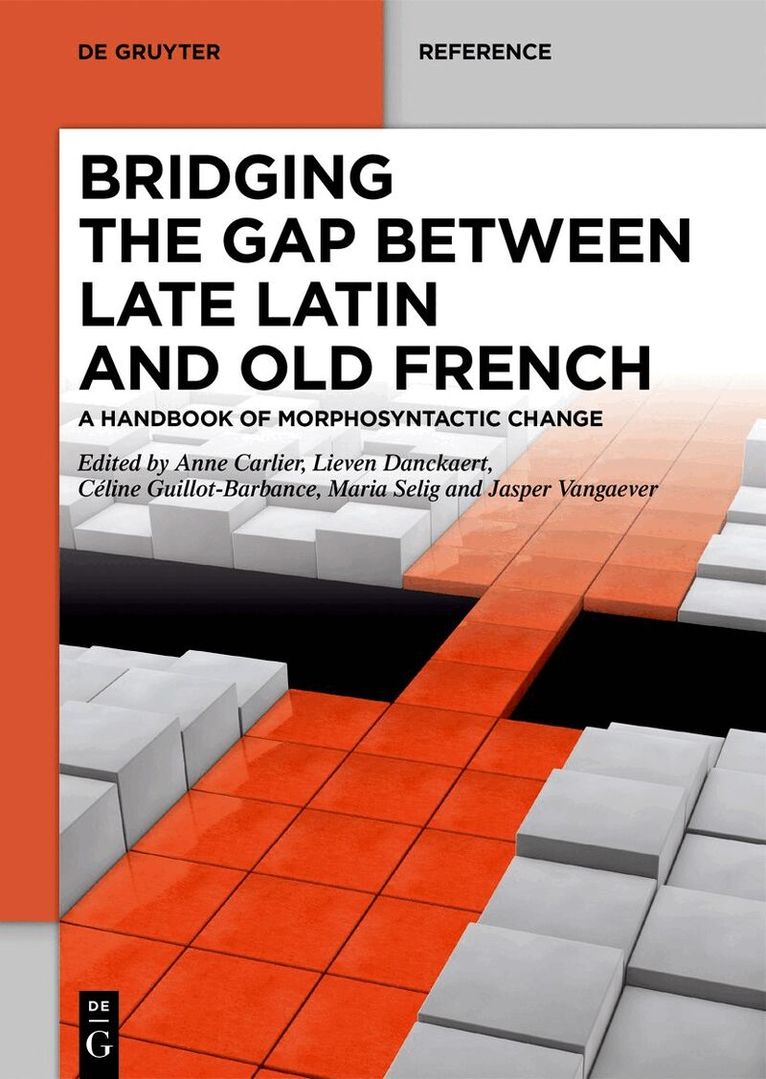
Bridging the gap between Late Latin and Old French
A handbook of morphosyntactic change
Inbunden, Engelska, 2026
4 231 kr
Kommande
It is generally agreed that, of all the Romance languages, French differs most strongly from its Latin ancestor—but relatively little is known about how exactly this situation came about. The present volume provides fresh leads helping to answer this question, by offering a comprehensive account of the morpho-syntactic changes that took place during the transition from Latin to French,Empirically based on a corpus of Merovingian Latin and Old French texts from ca. 500 until 1250 AD, the quantitative and qualitative analysis covers topics such as the Tense-Aspect-Mood system, quantification, nominal determination, pronouns, subordination, word order, information structure and discourse organisation, while paying special attention to the sociolinguistic properties of each text, as well as to differences between text types and genres.The most innovative feature of the book is that all chapters are co-authored by specialists of Late Latin and of Old French, bringing together the expertise of what have traditionally been two separate research communities. The discussion is informed by the theoretical literature, but not biased towards a particular framework. The book should be of great interest to Latinists and Romanists alike, and, more generally, to historical linguists.