Anne Breitbarth - Böcker
Visar alla böcker från författaren Anne Breitbarth. Handla med fri frakt och snabb leverans.
6 produkter
6 produkter
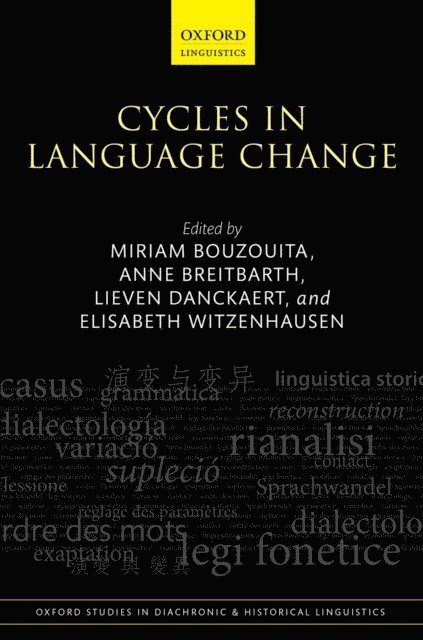
Del 37 - Oxford Studies in Diachronic and Historical Linguistics
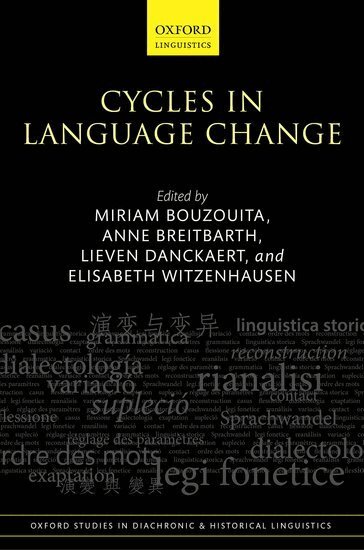
Cycles in Language Change
Inbunden, Engelska, 2019
1 271 kr
Skickas inom 5-8 vardagar
This volume explores the multiple aspects of cyclical syntactic change from a wide range of empirical perspectives. The notion of 'linguistic cycle' has long been recognized as being relevant to the description of many processes of language change. In grammaticalization, a given linguistic form loses its lexical meaning - and sometimes some of its phonological content - and then gradually weakens until it ultimately vanishes. This change becomes cyclical when the grammaticalized form is replaced by an innovative item, which can then develop along exactly the same pathway. But cyclical changes have also been observed in language change outside of grammaticalization proper.The chapters in this book reflect the growing interest in the phenomenon of grammaticalization and cyclicity in generative syntax, with topics including the diachrony of negation, the syntax of determiners and pronominal clitics, the internal structure of wh-words and logical operators, cyclical changes in argument structure, and the relationship between morphology and syntax. The contributions draw on data from multiple language families, such as Indo-European, Semitic, Japonic, and Athabascan.The volume combines empirical descriptions of novel comparative data with detailed theoretical analysis, and will appeal to historical linguists working in formal and usage-based frameworks, as well as to typologists and scholars interested in language variation and change more broadly.
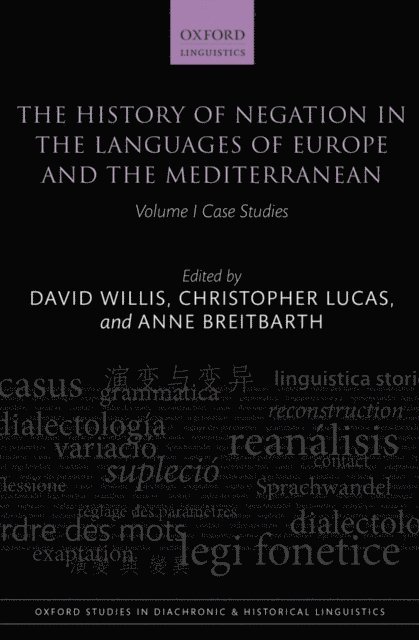
Del 5 - Oxford Studies in Diachronic and Historical Linguistics
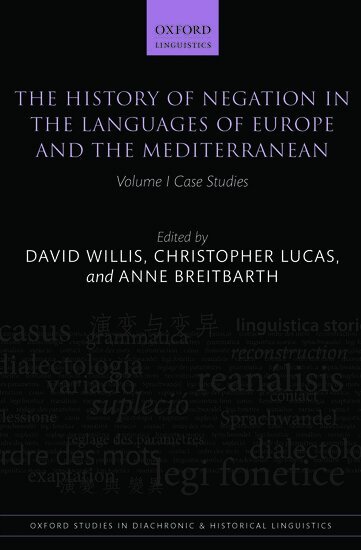
The History of Negation in the Languages of Europe and the Mediterranean
Volume I Case Studies
Inbunden, Engelska, 2013
1 505 kr
Skickas inom 5-8 vardagar
This is the first book in a two-volume comparative history of negation in the languages of Europe and the Mediterranean. The work integrates typological, general, and theoretical research, documents patterns and directions of change in negation across languages, and examines the linguistic and social factors that lie behind such changes. The first volume presents linked case studies of particular languages and language groups, including French, Italian, English, Dutch, German, Celtic, Slavonic, Greek, Uralic, and Afro-Asiatic. Each outlines and analyses the development of sentential negation and of negative indefinites and quantifiers, including negative concord and, where appropriate, language-specific topics such as the negation of infinitives, negative imperatives, and constituent negation.The second volume (to be pubished in 2014) will offer comparative analyses of changes in negation systems of European and north African languages and set out an integrated framework for understanding them. The aim of both is a universal understanding of the syntax of negation and how it changes. Their authors develop formal models in the light of data drawn from historical linguistics, especially on processes of grammaticalization, and consider related effects on language acquisition and language contact. At the same time the books seek to advance models of historical syntax more generally and to show the value of uniting perspectives from different theoretical frameworks.
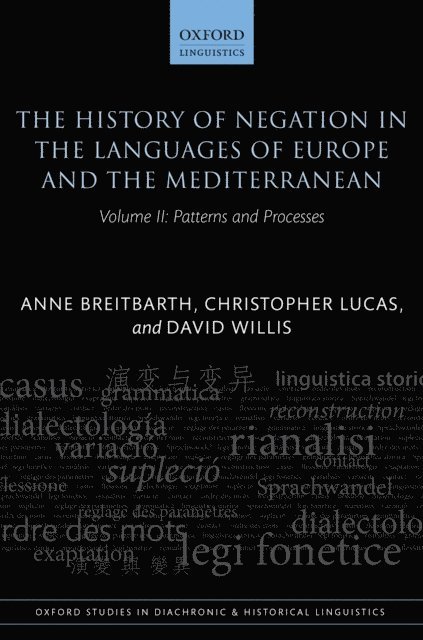
Del 40 - Oxford Studies in Diachronic and Historical Linguistics
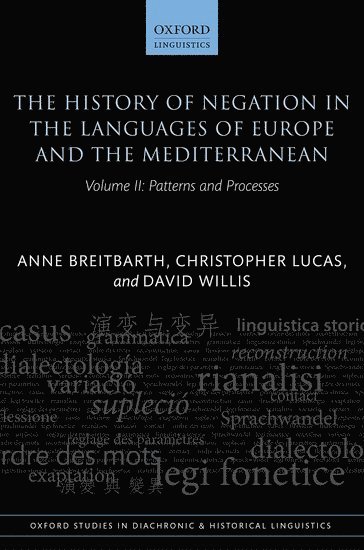
The History of Negation in the Languages of Europe and the Mediterranean
Volume II: Patterns and Processes
Inbunden, Engelska, 2020
1 375 kr
Skickas inom 5-8 vardagar
This is the second book in a two-volume comparative history of negation in the languages of Europe and the Mediterranean. The work integrates typological, general, and theoretical research, documents patterns and directions of change in negation across languages, and examines the linguistic and social factors that lie behind such changes. The aim of both volumes is to set out an integrated framework for understanding the syntax of negation and how it changes.While the first volume (OUP, 2013) presented linked case studies of particular languages and language groups, this second volume constructs a holistic approach to explaining the patterns of historical change found in the languages of Europe and the Mediterranean over the last millennium. It identifies typical developments found repeatedly in the histories of different languages and explores their origins, as well as investigating the factors that determine whether change proceeds rapidly, slowly, or not at all. Language-internal factors such as the interaction of syntax, semantics, and pragmatics, and the biases inherent in child language acquisition, are investigated alongside language-external factors such as imposition, convergence, and borrowing. The book proposes an explicit formal account of language-internal and contact-induced change for both the expression of sentential negation ('not') and negative indefinites ('anyone', 'nothing'). It sheds light on the major ways in which negative systems develop, on the nature of syntactic change, and indeed on linguistic change more generally, demonstrating the insights that large-scale comparison of linguistic histories can offer.
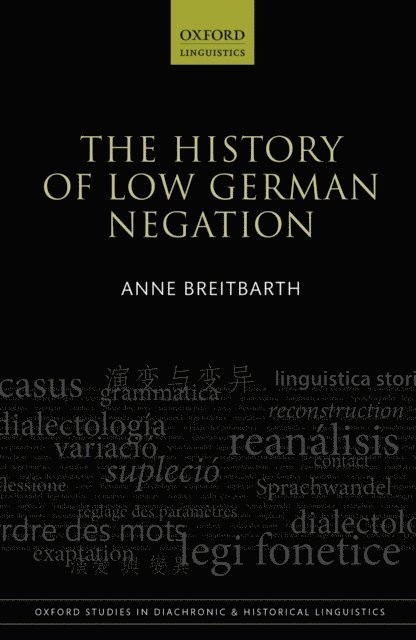
Del 13 - Oxford Studies in Diachronic and Historical Linguistics
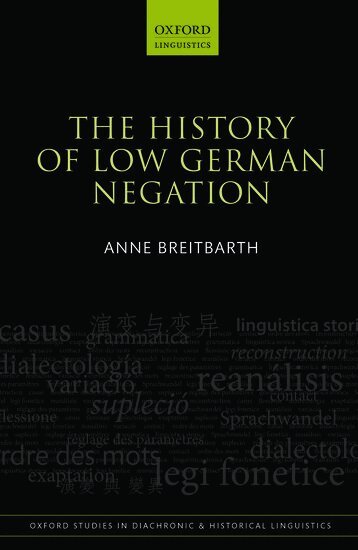
The History of Low German Negation
Inbunden, Engelska, 2014
1 289 kr
Skickas inom 5-8 vardagar
This book examines the diachronic development of negation in Low German, from Old Saxon up to the point at which Middle Low German is replaced by High German as the written language. It investigates both the development of standard negation, or Jespersen's Cycle, and the changing interaction between the expression of negation and indefinites in its scope, giving rise to negative concord along the way. Anne Breitbarth shows that developments in Low German form a missing link between those in High German, English, and Dutch, which have been much more widely researched. These changes are analysed using a generative account of syntactic change combined with minimalist assumptions concerning the syntax of negation and negative concord. The book provides the first substantial, diachronic analysis of the development of the expression of negation through the Old Saxon and Middle Low German periods, and will be of interest not only to students and researchers in the history of German, but also to all those working on the syntax of negation from a diachronic and synchronic perspective.
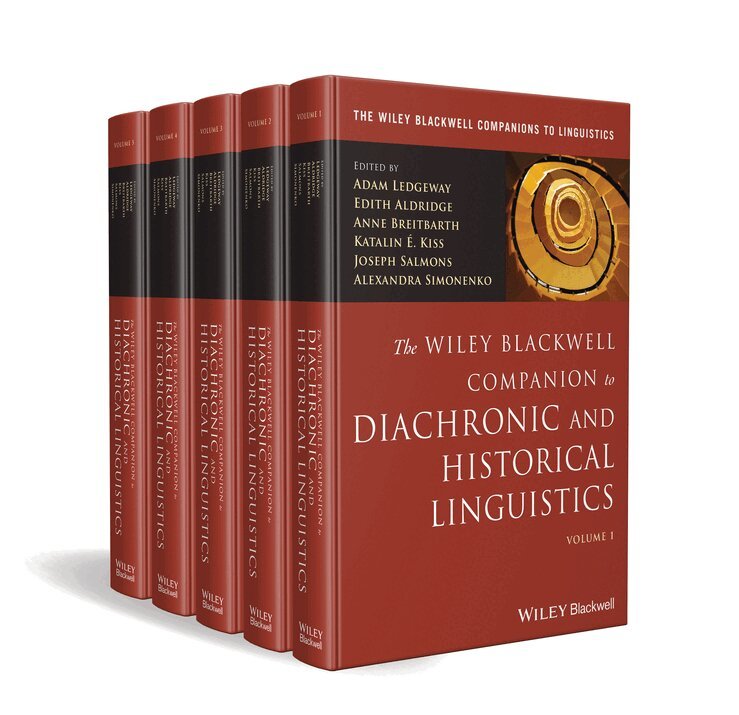
Wiley Blackwell Companion to Diachronic and Historical Linguistics, 5 Volume Set
Inbunden, Engelska, 2026
9 862 kr
Skickas inom 7-10 vardagar
The first multi-volume reference work dedicated entirely to the field of diachronic linguistics The Wiley Blackwell Companion to Diachronic and Historical Linguistics is a state-of-the-art resource that explores the mechanisms underlying linguistic evolution. Bridging the gap between theoretical models and empirical research, this comprehensive work connects linguistics with allied disciplines such as psychology, anthropology, sociology, and biology, and provides an enriched understanding of how language interacts with human society and cognition. Contributions from more than 150 leading scholars cover an unparalleled range of key topics, from phonetics and syntax to semantics, pragmatics, and beyond. Spanning five volumes, the Companion combines cutting-edge theoretical perspectives with detailed case studies from a variety of language families, including underrepresented and non-verbal languages, such as sign languages. By examining the interaction of linguistic systems with societal and environmental factors, this landmark work offers a robust framework for investigating the dynamics of language variation and historical development. Synthesizing decades of groundbreaking research while paving the way for new discoveries, The Wiley Blackwell Companion to Diachronic and Historical Linguistics: Presents insights from diverse theoretical frameworks and methodologies in one comprehensive collectionFeatures in-depth analyses of diverse languages and language families, including lesser-studied languagesExplores the dynamics of language change within and across speakers, communities, and societiesHighlights the role of computational tools and statistical methods in advancing diachronic researchEstablishes connections with related fields to foster interdisciplinary collaborationThe Wiley Blackwell Companion to Diachronic and Historical Linguistics is ideal for advanced undergraduate, graduate, and postgraduate students in linguistics, particularly those taking courses on diachronic linguistics, historical linguistics, and language change. It is an indispensable reference for researchers and practitioners in fields intersecting with language evolution, including academic and professional linguists, philologists, and anthropologists engaged in exploring the complexities of language development and change.
2 272 kr
Skickas inom 5-8 vardagar
The concept of 'trigger' is a core concept of Chomsky's Minimalist Program. The idea that certain types of movement are triggered by some property of the target position is at least as old as the notion that the movement of noun phrases to the subject position is triggered by their need to receive nominative case. In more recent versions of syntactic theory, triggering mechanisms are thought to regulate all of movement. Furthermore, a quite narrow range of triggering mechanisms is permitted. As is to be expected, such a restrictive approach meets a variety of difficulties. Specifically, the question is whether all triggering elements required to cover displacement of all kinds in natural language can be independently motivated. Further, how can a trigger theory, which crucially relies on the idea that all movement is obligatory, deal with apparently optional movement processes? Are features an adequate means to express the triggering function in all cases? More radically, are all movement phenomena really the result of the checking of trigger features? And what about apparent triggering factors that are 'external' to syntax such as prosody - can they be captured in a rigid trigger theory? In other words, could certain aspects of triggered movement be due to interface conditions? Such is the range of questions addressed by the fourteen contributions to this book. They cover a considerable range of languages (including Afrikaans, Breton, Bulgarian, Dutch, English, French, German, Gungbe, Hungarian, Italian, Japanese, Kiswahili, Romanian). These papers present materials, both empirical and theoretical, that will not fail to have considerable impact on the further development of the concept of trigger in syntactic theory.