Linda Weiss - Böcker
Visar alla böcker från författaren Linda Weiss. Handla med fri frakt och snabb leverans.
8 produkter
8 produkter
378 kr
Skickas inom 10-15 vardagar
For more than half a century, the United States has led the world in developing major technologies that drive the modern economy and underpin its prosperity. Linda Weiss attributes the U.S. capacity for transformative innovation to the strength of its national security state, a complex of agencies, programs, and hybrid arrangements that has developed around the institution of permanent defense preparedness and the pursuit of technological supremacy. In America Inc.? she examines how that complex emerged and how it has evolved in response to changing geopolitical threats and domestic political constraints, from the Cold War period to the post-9/11 era.Weiss focuses on state-funded venture capital funds, new forms of technology procurement by defense and security-related agencies, and innovation in robotics, nanotechnology, and renewable energy since the 1980s. Weiss argues that the national security state has been the crucible for breakthrough innovations, a catalyst for entrepreneurship and the formation of new firms, and a collaborative network coordinator for private-sector initiatives. Her book appraises persistent myths about the military-commercial relationship at the core of the National Security State. Weiss also discusses the implications for understanding U.S. capitalism, the American state, and the future of American primacy as financialized corporations curtail investment in manufacturing and innovation.
Del 86 - Cambridge Studies in International Relations
States in the Global Economy
Bringing Domestic Institutions Back In
Häftad, Engelska, 2003
507 kr
Skickas inom 7-10 vardagar
The growing interconnectedness of national economies and an expanding awareness of global interdependence in the 1990s have generated lively debate over the future of national governance. In a world of mobile capital, are states vital to the social and economic wellbeing of their citizens? A number of changes in the state's domestic and international environment - ranging from regulatory reforms and welfare state restructuring to the proliferation of intergovernmental agreements - have promoted the view that globalisation has a negative impact, compromising state capacities to govern domestically. This book challenges the 'constraints thesis'. Covering vital areas of state activity (welfare, taxation, industrial strategy, and regulatory reform), the contributors focus on a range of issues (finance, trade, technology) faced by both developed and developing countries. The contributors argue that globalisation can enable as well as constrain, and they seek to specify the institutional conditions which sharpen or neutralise the pressures of interdependence.
Del 86 - Cambridge Studies in International Relations
States in the Global Economy
Bringing Domestic Institutions Back In
Inbunden, Engelska, 2003
1 442 kr
Skickas inom 7-10 vardagar
The growing interconnectedness of national economies and an expanding awareness of global interdependence in the 1990s have generated lively debate over the future of national governance. In a world of mobile capital, are states vital to the social and economic wellbeing of their citizens? A number of changes in the state's domestic and international environment - ranging from regulatory reforms and welfare state restructuring to the proliferation of intergovernmental agreements - have promoted the view that globalisation has a negative impact, compromising state capacities to govern domestically. This book challenges the 'constraints thesis'. Covering vital areas of state activity (welfare, taxation, industrial strategy, and regulatory reform), the contributors focus on a range of issues (finance, trade, technology) faced by both developed and developing countries. The contributors argue that globalisation can enable as well as constrain, and they seek to specify the institutional conditions which sharpen or neutralise the pressures of interdependence.
213 kr
Skickas inom 5-8 vardagar
334 kr
Skickas inom 5-8 vardagar
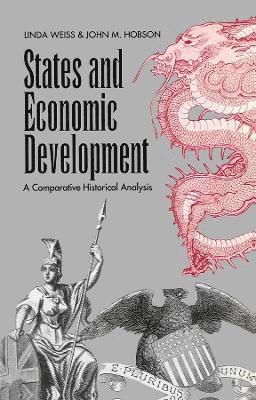
This book addresses the role of political institutions in economic performance, examining the changing state-economy relationships through a comparative history of political and economic development in Britain, USA, Russia, Japan, Taiwan and Korea.
272 kr
Skickas inom 11-20 vardagar
It is widely claimed that as the integration of the world economy advances, national governments are becoming less relevant, losing their powers not only to influence macroeconomic outcomes and to implement social programmes, but to determine strategies for managing the industrial economy. In the face of such claims of state powerlessness, this book proposes that what lies behind some of the most successful economics today is a series of state-informed and state-embedded institutions for governing the economy. The book's central proposition is that the impact of external economic pressures is to a large degree domestically determined, varying in important measure according to the robustness or weakness of national institutions. This thesis is advanced through an analysis of the sources and varieties of state capacity for governing industrial transformation. Focusing on the unravelling of Sweden's distributive model of adjustment, on the evolution of developmental states in East Asia, as well as on the parallel strengths of the German and Japanese systems of industrial co-ordination, it is shown how different types of state capacity - "developmental", "distributive" and "dual" - impact on industrial vitality and domestic adjustment to the international economy. The comparative perspective developed in this study indicates that, as world economic integration proceeds, state capabilities will matter more rather than less in fostering social well-being and wealth creation. This book will be essential reading for 2nd- and 3rd-year undergraduates in comparative politics, political economy and political sociology as well as to all those who have an interest in the nature and prospects of the state in the face of changes to the world economy.
900 kr
Skickas inom 10-15 vardagar
For more than half a century, the United States has led the world in developing major technologies that drive the modern economy and underpin its prosperity. Linda Weiss attributes the U.S. capacity for transformative innovation to the strength of its national security state, a complex of agencies, programs, and hybrid arrangements that has developed around the institution of permanent defense preparedness and the pursuit of technological supremacy. In America Inc.? she examines how that complex emerged and how it has evolved in response to changing geopolitical threats and domestic political constraints, from the Cold War period to the post-9/11 era.Weiss focuses on state-funded venture capital funds, new forms of technology procurement by defense and security-related agencies, and innovation in robotics, nanotechnology, and renewable energy since the 1980s. Weiss argues that the national security state has been the crucible for breakthrough innovations, a catalyst for entrepreneurship and the formation of new firms, and a collaborative network coordinator for private-sector initiatives. Her book appraises persistent myths about the military-commercial relationship at the core of the National Security State. Weiss also discusses the implications for understanding U.S. capitalism, the American state, and the future of American primacy as financialized corporations curtail investment in manufacturing and innovation.
How to Kill a Country: Australia's Devastating Trade Deal with the United States
Häftad, Engelska, 2005
310 kr
Tillfälligt slut