• Fri frakt över 249 kr
  • •
  • Snabba leveranser
  • •
  • Billiga böcker
Kundservice

Du är på sajten för privatpersoner.

Företag, bibliotek eller offentlig verksamhet?

Du handlar på classic.bokus.com, där alla dina funktioner finns intakta.
Till classic.bokus.com
Bokus logotyp. Gå till startsidan.
  • Erbjudanden
  • Nyheter
  • Student
  • Topplistor
  • Barn & ungdom
  • Bokus Play
  • E-böcker
  • Pocketböcker
  • Spel & pussel

10% rabatt på allt med kod: NYSTART10 →

Sidfot

Mina sidor

    Hjälp

    • Kundservice
    • Vanliga frågor och svar
    • Frakt och leverans
    • Retur vid ångerrätt
    • Reklamera vara
    • Betalning
    • Köpvillkor
    • Allmänna villkor
    • Information om webbplatsens tillgänglighet

    Om Bokus

    • Om oss
    • Pressrum
    • För studenter
    • För företag
    • För bibliotek och offentlig verksamhet
    • För leverantörer
    • Hållbarhet

    Populärt

    • Aktuella erbjudanden
    • Presentkort
    • Studentlitteratur
    • Nya böcker
    • Topplistor
    • Signerade böcker
    • Engelska böcker

    Inspiration

    • Boktips
    • BookTok
    • Populära bokserier
    • Barnbokskaraktärer
    • Populära författare
    Logotyp för Bokus
    Följ oss på Facebook (extern länk)Följ oss på Instagram (extern länk)Följ oss på YouTube (extern länk)Följ oss på TikTok (extern länk)
    bokus @ CookiesAnpassa cookiesIntegritetspolicyKöpvillkor
    Till Citymail hemsida (extern länk)Till Budbee hemsida (extern länk)Till Postnord hemsida (extern länk)Till Schenker hemsida (extern länk)Till Early Bird hemsida (extern länk)Till Walleys hemsida (extern länk)
    1. Ekonomi och Ledarskap
    2. Nationalekonomi
    3. Ekonomisk politik

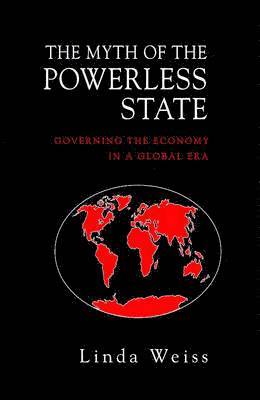
    Myth of the Powerless State

    Governing the Economy in a Global Era

    AvLinda Weiss

    Häftad, Engelska, 1998

    278 kr

    Beställningsvara. Skickas inom 11-20 vardagar. Fri frakt över 249 kr.

    Beskrivning

    It is widely claimed that as the integration of the world economy advances, national governments are becoming less relevant, losing their powers not only to influence macroeconomic outcomes and to implement social programmes, but to determine strategies for managing the industrial economy. In the face of such claims of state powerlessness, this book proposes that what lies behind some of the most successful economics today is a series of state-informed and state-embedded institutions for governing the economy. The book's central proposition is that the impact of external economic pressures is to a large degree domestically determined, varying in important measure according to the robustness or weakness of national institutions. This thesis is advanced through an analysis of the sources and varieties of state capacity for governing industrial transformation. Focusing on the unravelling of Sweden's distributive model of adjustment, on the evolution of developmental states in East Asia, as well as on the parallel strengths of the German and Japanese systems of industrial co-ordination, it is shown how different types of state capacity - "developmental", "distributive" and "dual" - impact on industrial vitality and domestic adjustment to the international economy. The comparative perspective developed in this study indicates that, as world economic integration proceeds, state capabilities will matter more rather than less in fostering social well-being and wealth creation. This book will be essential reading for 2nd- and 3rd-year undergraduates in comparative politics, political economy and political sociology as well as to all those who have an interest in the nature and prospects of the state in the face of changes to the world economy.

    Produktinformation

    • Utgivningsdatum:1998-04-07
    • Mått:147 x 224 x 18 mm
    • Vikt:408 g
    • Format:Häftad
    • Språk:Engelska
    • Antal sidor:280
    • Förlag:John Wiley and Sons Ltd
    • ISBN:9780745615820

    Utforska kategorier

    • Ekonomisk politik inom Ekonomi och Ledarskap
    • Makroekonomi inom Ekonomi och Ledarskap

    Mer om författaren

    Linda M. Weiss is an Australian professor of political science at the University of Sydney, specialising in the international and comparative politics of economic development.

    Recensioner i media

    "I can unreservedly recommend this book as easily the most intelligent, best-researched and original account available of the relations between states and capitalist economies in the advanced North. Linda Weiss's careful dissections of economic policies and performance in Japan and East Asia, Sweden, Germany, Britain and the United States demolishes most conventional generalizations deriving from neo-liberal, "globalization" or social democratic theories alike. This is macro-sociology of the highest quality." Professor Michael Mann, UCLA "This is a splendid study in political economy. Weiss uses the comparison between East Asia, Sweden and Germany as the basis for a theoretical analysis of the role of the state as a coordinator and steerer of industrial upgrading. Her style is punchy, her argument is original. Future research will have to take The Myth of the Powerless State as a point of reference." Professor Robert Wade, Russell Sage Foundation, New York"Articulate, engaging and highly persuasive ... this is a fine work. And it is easily the best attempt so far to reinstate the anti-liberal, pro-state, economically national cause." Australian Journal of Political Science"Her statement of a case against leaving things to markets that are currently influential is clear and thoughtful, and her argument deserves attention from both sides of the political divide." Times Literary Supplement"A welcome contribution to the ongoing debate over globalization. This book provides the best general discussion of state power yet available." Foreign Affairs

    Innehållsförteckning

    • Preface. 1. The State is Dead. Long Live the State.Introduction.The Phenomenon of 'State Denial'.Scope of the Argument.The Book in Outline.2. The Sources of State Capacity. .Introduction.The Problem of State Capacity.Approaches to State Capacity.Conclusion.3. Transformative Capacity in Evolution: East Asian Developmental States.Introduction.Institutions and Economic Performance.Institutional Capacities for Industrial Transformation.The Changing Basis of State Capacity.Forms and Dynamics of Governed Interdependence.Conclusion: State 'Power' in East Asia.4. Limits of the Distributive State: Swedish Model or Global Economy? .Introduction.Distributive State Capacity.The Model Unravels: External Pressures?.Undermining from Within.The Limits of a Distributive Strategy.Explanations of the Swedish Strategy.Conclusion.5. Dualistic States: Germany in the Japanese Mirror.Introduction.The German Case: How 'Developmental' is the State?.The State in the Rise of German Industrial Power. Geopolitical Submergence of Transformative Capacity.Private-Sector Governance: A State-informed System of Coordination.Postwar Developmentalism: Innovation Without Change.Reconstituting Transformative Capacity.Dual Capabilities and National Prosperity.How 'Distributive' is the Japanese State?.Conclusion.6. The Limits of Globalization. Introduction.What does 'Globalization' Mean?.The Question of Novelty.The Question of Magnitude.The Question of Distribution.The Question of Mobility.7. The Myth of the Powerless State.The Extent of Government Powerlessness.Convergence Versus Varieties of State Capacity.Adaptivity of the State.The State as Victim of Midwife of 'Globalization'.The Emergence of 'Catalytic' States.Conclusion.Notes.Bibliography.Index.