Luc Brisson - Böcker
Visar alla böcker från författaren Luc Brisson. Handla med fri frakt och snabb leverans.
9 produkter
9 produkter
1 169 kr
Skickas inom 11-20 vardagar
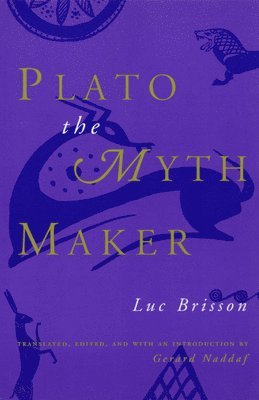
One thinks of a myth as a fictional story, and Plato was the first to use the term "muthos" in that sense. But Plato also used "muthos" to describe the practice of making and telling myths, the oral transmission of all that a community keeps in its collective memory. In the first part of this text, Luc Brisson reconstructs Plato's multifaceted and not uncritical description of "muthos" in light of the latter's famous Atlantis story. The second part of the book contrasts this sense of myth, as Plato does, with another form of speech which he believed was far superior: the "logos" of philosophy. Brisson's work is part lexical, part philosophical, and part ethnological, and Gerard Naddaf's introduction shows the originality and importance both of Brisson's method and of Plato's analysis in the context of contemporary debates over the origin and evolution of the oral tradition.
284 kr
Skickas inom 7-10 vardagar
We think of a myth as a fictional story, and Plato was the first to use the term "muthos" in that sense. But Plato also used "muthos" to describe the practice of making and telling myths, the oral transmission of all that a community keeps in its collective memory. In the first part of this text, Luc Brisson reconstructs Plato's multifaceted and not uncritical description of "muthos" in light of the latter's famous Atlantis story. The second part of the book contrasts this sense of myth, as Plato does, with another form of speech which he believed was far superior: the "logos" of philosophy. Brisson's work is part lexical, part philosophical, and part ethnological, and Gerard Naddaf's substantial introduction shows the originality and importance both of Brisson's method and of Plato's analysis in the context of contemporary debates over the origin and evolution of the oral tradition.
How Philosophers Saved Myths
Allegorical Interpretation and Classical Mythology
Inbunden, Engelska, 2004
456 kr
Tillfälligt slut
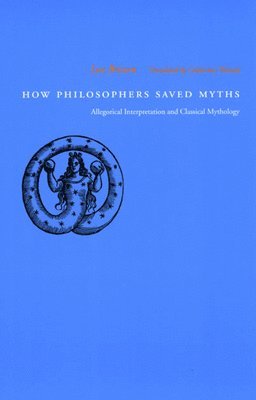
In this concise but wide-ranging study, Luc Brisson describes how the myths of Greece and Rome were transmitted from antiquity to the Renaissance. He argues that philosophy was responsible for saving myth from historical annihilation. Although philosophy was initially critical of myth, mythology was progressively reincorporated into philosophy through allegory. Brisson reveals how philosophers employed allegory and how it enabled myth to take on a number of different interpretive systems throughout the centuries: moral, physical, psychological, political, and even metaphysical.
How Philosophers Saved Myths
Allegorical Interpretation and Classical Mythology
Häftad, Engelska, 2008
244 kr
Skickas inom 7-10 vardagar
In this concise but wide-ranging study, Luc Brisson describes how the myths of Greece and Rome were transmitted from antiquity to the Renaissance. He argues that philosophy was responsible for saving myth from historical annihilation. Although philosophy was initially critical of myth, mythology was progressively reincorporated into philosophy through allegory. Brisson reveals how philosophers employed allegory and how it enabled myth to take on a number of different interpretive systems throughout the centuries: moral, physical, psychological, political, and even metaphysical.
Inventing the Universe
Plato's Timaeus, the Big Bang, and the Problem of Scientific Knowledge
Häftad, Engelska, 1995
552 kr
Skickas inom 3-6 vardagar
A parallel investigation of both Plato's Timaeusand the contemporary standard Big Bang model of the universe shows that any possible scientific knowledge of the universe is ultimately grounded in irreducible and undemonstrable propositions. These are inventions of the human mind. The scientific knowledge of the universe is entirely composed in a series of axioms and rules of inference underlying a formalized system. There is no logical relationship between the sensible perception of a world of becoming and the formalized system of axioms known as a "scientific explanation."The "irrational gap" between perception and explanation can be appraised historically and identified in three stages: Plato's Timaeus furnishes the first example of a scientific theory dealing with a realm of ideality that cannot be derived from immediate sensible perception; the Big Bang model is constituted on the basis of the purely geometrical notion of symmetry; and in the more recent Algorithmic Theory of Information, the analysis of the purely symbolic language expressing physical reality reveals the level of complexity of any given theory formulated in this language. The result is that the probability of the universe actually conforming with simple mathematics is zero.In a formal system, a theorem contains more information than can be found in the set of axioms of this system, and it remains undecidable. In Aristotle' s language, the theorems that can be proved within a theoretical model are already potentially contained in the system of axioms underlying these theorems.
2 195 kr
Skickas inom 10-15 vardagar
The figure of Orpheus has long exercised a potent influence on religious thought. Yet what we know directly about Orphism comes from a scatter of isolated and often very short fragments quoted in the works of Platonists of the Roman period, notably Proclus, Damascius and Olympiodorus. The author’s concern here is to establish the context in which these passages were cited, and to trace the development of the written tradition, from the texts which contain a critique of the beliefs of the Homeric era to those, whether newly composed or transformed, which show signs of adaptation to later religious and philosophical movements, among them Stoicism and Platonism. In sharp contrast to views held by others, it is argued that it is possible to map out a process of evolution, amongst other criteria by focusing on the role and place of Chronos in the Orphic theogony. The author also asks whether there really ever existed true Orphic sects with a cult with specific rites, and would conclude that the present evidence cannot be held to substantiate this. Orphée a pendant longtemps exercé une puissante influence sur la pensée religieuse. Cependant, ce que nous connaissons directement de l’Orphïsme se réduit à une poignée de fragments isolés et souvent très courts qui se trouvent éparpillés dans les oeuvres de Platoniciens ayant vécu sous l'Empire romain, surtout Proclus, Damascius et Olympiodore. Dans les articles qui composent ce recueil, l'auteur s'est attaché à reconstituer les contextes dans lesquels ces passages sont cités, et à comprendre comment s'est développée la tradition écrite à laquelle ils appartiennent, depuis les textes qui critiquent les croyances véhiculées par Homère et par Hésiode et qui, ayant fait l'objet d'une rédaction ou d'une transformation récente, présentent les signes d'une adaptation à des mouvements religieux ou philosophiques tardifs, le Stoïcisme et le médio-Platonisme entre autres. S'opposant en cela à b
1 741 kr
Skickas inom 3-6 vardagar
Del 83 - Academia Philosophical Studies
From the Pseudopythagorica to the Neopythagoreans
Häftad, Engelska, 2025
2 279 kr
Skickas inom 3-6 vardagar
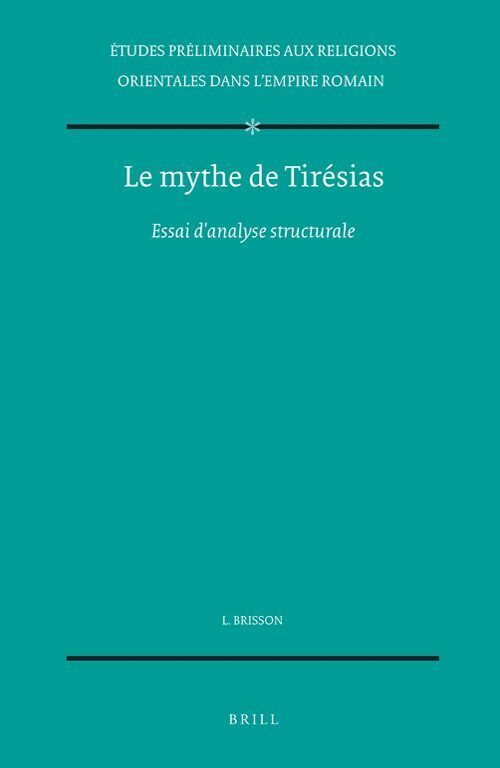
Del 55 - Études préliminaires aux religions orientales dans l'Empire romain
Le mythe de Tirésias
Essai d'analyse structurale
Inbunden, Franska, 1976
1 663 kr
Skickas inom 5-8 vardagar