• Fri frakt över 249 kr
  • •
  • Snabba leveranser
  • •
  • Billiga böcker
Kundservice

Du är på sajten för privatpersoner.

Företag, bibliotek eller offentlig verksamhet?

Du handlar på classic.bokus.com, där alla dina funktioner finns intakta.
Till classic.bokus.com
Bokus logotyp. Gå till startsidan.
  • Erbjudanden
  • Nyheter
  • Student
  • Topplistor
  • Barn & ungdom
  • Bokus Play
  • E-böcker
  • Pocketböcker
  • Spel & pussel

10% rabatt på allt med kod: NYSTART10 →

Sidfot

Mina sidor

    Hjälp

    • Kundservice
    • Vanliga frågor och svar
    • Frakt och leverans
    • Retur vid ångerrätt
    • Reklamera vara
    • Betalning
    • Köpvillkor
    • Allmänna villkor
    • Information om webbplatsens tillgänglighet

    Om Bokus

    • Om oss
    • Pressrum
    • För studenter
    • För företag
    • För bibliotek och offentlig verksamhet
    • För leverantörer
    • Hållbarhet

    Populärt

    • Aktuella erbjudanden
    • Presentkort
    • Studentlitteratur
    • Nya böcker
    • Topplistor
    • Signerade böcker
    • Engelska böcker

    Inspiration

    • Boktips
    • BookTok
    • Populära bokserier
    • Barnbokskaraktärer
    • Populära författare
    Logotyp för Bokus
    Följ oss på Facebook (extern länk)Följ oss på Instagram (extern länk)Följ oss på YouTube (extern länk)Följ oss på TikTok (extern länk)
    bokus @ CookiesAnpassa cookiesIntegritetspolicyKöpvillkor
    Till Citymail hemsida (extern länk)Till Budbee hemsida (extern länk)Till Postnord hemsida (extern länk)Till Schenker hemsida (extern länk)Till Early Bird hemsida (extern länk)Till Walleys hemsida (extern länk)
    1. Filosofi och religion
    2. Filosofi
    3. Filosofiska discipliner

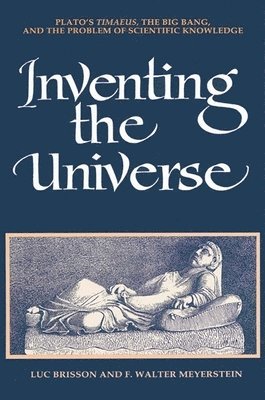
    Inventing the Universe

    Plato's Timaeus, the Big Bang, and the Problem of Scientific Knowledge

    AvLuc Brisson,F. Walter Meyerstein

    Häftad, Engelska, 1995

    Del i serien SUNY series in Ancient Greek Philosophy

    442 kr

    Beställningsvara. Skickas inom 5-8 vardagar. Fri frakt över 249 kr.

    Beskrivning

    A parallel investigation of both Plato's Timaeusand the contemporary standard Big Bang model of the universe shows that any possible scientific knowledge of the universe is ultimately grounded in irreducible and undemonstrable propositions. These are inventions of the human mind. The scientific knowledge of the universe is entirely composed in a series of axioms and rules of inference underlying a formalized system. There is no logical relationship between the sensible perception of a world of becoming and the formalized system of axioms known as a "scientific explanation."The "irrational gap" between perception and explanation can be appraised historically and identified in three stages: Plato's Timaeus furnishes the first example of a scientific theory dealing with a realm of ideality that cannot be derived from immediate sensible perception; the Big Bang model is constituted on the basis of the purely geometrical notion of symmetry; and in the more recent Algorithmic Theory of Information, the analysis of the purely symbolic language expressing physical reality reveals the level of complexity of any given theory formulated in this language. The result is that the probability of the universe actually conforming with simple mathematics is zero.In a formal system, a theorem contains more information than can be found in the set of axioms of this system, and it remains undecidable. In Aristotle' s language, the theorems that can be proved within a theoretical model are already potentially contained in the system of axioms underlying these theorems.

    Produktinformation

    • Utgivningsdatum:1995-07-20
    • Mått:152 x 229 x 13 mm
    • Vikt:290 g
    • Format:Häftad
    • Språk:Engelska
    • Serie:SUNY series in Ancient Greek Philosophy
    • Antal sidor:193
    • Förlag:State University of New York Press
    • ISBN:9780791426920

    Utforska kategorier

    • Filosofiska discipliner inom Filosofi och religion

    Mer om författaren

    Luc Brisson is Director of Research at Centre National de la Recherche Scientifique. He has published several books and articles. F. Walter Meyerstein is in the Philosophy Department at the Universitate Autonoma de Barcelona, and is studying the philosophical implications of modern science.

    Innehållsförteckning

    • Acknowledgments Introduction: The Problem of Scientific KnowledgeSituating the problem: our essential presuppositions The procedure followed in this analysis The Model of the Universe in Plato's TimaeusThe Big Bang Model of CosmologyAlgorithmic Information Theory NotesPart I: The Model of the Universe in the TimaeusThe date of the composition of the TimaeusThe first twelve axioms of the cosmological model advanced in the TimaeusPlato's theory of matter and the cosmological axiomsPlato's explanation of the complexity of sensible things Experimental verification in Plato's timeStandards and instruments of measure in Plato's timeThe numbering system in Plato's timeExperimentation in the TimaeusNotesPart II: Contemporary Big Bang CosmologyA. The standard Big Bang model: short descriptionThe "philosophical" presuppositionsThe geometric axiomsEinstein's gravitationEinstein's dynamic axioms: matter and energy in the universetime and causality in the universeSolving Einstein's field equationsIsotropy and homogeneity of the energy/matter content of the universe: the standard Friendmann-Robertson-Walker modelB. The relation between the model and observation The Hubble lawCosmic microwave background radiationThe relative abundance of light elementsObservational limits in cosmologyProblems affecting the FRW model: observations requiring additional axiomsThe inflationary scenarioC. Modern theory of matterThe central role of the concept of symmetryNotes Part III: What Knowledge is Conveyed by Science?The symbolic description of realityAlgorithmic Information Theory: some relevant aspects The Turing machineA definition of scienceThe science of the axioms in Aristotle's Posterior AnalyticsFinal conclusionsNotesIndices