Luca Molà – författare
Visar alla böcker från författaren Luca Molà. Handla med fri frakt och snabb leverans.
3 produkter
3 produkter
Del 9 - I Tatti Research Series
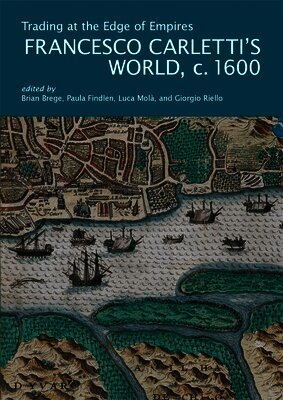
Trading at the Edge of Empires
Francesco Carletti's World, c. 1600
Häftad, Engelska, 2026
636 kr
Kommande
In narrating his circumnavigation of the world at the turn of the seventeenth century, the Florentine Francesco Carletti became the first European merchant to leave an account of travel on existing commercial routes. A repentant ex-slave trader and smuggler turned dealer in Chinese goods, Carletti travelled “at the edge of empires,” providing a unique perspective on the promise and peril of a connected globe. With his long stays in Lima, Mexico City, Manila, Nagasaki, Macao, and Goa, as well as travels across the Americas, the Pacific, and Asia, Carletti documents a changing world in which European powers and traders interacted and often clashed with other empires and polities. Trading at the Edge of Empires brings together 24 scholars to situate and unpack how Carletti’s travels illuminate our understanding of trade, slavery, empire, religion, language, ethnography, cartography, cosmography, and material culture in the early modern world.
652 kr
Tillfälligt slut
The manufacture of luxury textiles, such as silk, was central to an Italian Renaissance economy based on status and conspicuous consumption. From the rapidly changing fashions that drove demand to the jobs created for craftsmen, weavers, and merchants, the wealth and prestige associated with silk throughout Europe made it Italy's leading export industry. In this important book, Luca Mola examines the silk industry in Renaissance Venice amid changing markets, suppliers, producers, and government regulations. Drawing on archival research and a vast amount of European scholarship, Mola documents the innovations Venetians made in manufacturing and marketing to spur the silk industry. He uncovers the alliance between manufacturers and government to promote the industry in a changing international economic environment. Through flexible laws, quality was regulated to meet the varying requirements of an increasing range of customers. Mola also analyzes state policy that favored the development and organization of silk producers throughout the Terraferma.His findings contribute in an important way to the ongoing scholarly assessment of Venice's place in the economy of the Renaissance and the Mediterranean world.
Del 1 - Pasold Studies in Textile, Dress and Fashion History
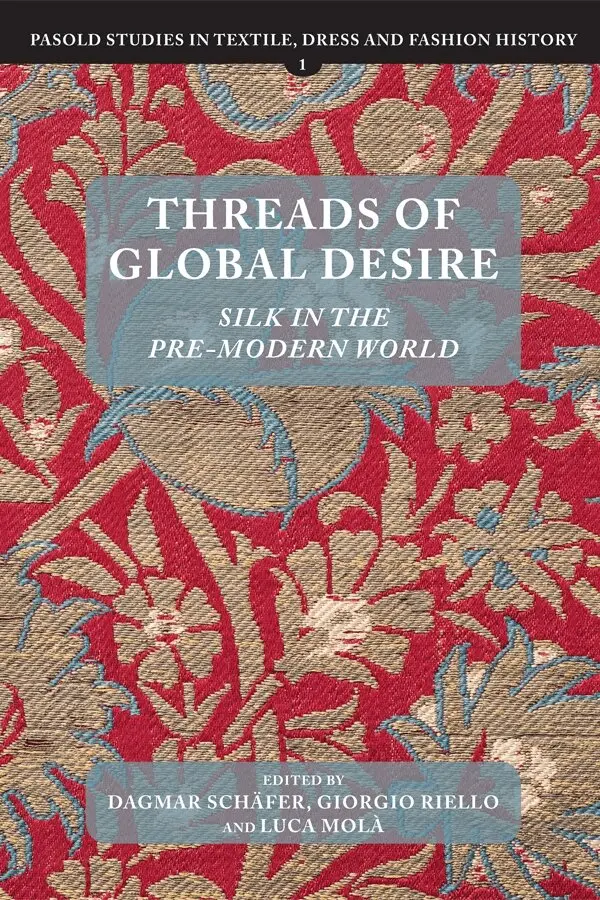
Threads of Global Desire
Silk in the Pre-Modern World
Inbunden, Engelska, 2018
759 kr
Skickas inom 7-10 vardagar
Considering silk as a major force of cross-cultural interaction, this book examines the integration of silk production and consumption into various cultures in the pre-modern world.Silk has long been a global commodity that, because of its exceptional qualities, high value and relative portability, came to be traded over very long distances. Similarly, the silk industry - from sericulture to the weaving of cloth - was one of the most important fields of production in the medieval and early modern world. The production and consumption of silks spread from China to Japan and Korea and travelled westward as far as India, Persia and theByzantine Empire, Europe, Africa and the Americas. As contributors to this book demonstrate, in this process of diffusion silk fostered technological innovation and allowed new forms of organization of labour to emerge. Its consumption constantly reshaped social hierarchies, gender roles, aesthetic and visual cultures,as well as rituals and representations of power.Threads of Global Desire is the first attempt at considering a global history of silk in the pre-modern era. The book examines the role of silk production and use in various cultures and its relation to everyday and regulatory practices. It considers silk as a major force of cross cultural interaction through technological exchange and trade in finished and semi-finished goods. Silks mediated design and a taste for luxuries and were part of gifting practices in diplomatic and private contexts. Silk manufacturing also fostered thecirculation of skilled craftsmen, connecting different centres and regions across continents and linking the countryside to urban production.DAGMAR SCHÄFER is Director of Department 3 'Artefacts, Action, and Knowledge'at the Max Planck Institute for the History of Science in Berlin and Professor h.c. of the History of Technology at the Technical University, Berlin.GIORGIO RIELLO is Professor of Global History and Culture at the University of Warwick. He has published extensively on the history of material culture and trade in early modern Europe and Asia and in particular on textiles and fashion.LUCA MOLA is Professor of Early Modern Europe: History of the Renaissance and the Mediterranean in a World Perspective at the European University Institute in Fiesole.Contributors: JOSÉ L. GASCH-TOMAS, SURAIYA FAROQHI, KAROLINA HUTKOVA, FUJITA KAYOKO, BEN MARSH, RUDOLPHMATTHEE, LESLEY ELLIS MILLER, DAVID MITCHELL, LUCA MOLA, LISA MONNAS, AMANDA PHILLIPS, GIORGIO RIELLO, DAGMAR SCHÄFER, ANGELA SHENG