Lucian Turcescu – författare
Visar alla böcker från författaren Lucian Turcescu. Handla med fri frakt och snabb leverans.
13 produkter
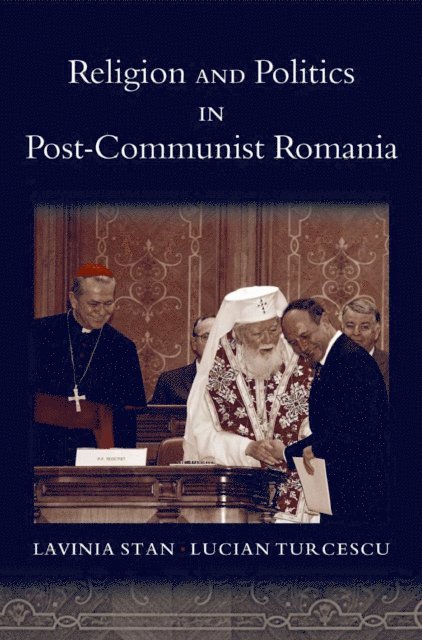
Religion and Politics in Post-Communist Romania
Av Lucian Turcescu, Lavinia Stan
E-bok, 2007
1133 kr
Lägg i varukorg
In the post-communist era it has become evident that the emerging democracies in Eastern Europe will be determined by many factors, only some of them political. Throughout the region, the Orthodox, Roman Catholic, and Greek Catholic churches have tried to impose their views on democracy through …
Gregory of Nyssa and the Concept of Divine Persons
E-bok, 2005
899 kr
Lägg i varukorg
The concept of personhood is central to a wide range of contemporary issues, ranging from reproductive rights to the death penalty and euthanasia. We may think that the concept of person is a modern development. In fact, however, this idea does not originate with our discovery of human rights, …
Gregory of Nyssa and the Concept of Divine Persons
Inbunden, 2005
1408 kr
Lägg i varukorg
The concept of personhood is central to a wide range of contemporary issues, ranging from reproductive rights to the death penalty and euthanasia. We may think that the concept of person is a modern discovery. In fact, however, this idea does not originate with our discovery of human rights, …
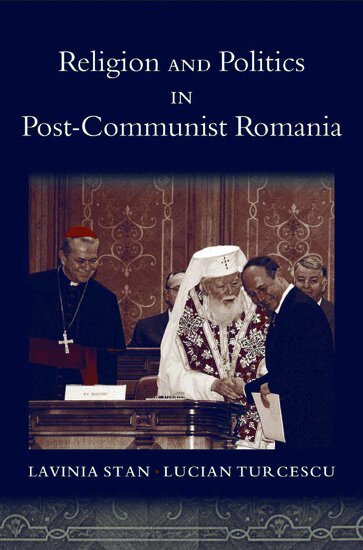
Religion and Politics in Post-Communist Romania
Av Lavinia Stan, Lucian Turcescu
Inbunden, 2007
1720 kr
Lägg i varukorg
In the post-communist era it has become evident that the emerging democracies in Eastern Europe will be determined by many factors, only some of them political. Throughout the region, the Orthodox, Roman Catholic, and Greek Catholic churches have tried to impose their views on democracy through …
Church, State, and Democracy in Expanding Europe
Av Lavinia Stan, Lucian Turcescu
Inbunden, 2011
1793 kr
Lägg i varukorg
Lavinia Stan and Lucian Turcescu examine the relationship between religion and politics in ten former communist Eastern European countries. Contrary to widespread theories of increasing secularization, Stan and Turcescu argue that in most of these countries, the populations have shown themselves to …
Gregory of Nyssa and the Concept of Divine Persons
E-bok, 2005
899 kr
Lägg i varukorg
The concept of personhood is central to a wide range of contemporary issues, ranging from reproductive rights to the death penalty and euthanasia. We may think that the concept of person is a modern development. In fact, however, this idea does not originate with our discovery of human rights, …
Religion and Politics in Post-Communist Romania
Av Lucian Turcescu, Lavinia Stan
E-bok, 2007
1133 kr
Lägg i varukorg
In the post-communist era it has become evident that the emerging democracies in Eastern Europe will be determined by many factors, only some of them political. Throughout the region, the Orthodox, Roman Catholic, and Greek Catholic churches have tried to impose their views on democracy through …
Church Reckoning with Communism in Post-1989 Romania
Av Lucian Turcescu, Lavinia Stan
Inbunden, 2021
1215 kr
Lägg i varukorg
The present volume focuses on the relationship with Communism of Romania's most important religious denominations and their attempt to cope with that difficult past which continues to cast an important shadow over their present. For the first time ever, this volume considers both the majority …
Churches, Memory and Justice in Post-Communism
Av Lucian Turcescu, Lavinia Stan
Inbunden, 2021
1530 kr
Lägg i varukorg
This book is the first to systematically examine the connection between religion and transitional justice in post-communism. There are four main goals motivating this book: 1) to explain how civil society (groups such as religious denominations) contribute to transitional justice efforts to address …
Churches, Memory and Justice in Post-Communism
Av Lavinia Stan, Lucian Turcescu
E-bok, 2021
1942 kr
Lägg i varukorg
This book is the first to systematically examine the connection between religion and transitional justice in post-communism. There are four main goals motivating this book: 1) to explain how civil society (groups such as religious denominations) contribute to transitional justice efforts to address …
Churches, Memory and Justice in Post-Communism
Av Lucian Turcescu, Lavinia Stan
Häftad, 2022
1530 kr
Lägg i varukorg
This book is the first to systematically examine the connection between religion and transitional justice in post-communism. There are four main goals motivating this book: 1) to explain how civil society (groups such as religious denominations) contribute to transitional justice efforts to address …
Reception and Interpretation of the Bible in Late Antiquity
Proceedings of the Montréal Colloquium in Honour of Charles Kannengiesser, 11-13 October 2006
Av Lorenzo DiTommaso, Lucian Turcescu
Inbunden, 2008
4382 kr
Lägg i varukorg
The volume is a Festschrift offered to Charles Kannengiesser on the occasion of his 80th birthday and honours him for his numerous scholarly accomplishments. Its twenty-five contributions discuss some of the major issues pertaining to the reception and interpretation of the Bible in late antique …
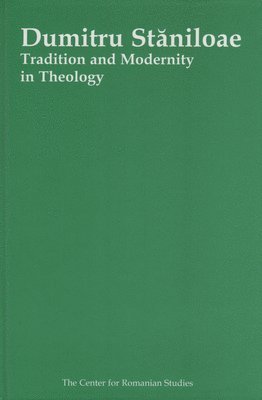
Dumitru Staniloae
Tradition and Modernity in Theology
Inbunden, 2002
398 kr
Tillfälligt slut
A comprehensive analysis of his thought, Dumitru Staniloae: Tradition and Modernity in Theology is an assessment of his theology.