Lucie Guibault - Böcker
Visar alla böcker från författaren Lucie Guibault. Handla med fri frakt och snabb leverans.
4 produkter
4 produkter
2 165 kr
Skickas inom 5-8 vardagar
This book is the result of a long-term comparative research project on intellectual property, with topics ranging from patents to copyright, examined across 16 jurisdictions. It does not aim at commenting on current policy issues. The country reports unearth the culturally, morally and historically imprinted thought patterns across Europe which underpin current discussions on the appropriation of information, and which do not change quickly. The research results question the common narratives of the distinctiveness of private and public law, of contracts and property, and of morality and the law.The point of departure is the public good character of information, with the focus being on public interests pursued when assigning information as property. The 14 selected cases, based on recent, and in some cases futuristic when the project began in 2001, scenarios, aim to identify how boundaries to information property emerge, the areas of law that are applied and the principles that are followed in order to balance the conflicting interests at stake. The issues discussed revolve around well-known interfaces such as IP and competition law, monetary interests versus personal interests in human genome data, individual freedoms-to-operate versus collective action models as found in basic research or ‘creative commons’. The book shows how some national discussions appear similar on the surface, in terms of resorting to parallel principles, but subsequent domestic policy answers vary greatly. Even legislation which aims at harmonisation may result into more diversity. Inversely, we found legal institutions applied which install contrasting legal rules which however aim at exactly the same behavioural change.The national reports in Part III are complemented by comparative analyses by the editors, whilst the chapters in Part II are dedicated to an analysis of the submissions from a theoretical point of view, departing from the editors’ own research interests. The chapter in Part I describes the overall ‘Common Core’ research method, which splits the national reports into operative, descriptive and metalegal formants.Boundaries of Information Property is aimed at researchers in IP and practitioners interested in the foundational theory of their subject. It is an inspiring read for those interested in the deeper structures of regulating information.With a foreword by Sjef van Erp (em. University of Maastricht) and contributions by Christine Godt (Carl von Ossietzky University of Oldenburg), Geertrui Van Overwalle (University of Leuven), Lucie Guibault (Dalhousie University), Deryck Beyleveld (University of Durham), Mike Adcock (University of Durham), Ramūnas Birštonas (Vilnius University), Maja Bogataj Jančič (Intellectual Property Institute, Ljubljana), Konstantinos Christodoulou (University of Athens), Teresa Franquet Sugrañes (University Rovira i Virgili), Pablo Garrido Pérez (University of Barcelona), Christophe Geiger (Luiss Guido Carli University), Silvia Gómez Trinidad (University of Barcelona), Mariona Gual Dalmau (University of Barcelona), Aleksei Kelli (University of Tartu), Tomaž Keresteš (University of Maribor), Maja Lubarda (Lawyer, Ljubljana), Thomas Margoni (University of Leuven), Jan Mates (Attorney-at-Law, Prague), Maureen O’Sullivan (NUI Galway), Andrea Pradi (University of Trento), Martina Repas (University of Maribor), Giorgio Resta (University of Rome 3), Ole-Andreas Rognstad (University of Oslo), Cristina Roy Pérez (University of Barcelona), Jens Schovsbo (University of Copenhagen), Agnes Schreiner (University of Amsterdam), Simone Schroff (Plymouth University), Tobias Schulte in den Bäumen (Hapag-Llyod, Hamburg), Simona Štrancar (University of Maribor), Tomasz Targosz (Jagiellonian University), Elżbieta Traple (Jagiellonian University), and Gabriele Venskaityte (European Commission, Brussels).
2 966 kr
Tillfälligt slut
2 186 kr
Tillfälligt slut
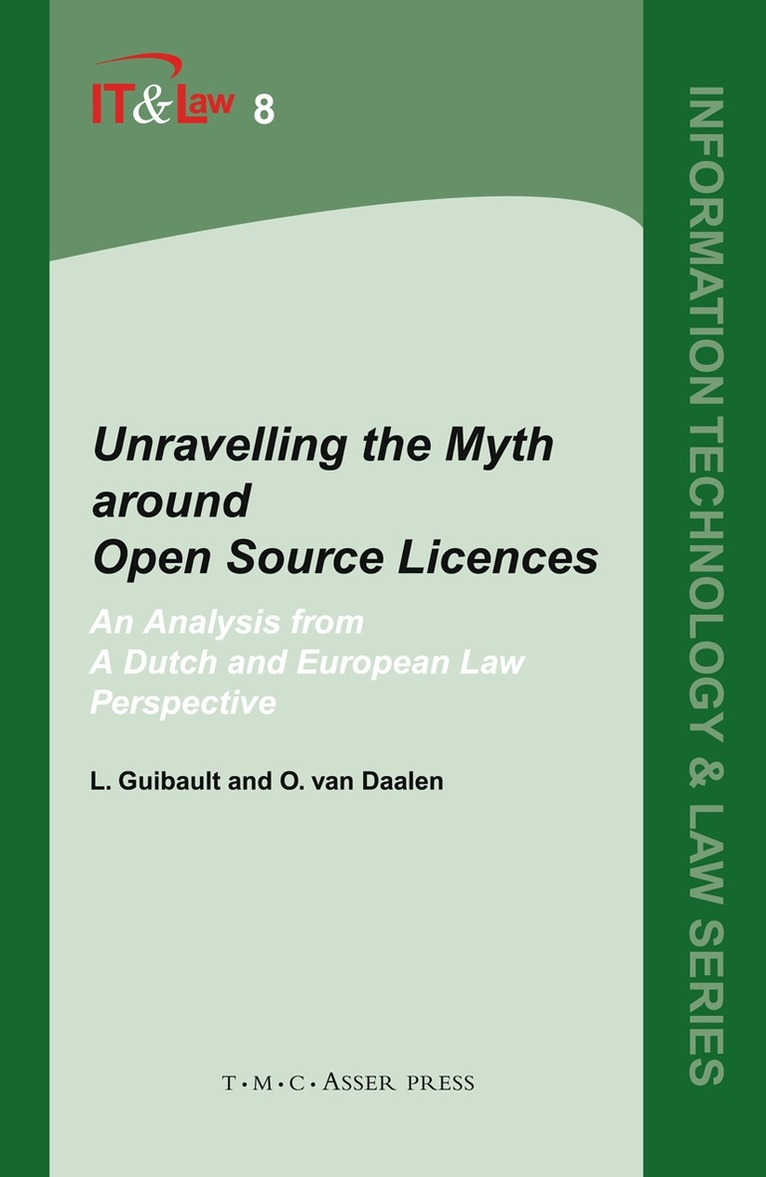
Unravelling the Myth around Open Source Licences
An Analysis from a Dutch and European Law Perspective
Inbunden, Engelska, 2006
492 kr
Skickas inom 10-15 vardagar
Open source software licences are based on two fundamental principles: the possibility for users to use the software for any purpose and the possibility to modify and redistribute it without prior authorisation from the initial developer. Some open source software licences, like the General Public Licence (GPL), also impose a corollary obligation on the licensee: to make the source code available to other developers. The idea behind this form of licensing is that when programmers can read, redistribute and modify the source code for a piece of software, the software evolves.A number of legal challenges need to be addressed in order to ensure the most efficient deployment of open contentlicences in Europe and in the Netherlands, not least because most open source licences originate from the United States. This study gives an overview of the current legal situation regarding the use of open source software licences and investigates how the most commonly used open source software licences measure up to Dutch and European law. How does the distinct production and distribution model of open source licences fit in the current legal framework? Does the current legal environment support the use of open source licences or does it rather impede their use? In this last case, would certain adaptations to the law or to the licence terms be appropriate?By its in-depth analysis and clear conclusions, Unravelling the Myth around Open Source Licences amply contributes to the understanding of this complex field that policy makers, regulators, and academics so crucially require. Taking the provisions of the GNU GPL, the BSD, and the Mozilla Public Licence as examples, it investigates the implications of open source licensing from a private law, copyright law and patent law perspective. It also takes a brief look at the issue of the enforcement of these licences. To facilitate the use and enforcement of open source software licences in Europe, and more particularly in the Netherlands, the authors conclude their study by making a number of recommendations for the adaptation of the licence terms with a view to enhancing their compliance with the legal requirements.Lucie Guibault is Senior Researcher at the University of Amsterdam’s Institute for Information Law (IViR). Ot van Daalen is an attorney with the firm of De Brauw Blackstone Westbroek in Amsterdam.This is Volume 8 in the Information Technology and Law (IT&Law) Series