
Magda Lipska - Böcker
Visar alla böcker från författaren Magda Lipska. Handla med fri frakt och snabb leverans.
2 produkter
2 produkter
249 kr
Skickas inom 7-10 vardagar
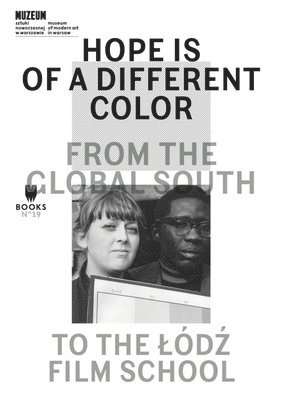
The history of film students from the Global South who studied in Poland during the Cold War. As Poland’s second-largest city, Łódź was a hub for international students who studied in Poland from the mid-1960s to 1989. The Łódź Film School, a member of CILECT since 1955, was a favored destination, with students from Africa, Latin America, and the Middle East accounting for one-third of its international student body. Despite the school’s international reputation, the experience of its filmmakers from the Global South is little known beyond Poland. Hope Is of a Different Color addresses the history of student exchanges between the Global South and the Polish People’s Republic during the Cold War. It sheds light on the experiences and careers of a generation of young filmmakers at Łódź, many of whom went on to achieve success as artists in their home countries, and provides insight into emerging areas of research and race relations in Central and Eastern Europe. The essays reflect on these issues from multiple perspectives, considering sociology, political science, art, and film history. The book also features previously unpublished photographs and film stills from private archives along with visual and written material collected at the Łódź Film School.
Was Socialist Realism Global?
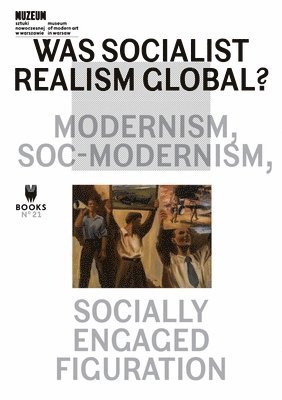
Modernism, Soc-modernism, Socially Engaged Figuration
Häftad, Engelska, 2024
242 kr
Skickas inom 7-10 vardagar
A wide-ranging examination of Socialist Realism that shows it extended far beyond Eastern Europe.Was Socialist Realism Global? takes up a question that was posed by art historian Piotr Piotrowski in his final book. It offers new perspectives both on socialist realism in a strict sense and on aspects of politically and socially engaged art of the twentieth century that employed broadly understood figuration. Contributors to the volume shed light on the genealogy of figuration, relate socialist art and socialist realism from Europe to analogous artistic practices in Latin America and beyond, and more. To date, they argue, the rewriting of the artistic canon of the postcolonial world has failed to sufficiently underscore the fact that through the period of decolonization and Cold War divisions internationally, artists across half the globe were educated according to doctrines of real socialism.Contributors: Jérôme Bazin, Kate Cowcher, Tatiana Flores, Joanna Kordjak, Partha Mitter, Yevheniia Moliar, Magdalena Moskalewicz, Katarzyna Murawska-Muthesius, Agata Pietrasik, Nadia Plungyan, Julia Secklehner, Zheng Shengtian, Mirela Tanta, Chuong-Dai Vo, Anthony Yung, and Carol Yinghua Lu