
Magdalena Buchczyk – författare
Visar alla böcker från författaren Magdalena Buchczyk. Handla med fri frakt och snabb leverans.
5 produkter
5 produkter
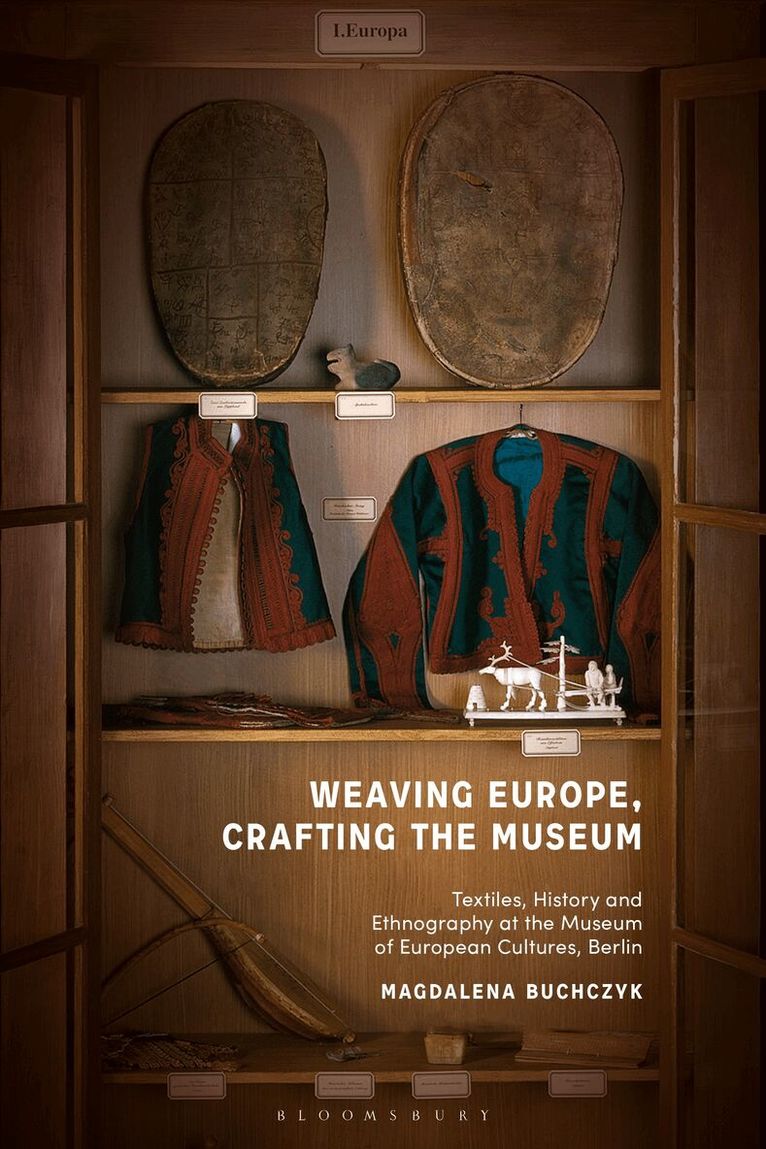
Weaving Europe, Crafting the Museum
Textiles, history and ethnography at the Museum of European Cultures, Berlin
Inbunden, Engelska, 2023
1 242 kr
Skickas inom 5-8 vardagar
Weaving Europe, Crafting the Museum delves into the history and the changing material culture in Europe through the stories of a basket, a carpet, a waistcoat, a uniform, and a dress. The focus on the objects from the collection of the Museum of European Cultures in Berlin offers an innovative and challenging way of understanding textile culture and museums. The book shows that textiles can be simultaneously used as the material object of research, and as a lens through which we can view museums. In doing so, the book fills a major gap by placing textile knowledge back into the museum.Each chapter focuses on one object story and can be read individually. Swooping from 19th-century wax figure cabinets, Nazi-era collections, Cold War exhibitions in East and West Berlin, and institutional reshuffling after German unification, it reveals the dramatically changing story of the museum and its collection. Based on research with museum curators, makers and users of the textiles in Italy and Germany, Poland and Romania, the book provides intimate insights into how objects are mobilised to very different social and political effects. It sheds new light on movements across borders, political uses of textiles by fascist and communist regimes, the objects’ fall into oblivion, as well as their heritage and tourist afterlives. Addressing this complex museum legacy, the book suggests new pathways to prefigure the future.Featuring new archival and ethnographic research, evocative examples and images, it is an essential read for students of textile and material culture, museum and curatorial studies as well as anyone interested in history, heritage and craft.
Weaving Europe, Crafting the Museum
Textiles, history and ethnography at the Museum of European Cultures, Berlin
Häftad, Engelska, 2024
411 kr
Skickas inom 10-15 vardagar
Weaving Europe, Crafting the Museum delves into the history and the changing material culture in Europe through the stories of a basket, a carpet, a waistcoat, a uniform, and a dress. The focus on the objects from the collection of the Museum of European Cultures in Berlin offers an innovative and challenging way of understanding textile culture and museums. The book shows that textiles can be simultaneously used as the material object of research, and as a lens through which we can view museums. In doing so, the book fills a major gap by placing textile knowledge back into the museum.Each chapter focuses on one object story and can be read individually. Swooping from 19th-century wax figure cabinets, Nazi-era collections, Cold War exhibitions in East and West Berlin, and institutional reshuffling after German unification, it reveals the dramatically changing story of the museum and its collection. Based on research with museum curators, makers and users of the textiles in Italy and Germany, Poland and Romania, the book provides intimate insights into how objects are mobilised to very different social and political effects. It sheds new light on movements across borders, political uses of textiles by fascist and communist regimes, the objects’ fall into oblivion, as well as their heritage and tourist afterlives. Addressing this complex museum legacy, the book suggests new pathways to prefigure the future.Featuring new archival and ethnographic research, evocative examples and images, it is an essential read for students of textile and material culture, museum and curatorial studies as well as anyone interested in history, heritage and craft.
1 292 kr
Kommande
885 kr
Kommande

Counter-Cartographies of Trace
Theoretical, Methodological and Ethical Approaches Across Disciplines
Häftad, Engelska, 2026
843 kr
Kommande
This volume provides a road map for a new field of transdisciplinary Traces Studies. Based on four years of collaborative, interdisciplinary research, it adopts an experimental approach to traces. In a world marked by layered forms of violence - political, economic, social, and environmental - the contributions offer a vital and timely intervention. Instead of searching for lost or silenced histories, they turn to counter-cartography: a radical practice where gaps, absences, and fragments become powerful sites of possibility. In this way, the authors seek to open space for speculation, incompleteness and the possibility of imagining: What might it be like - or feel like - to move through fractured, uncertain worlds guided by traces? How might we reimagine complex social realities and contested terrains through what remains? And what new possibilities might emerge from the act of tracing?First articulation of Traces StudiesOpens fresh pathways for engaging with the legacies of violence, the climate crisis, technological change, imperial histories, and everyday practices of resistanceFeaturing contributions from academic and artistic, non-academic voices