Manfred Droste - Böcker
Visar alla böcker från författaren Manfred Droste. Handla med fri frakt och snabb leverans.
6 produkter
6 produkter
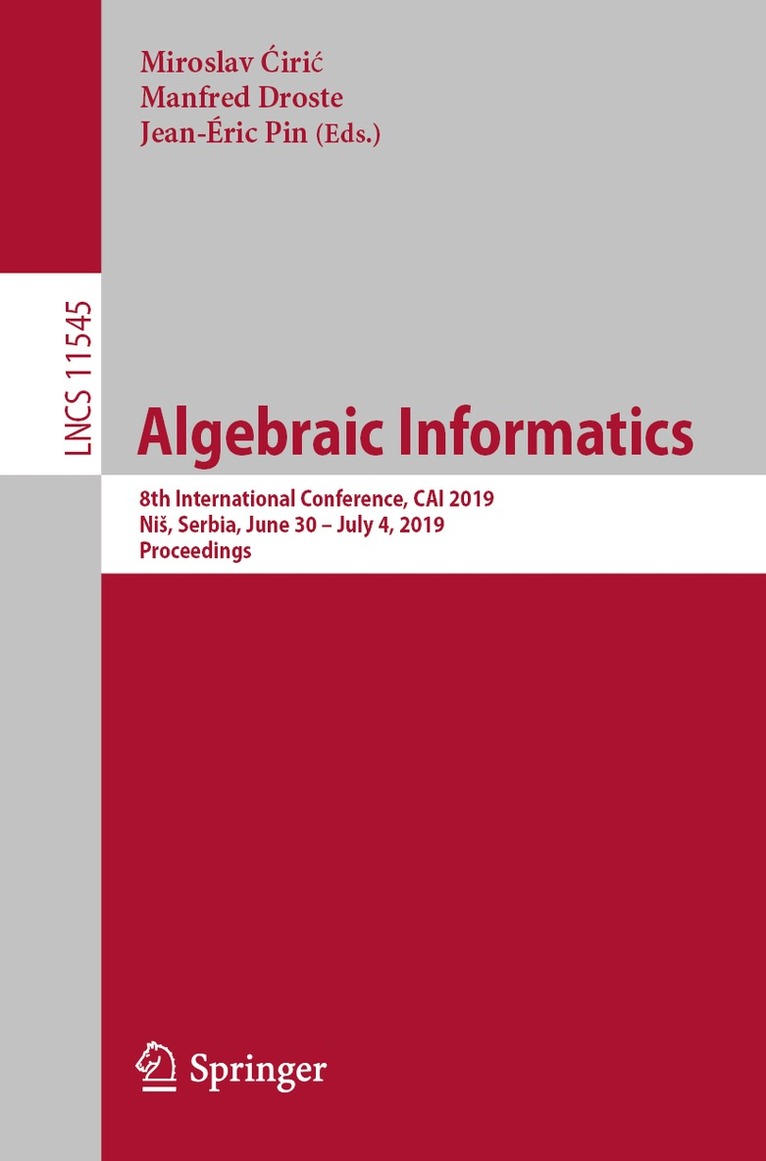
Del 11545 - Lecture Notes in Computer Science
Algebraic Informatics
8th International Conference, CAI 2019, Niš, Serbia, June 30–July 4, 2019, Proceedings
Häftad, Engelska, 2019
538 kr
Skickas inom 10-15 vardagar
This book constitutes the refereed proceedings of the 8th International Conference on Algebraic Informatics, CAI 2019, held in Niš, Serbia, in June/July 2019. The 20 revised papers presented were carefully reviewed and selected from 35 submissions. The papers present research at the intersection of theoretical computer science, algebra, and related areas. They report original unpublished research and cover a broad range of topics from automata theory and logic, cryptography and coding theory, computer algebra, design theory, natural and quantum computation, and related areas.
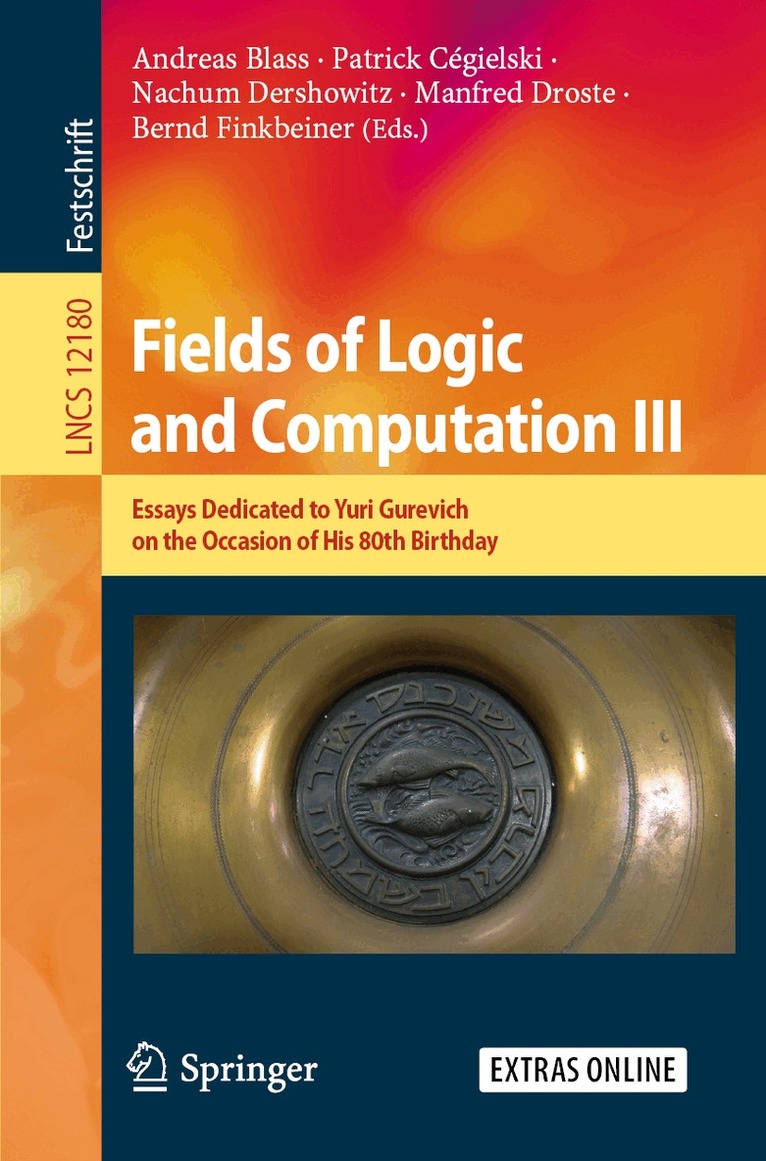
Del 12180 - Lecture Notes in Computer Science
Fields of Logic and Computation III
Essays Dedicated to Yuri Gurevich on the Occasion of His 80th Birthday
Häftad, Engelska, 2020
554 kr
Skickas inom 10-15 vardagar
This Festschrift is published in honor of Yuri Gurevich’s 80th birthday. An associated conference, YuriFest 2020, was planned for May 18–20 in Fontainebleau, France, in combination with the 39th Journées sur les Arithmétiques Faibles also celebrating Yuri’s 80th birthday.
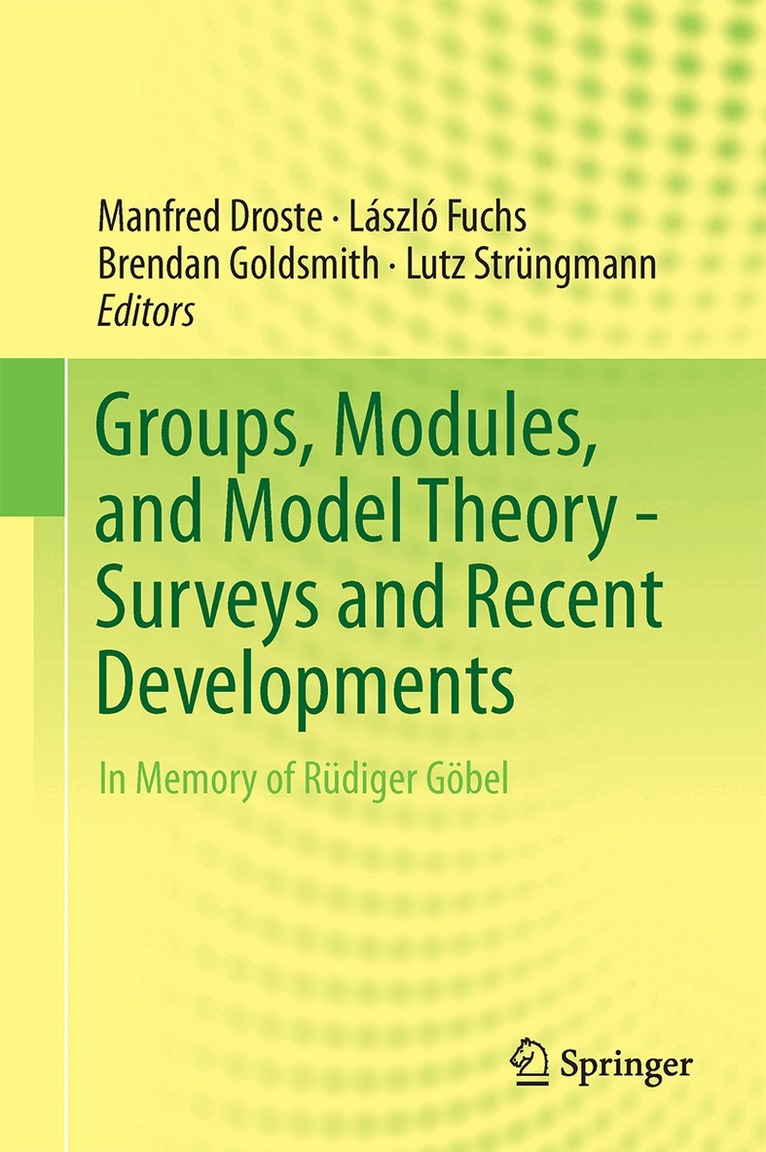
Groups, Modules, and Model Theory - Surveys and Recent Developments
In Memory of Rüdiger Göbel
Inbunden, Engelska, 2017
1 069 kr
Skickas inom 10-15 vardagar
This volume focuses on group theory and model theory with a particular emphasis on the interplay of the two areas. The survey papers provide an overview of the developments across group, module, and model theory while the research papers present the most recent study in those same areas. With introductory sections that make the topics easily accessible to students, the papers in this volume will appeal to beginning graduate students and experienced researchers alike. As a whole, this book offers a cross-section view of the areas in group, module, and model theory, covering topics such as DP-minimal groups, Abelian groups, countable 1-transitive trees, and module approximations. The papers in this book are the proceedings of the conference “New Pathways between Group Theory and Model Theory,” which took place February 1-4, 2016, in Mülheim an der Ruhr, Germany, in honor of the editors’ colleague Rüdiger Göbel. This publication is dedicated to Professor Göbel, who passed away in 2014. He was one of the leading experts in Abelian group theory.
Groups, Modules, and Model Theory - Surveys and Recent Developments
In Memory of Rüdiger Göbel
Häftad, Engelska, 2018
1 069 kr
Skickas inom 10-15 vardagar
This volume focuses on group theory and model theory with a particular emphasis on the interplay of the two areas. The survey papers provide an overview of the developments across group, module, and model theory while the research papers present the most recent study in those same areas. With introductory sections that make the topics easily accessible to students, the papers in this volume will appeal to beginning graduate students and experienced researchers alike. As a whole, this book offers a cross-section view of the areas in group, module, and model theory, covering topics such as DP-minimal groups, Abelian groups, countable 1-transitive trees, and module approximations. The papers in this book are the proceedings of the conference “New Pathways between Group Theory and Model Theory,” which took place February 1-4, 2016, in Mülheim an der Ruhr, Germany, in honor of the editors’ colleague Rüdiger Göbel. This publication is dedicated to Professor Göbel, who passed away in 2014. He was one of the leading experts in Abelian group theory.
2 426 kr
Skickas inom 10-15 vardagar
The purpose of this Handbook is to highlight both theory and applications of weighted automata. Weighted finite automata are classical nondeterministic finite automata in which the transitions carry weights. These weights may model, e. g. , the cost involved when executing a transition, the amount of resources or time needed for this,or the probability or reliability of its successful execution. The behavior of weighted finite automata can then be considered as the function (suitably defined) associating with each word the weight of its execution. Clearly, weights can also be added to classical automata with infinite state sets like pushdown automata; this extension constitutes the general concept of weighted automata. To illustrate the diversity of weighted automata, let us consider the following scenarios. Assume that a quantitative system is modeled by a classical automaton in which the transitions carry as weights the amount of resources needed for their execution. Then the amount of resources needed for a path in this weighted automaton is obtained simply as the sum of the weights of its transitions. Given a word, we might be interested in the minimal amount of resources needed for its execution, i. e. , for the successful paths realizing the given word. In this example, we could also replace the “resources” by “profit” and then be interested in the maximal profit realized, correspondingly, by a given word.
2 183 kr
Skickas inom 5-8 vardagar
The purpose of this Handbook is to highlight both theory and applications of weighted automata. Weighted finite automata are classical nondeterministic finite automata in which the transitions carry weights. These weights may model, e. g. , the cost involved when executing a transition, the amount of resources or time needed for this,or the probability or reliability of its successful execution. The behavior of weighted finite automata can then be considered as the function (suitably defined) associating with each word the weight of its execution. Clearly, weights can also be added to classical automata with infinite state sets like pushdown automata; this extension constitutes the general concept of weighted automata. To illustrate the diversity of weighted automata, let us consider the following scenarios. Assume that a quantitative system is modeled by a classical automaton in which the transitions carry as weights the amount of resources needed for their execution. Then the amount of resources needed for a path in this weighted automaton is obtained simply as the sum of the weights of its transitions. Given a word, we might be interested in the minimal amount of resources needed for its execution, i. e. , for the successful paths realizing the given word. In this example, we could also replace the “resources” by “profit” and then be interested in the maximal profit realized, correspondingly, by a given word.