Werner Kuich - Böcker
Visar alla böcker från författaren Werner Kuich. Handla med fri frakt och snabb leverans.
5 produkter
5 produkter
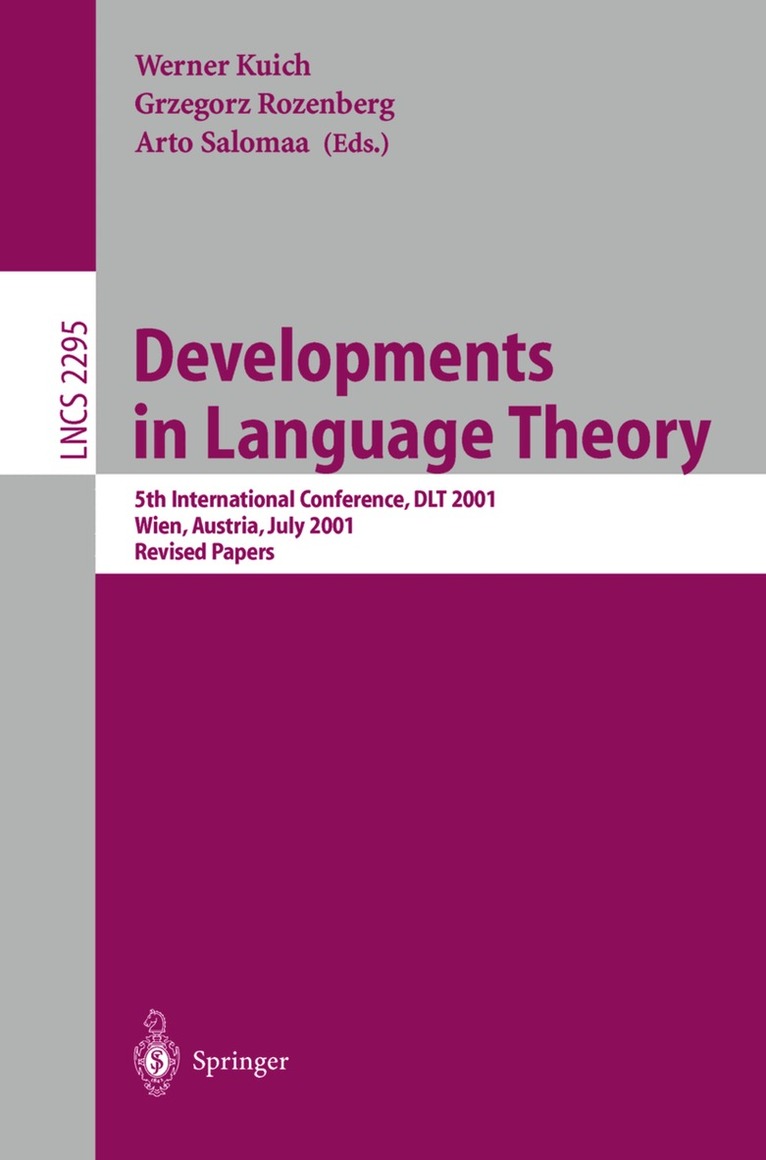
Developments in Language Theory
5th International Conference, DLT 2001, Vienna, Austria, July 16-21, 2001. Revised Papers
Häftad, Engelska, 2002
535 kr
Skickas inom 10-15 vardagar
DLT 2001 was the ?fth Conference on Developments in Language Theory. It was a broadly based conference covering all aspects of Language Theory: grammars and - ceptorsforstrings,graphs,arrays,etc.;ef?cientalgorithmsforlanguages;combinatorial andalgebraicpropertiesoflanguages;decisionproblems;relationstocomplexitytheory; logic; picture description and analysis; DNA computing; cryptography; concurrency. DLT 2001 was held at Technische Universitat .. Wien from July 16 to July 21, 2001. The OrganizingCommitteeconsistedofRudolfFreund,WernerKuich(chairman),Christiane Nikoll, Margarethe Soukup, Friedrich Urbanek. Previous DLTs were held in Turku (1993), Magdeburg (1995), Thessalonike (1997), Aachen (1999). The Program Committee of DLT 2001 consisted of Christian Choffrut (Paris), J.. urgen Dassow (Magdeburg), Masami Ito (Kyoto), Werner Kuich (Wien, chairman),GiancarloMauri(Milano),GheorghePaun ? (Bucuresti), , GrzegorzRozenberg (Leiden), Arto Salomaa (Turku), Wolfgang Thomas (Aachen). It selected 24 papers from 64 papers submitted in response to the call for papers.These papers came from the following countries: Australia, Austria, Belgium, Brazil, Bulgaria, Canada, Czech Republic, Estonia, Finland, France, Germany, Hungary, India, Italy, Japan, Moldova, The Netherlands, Phillipines, Poland, Romania, Russia, Slovakia, Spain, United Kingdom, USA. Each submitted paper was evaluated by at least four members of the Program Committee. Together with 10 invited presentations all 24 selected papers are contained in this volume. The papers in this volume are printed according to the order of presentation at DLT 2001 and thus grouped into sessions, most of which are thematic. It is a pleasure for the editors to thank the members of the Program Committee for the evaluation of the papers, and the many referees who assisted in this process.
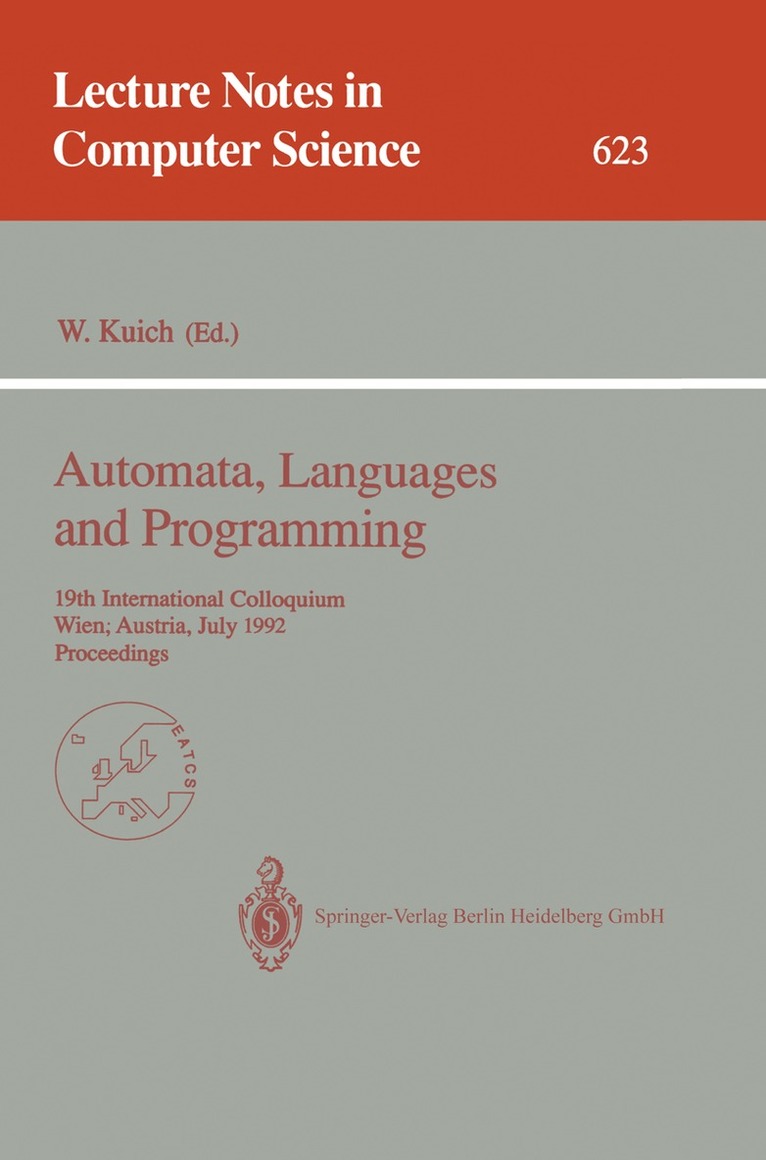
Automata, Languages and Programming
19th International Colloquium, Wien, Austria, July 13-17, 1992. Proceedings
Häftad, Engelska, 1992
1 095 kr
Skickas inom 10-15 vardagar
This volume presents the proceedings of the 19th International Colloquium on Automata, Languages, and Programming (ICALP 92) in a series of meetings sponsored by the European Association for Theoretical Computer Science (EATCS). ICALP is a broadly based conference covering all aspects of theoretical computer science, including such topics as computability, automata, formal languages, term rewriting, analysis of algorithms, computational geometry, computational complexity, symbolic and algebraic computation, cryptography, data types and data structures, theory of databases and knowledge bases, semantics of programming languages, program specification, transformation and verification, foundations of logic programming, theory of logical design and layout, parallel and distributed computation, theory of concurrency and theory of robotics. The papers in the volume are grouped into thematic parts corresponding to their order of presentation at ICALP 92.
2 414 kr
Skickas inom 10-15 vardagar
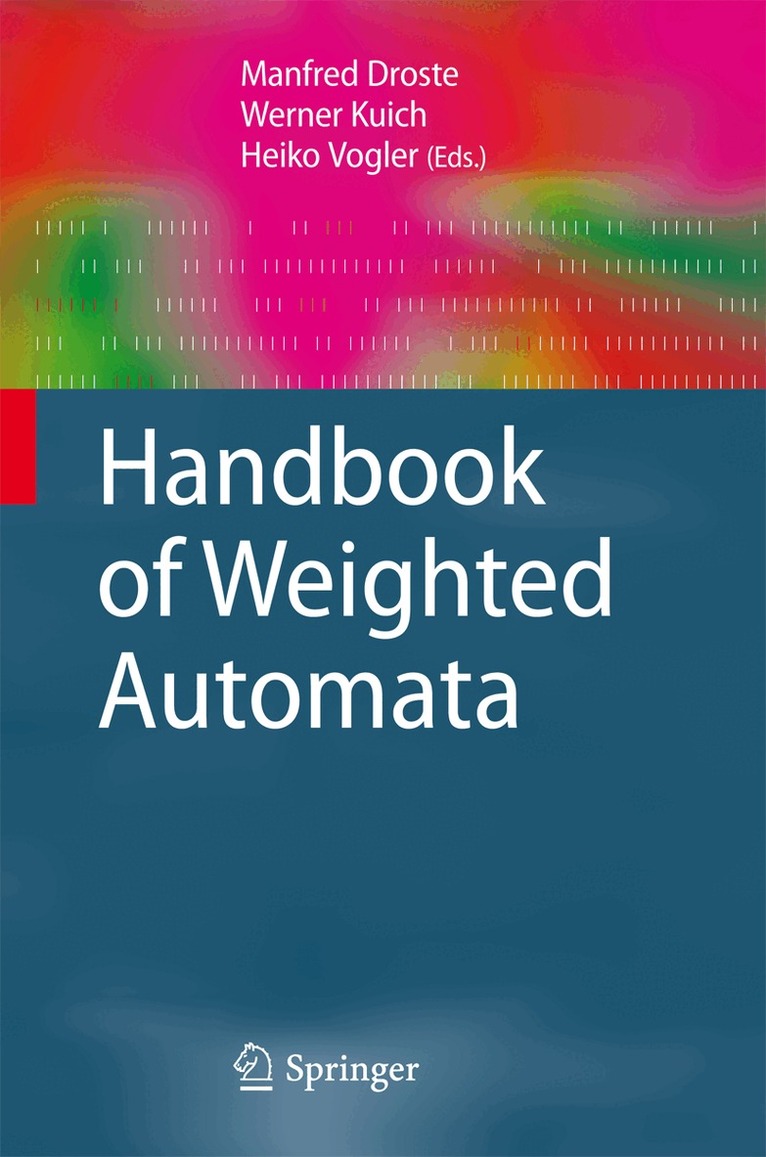
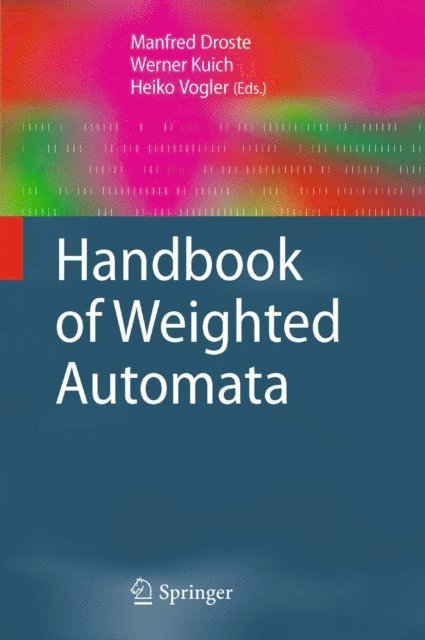
The purpose of this Handbook is to highlight both theory and applications of weighted automata. Weighted finite automata are classical nondeterministic finite automata in which the transitions carry weights. These weights may model, e. g. , the cost involved when executing a transition, the amount of resources or time needed for this,or the probability or reliability of its successful execution. The behavior of weighted finite automata can then be considered as the function (suitably defined) associating with each word the weight of its execution. Clearly, weights can also be added to classical automata with infinite state sets like pushdown automata; this extension constitutes the general concept of weighted automata. To illustrate the diversity of weighted automata, let us consider the following scenarios. Assume that a quantitative system is modeled by a classical automaton in which the transitions carry as weights the amount of resources needed for their execution. Then the amount of resources needed for a path in this weighted automaton is obtained simply as the sum of the weights of its transitions. Given a word, we might be interested in the minimal amount of resources needed for its execution, i. e. , for the successful paths realizing the given word. In this example, we could also replace the “resources” by “profit” and then be interested in the maximal profit realized, correspondingly, by a given word.
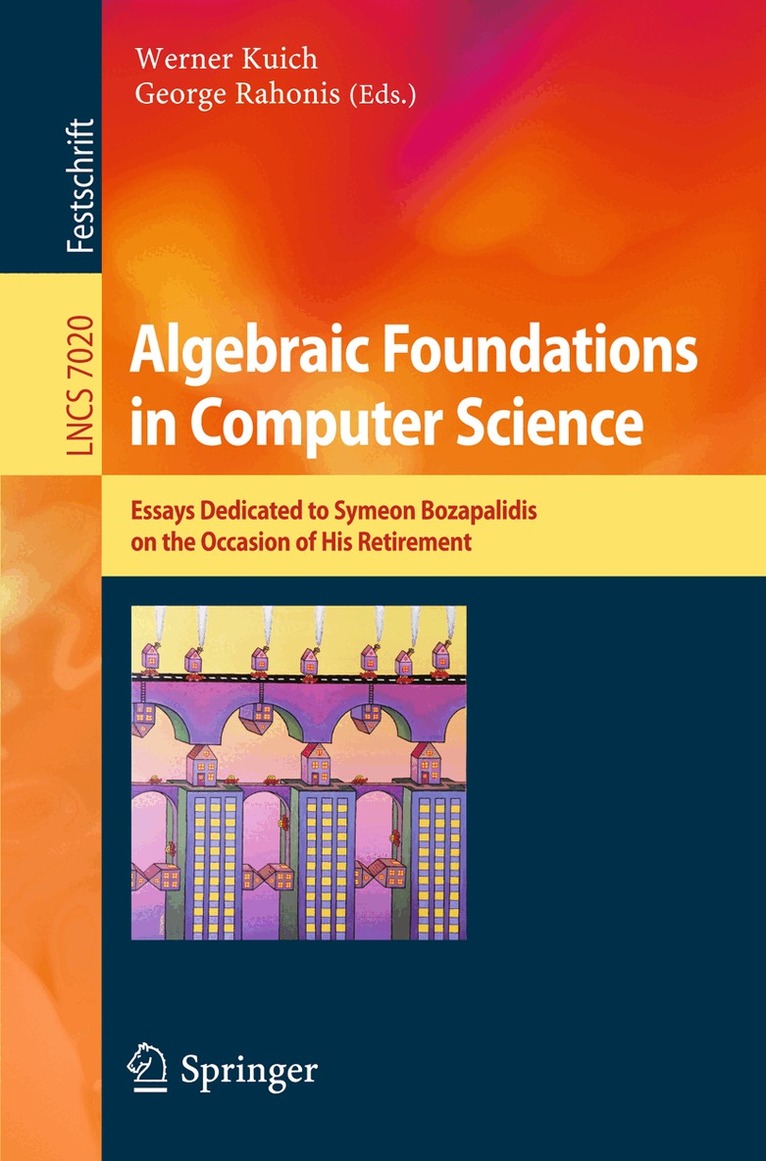
Algebraic Foundations in Computer Science
Essays Dedicated to Symeon Bozapalidis on the Occasion of His Retirement
Häftad, Engelska, 2011
551 kr
Skickas inom 10-15 vardagar
This Festschrift volume, published in honor of Symeon Bozapalidis on the occasion of his retirement after more than 35 years of teaching activity, focuses on the subjects taught by Symeon, namely: algebra, linear algebra, mathematical logic, number theory, automata theory, tree languages and series, algebraic semantics, and fuzzy languages. Since 1982 -- at the Aristotle University of Thessaloniki -- Symeon's main interests have been closely connected with the algebraic foundations in computer science. In particular, he contributed to the development of the theory of tree languages and series, the axiomatization of graphs, picture theory, and fuzzy languages.The volume contains 15 invited papers, written by colleagues, friends, and students of Symeon. All of the papers were carefully refereed and are connected to his research topics. Most of the papers were presented at the Workshop on Algebraic Foundations in Computer Science, held in Thessaloniki, Greece, during November 7--8, 2011.
2 183 kr
Skickas inom 5-8 vardagar
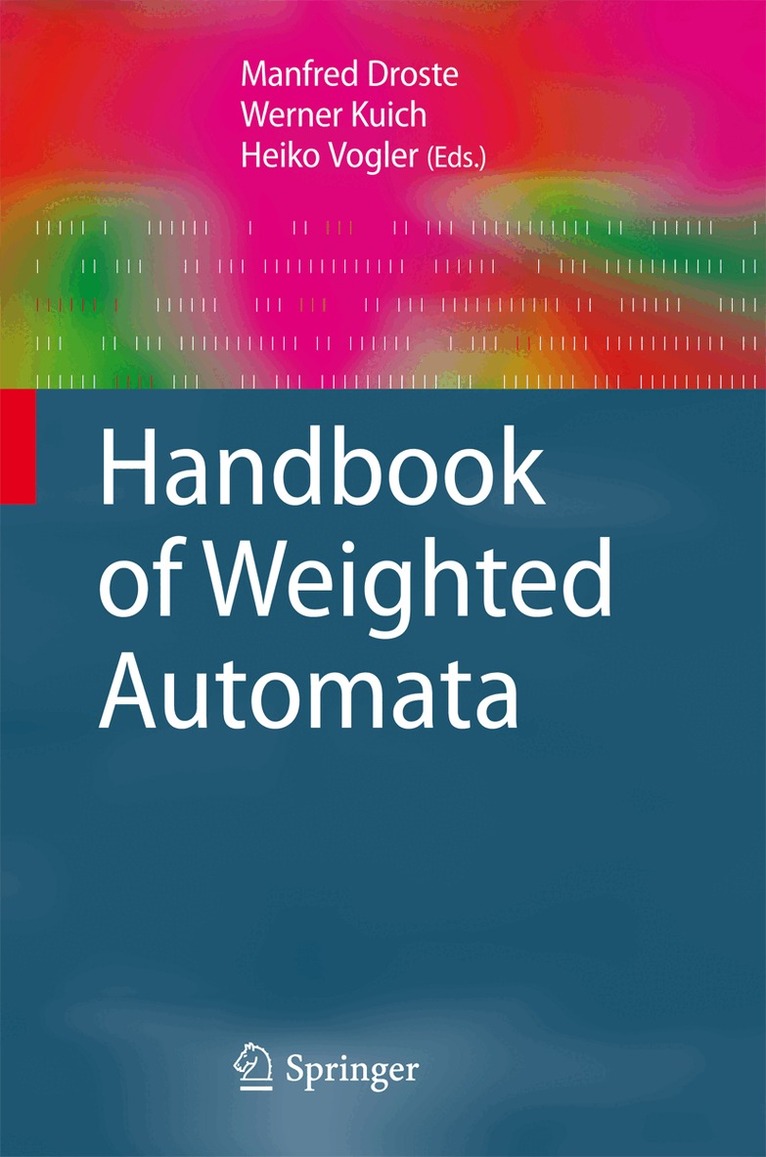
The purpose of this Handbook is to highlight both theory and applications of weighted automata. Weighted finite automata are classical nondeterministic finite automata in which the transitions carry weights. These weights may model, e. g. , the cost involved when executing a transition, the amount of resources or time needed for this,or the probability or reliability of its successful execution. The behavior of weighted finite automata can then be considered as the function (suitably defined) associating with each word the weight of its execution. Clearly, weights can also be added to classical automata with infinite state sets like pushdown automata; this extension constitutes the general concept of weighted automata. To illustrate the diversity of weighted automata, let us consider the following scenarios. Assume that a quantitative system is modeled by a classical automaton in which the transitions carry as weights the amount of resources needed for their execution. Then the amount of resources needed for a path in this weighted automaton is obtained simply as the sum of the weights of its transitions. Given a word, we might be interested in the minimal amount of resources needed for its execution, i. e. , for the successful paths realizing the given word. In this example, we could also replace the “resources” by “profit” and then be interested in the maximal profit realized, correspondingly, by a given word.