Marek Czachor - Böcker
Visar alla böcker från författaren Marek Czachor. Handla med fri frakt och snabb leverans.
3 produkter
3 produkter
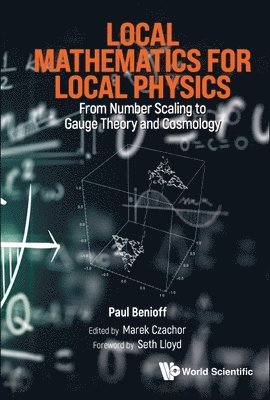
Local Mathematics For Local Physics: From Number Scaling To Guage Theory And Cosmology
Inbunden, Engelska, 2024
1 370 kr
Skickas inom 3-6 vardagar
The language of the universe is mathematics, but how exactly do you know that all parts of the universe "speak" the same language? Benioff builds on the idea that the entity that gives substance to both mathematics and physics is the fundamental field, called the "value field". While exploring this idea, he notices the similarities that the value field shares with several mysterious phenomena in modern physics: the Higgs field, and dark energy.The author first introduces the concept of the value field and uses it to reformulate the basic framework of number theory, calculus, and vector spaces and bundles. The book moves on to find applications to classical field theory, quantum mechanics and gauge theory. The last two chapters address the relationship between theory and experiment, and the possible physical consequences of both the existence and non-existence of the value field. The book is open-ended, and the list of open questions is certainly longer than the set of proposed answers.Paul Benioff, a pioneer in the field of quantum computing and the author of the first quantum-mechanical description of the Turing machine, devoted the last few years of his life to developing a universal description in which mathematics and physics would be on equal footing. He died on March 29, 2022, his work nearly finished. The final editing was undertaken by Marek Czachor who, in the editorial afterword, attempts to place the author's work in the context of a shift in the scientific paradigm looming on the horizon.
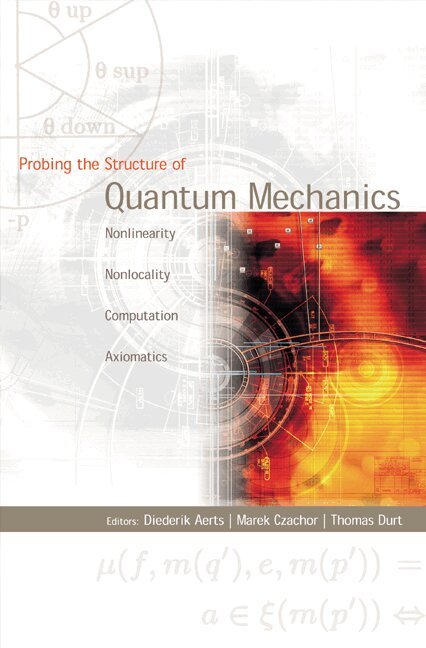
Probing The Structure Of Quantum Mechanics: Nonlinearity, Nonlocality, Computation And Axiomatics
Inbunden, Engelska, 2002
1 617 kr
Tillfälligt slut
During the last decade, scientists working in quantum theory have been engaging in promising new fields such as quantum computation and quantum information processing, and have also been reflecting on the possibilities of nonlinear behavior on the quantum level. These are challenging undertakings because (1) they will result in new solutions to important technical and practical problems that were unsolvable by the classical approaches (for example, quantum computers can calculate problems that are intractable if one uses classical computers); and (2) they open up new 'hard' problems of a fundamental nature that touch the foundation of quantum theory itself (for example, the contradiction between locality and nonlinearity and the interpretation of quantum computing as a universal process).In this book, one can distinguish two main streams of research to approach the just-mentioned problem field: (1) a theoretical structural part, which concentrates on the elaboration of a nonlinear quantum mechanics and the fundamentals of quantum computation; and (2) a theoretical experimental part, which focuses on the theoretical aspects of applications that arise from new technology and novel research perspectives such as quantum optics and quantum cryptography. Particular attention is also paid to the measurement problem, the classical limit and alternative interpretations (such as the hidden measurement approach).
2 686 kr
Skickas inom 3-6 vardagar
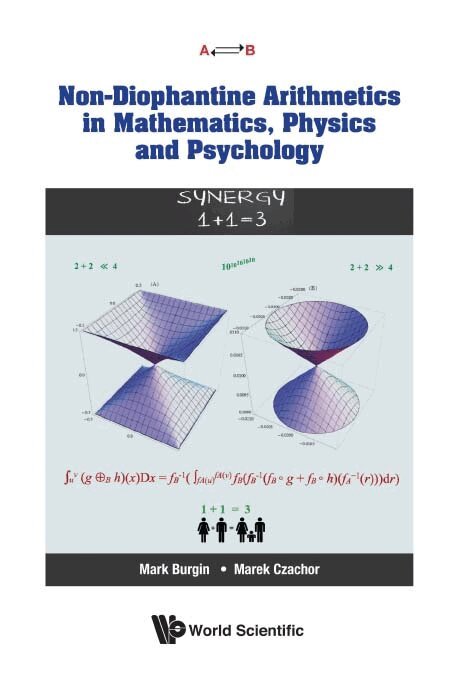
For a long time, all thought there was only one geometry — Euclidean geometry. Nevertheless, in the 19th century, many non-Euclidean geometries were discovered. It took almost two millennia to do this. This was the major mathematical discovery and advancement of the 19th century, which changed understanding of mathematics and the work of mathematicians providing innovative insights and tools for mathematical research and applications of mathematics.A similar event happened in arithmetic in the 20th century. Even longer than with geometry, all thought there was only one conventional arithmetic of natural numbers — the Diophantine arithmetic, in which 2+2=4 and 1+1=2. It is natural to call the conventional arithmetic by the name Diophantine arithmetic due to the important contributions to arithmetic by Diophantus. Nevertheless, in the 20th century, many non-Diophantine arithmetics were discovered, in some of which 2+2=5 or 1+1=3. It took more than two millennia to do this. This discovery has even more implications than the discovery of new geometries because all people use arithmetic.This book provides a detailed exposition of the theory of non-Diophantine arithmetics and its various applications. Reading this book, the reader will see that on the one hand, non-Diophantine arithmetics continue the ancient tradition of operating with numbers while on the other hand, they introduce extremely original and innovative ideas.