Margaret Burchinal – författare
Visar alla böcker från författaren Margaret Burchinal. Handla med fri frakt och snabb leverans.
2 produkter
2 produkter
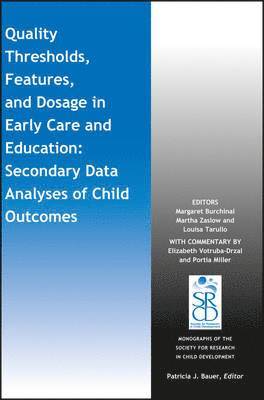
Quality Thresholds, Features, and Dosage in Early Care and Education
Secondary Data Analyses of Child Outcomes
Häftad, Engelska, 2016
428 kr
Skickas inom 7-10 vardagar
The questions of whether preschool children benefi t more strongly when early care and education (ECE) is at or above a threshold of quality, has specifi c quality features, and/or is of longer duration were examined in secondary data analyses of eight large ECE studies. These issues are pivotal in recent ECE policies designed to improve school readiness skills, especially for children from low-income families. Threshold analyses examined whether quality had stronger associations with gains in child outcomes in settings with high levels of quality than those with lower quality. Features analyses considered whether specific measures of instruction and of teacher-child interaction were more predictive of gains than global quality measures. Dosage analyses tested whether the amount of in ECE settings or in instruction in specific content areas predicted child outcomes. Threshold analyses provided some evidence for thresholds in measures of instructional quality in relation to reading and language skills in meta-analyses based on a prior-selected cut-points and, less clearly, in empirical methods designed to identify cut-points. Analyses examining quality features indicated stronger prediction of gains in child outcomes from interaction-specific and content-specific measures than from global measures. Propensity score analyses indicated that children had higher school readiness skills at the end of preschool and in kindergarten if they had two years of Head Start compared to one year. Finally, dosage analyses indicated that children showed larger gains in content areas when teachers spent more time providing instruction in those areas or when children had fewer absences. No evidence of quality by quantity interactions emerged. Implications of the thresholds findings for ECE policies such as Quality Rating and Improvement Systems are discussed. The dosage findings support the growing trend toward more than one year of access to publicly funded preschool programs for low-income children as well as increased focus on the content of ECE activities and instruction to enhance language, literacy, and math skills.
Best Practices in Quantitative Methods for Developmentalists, Volume 71, Number 3
Häftad, Engelska, 2006
415 kr
Tillfälligt slut
The role of quantitative methods in testing developmental hypotheses is widely recognized, yet even very experienced quantitative researchers often lack the knowledge required for good decision-making on methodology. The end result is a disconnect between research and practice in methods. The purpose of this monograph is to fill a gap in the literature by offering a series of overviews on common data-analytic issues of particular interest to researchers in child development. Our hope is that this monograph will make already developed methods accessible to developmentalists so they can understand and use them in their research. We start at the beginning with chapters on data management and measurement, two neglected topics in methods training despite the fact that every investigation should begin with proper consideration of each. We follow with two important topics for developmental research, missing data and growth modeling. Missing data can plague developmental work because participants sometimes miss one or more assessment points. Growth modeling methods offer researchers a true means to assess change over time as compared with cruder methods like difference scores and residualized change scores. Then comes a discussion of mediation and moderation, two tools that can be used to elucidate developmental processes. Because so much developmental science is non-experimental, we include a chapter on selection bias that compares five modeling strategies. Proper attention to data management, measurement, missing data, growth modeling (whenever possible), mediation and moderation, and potential selection bias is guaranteed to result in greater precision in inference-making. Even when researchers make good decisions about methods, it is critical for them to use good judgment about the practical importance of findings, so we conclude with this important discussion. We view this monograph as a first step to getting quantitative researchers started and we believe this reference will help researchers make better-informed decisions about methodology.