Margareta Ingrid Christian – författare
Visar alla böcker från författaren Margareta Ingrid Christian. Handla med fri frakt och snabb leverans.
3 produkter
3 produkter
406 kr
Skickas inom 7-10 vardagar
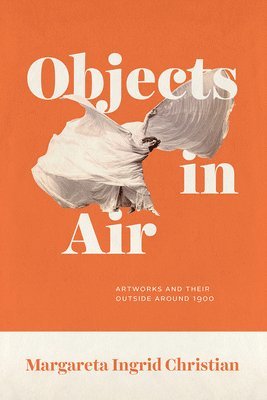
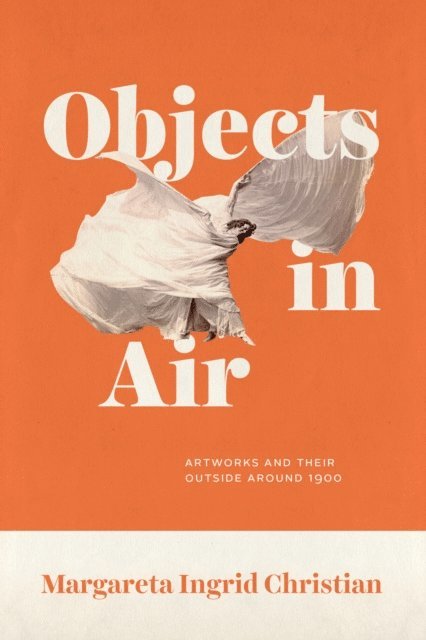
Margareta Ingrid Christian unpacks the ways in which, around 1900, art scholars, critics, and choreographers wrote about the artwork as an actual object in real time and space, surrounded and fluently connected to the viewer through the very air we breathe. Theorists such as Aby Warburg, Alois Riegl, Rainer Maria Rilke, and the choreographer Rudolf Laban drew on the science of their time to examine air as the material space surrounding an artwork, establishing its “milieu,” “atmosphere,” or “environment.” Christian explores how the artwork’s external space was seen to work as an aesthetic category in its own right, beginning with Rainer Maria Rilke’s observation that Rodin’s sculpture “exhales an atmosphere” and that Cezanne’s colors create “a calm, silken air” that pervades the empty rooms where the paintings are exhibited.Writers created an early theory of unbounded form that described what Christian calls an artwork’s ecstasis or its ability to stray outside its limits and engender its own space. Objects viewed in this perspective complicate the now-fashionable discourse of empathy aesthetics, the attention to self-projecting subjects, and the idea of the modernist self-contained artwork. For example, Christian invites us to historicize the immersive spatial installations and “environments” that have arisen since the 1960s and to consider their origins in turn-of-the-twentieth-century aesthetics. Throughout this beautifully written work, Christian offers ways for us to rethink entrenched narratives of aesthetics and modernism and to revisit alternatives.
Milieus of Minutiae
Contextualizing the Small in Literature, Philosophy, and Science
Inbunden, Engelska, 2024
1 484 kr
Skickas inom 10-15 vardagar
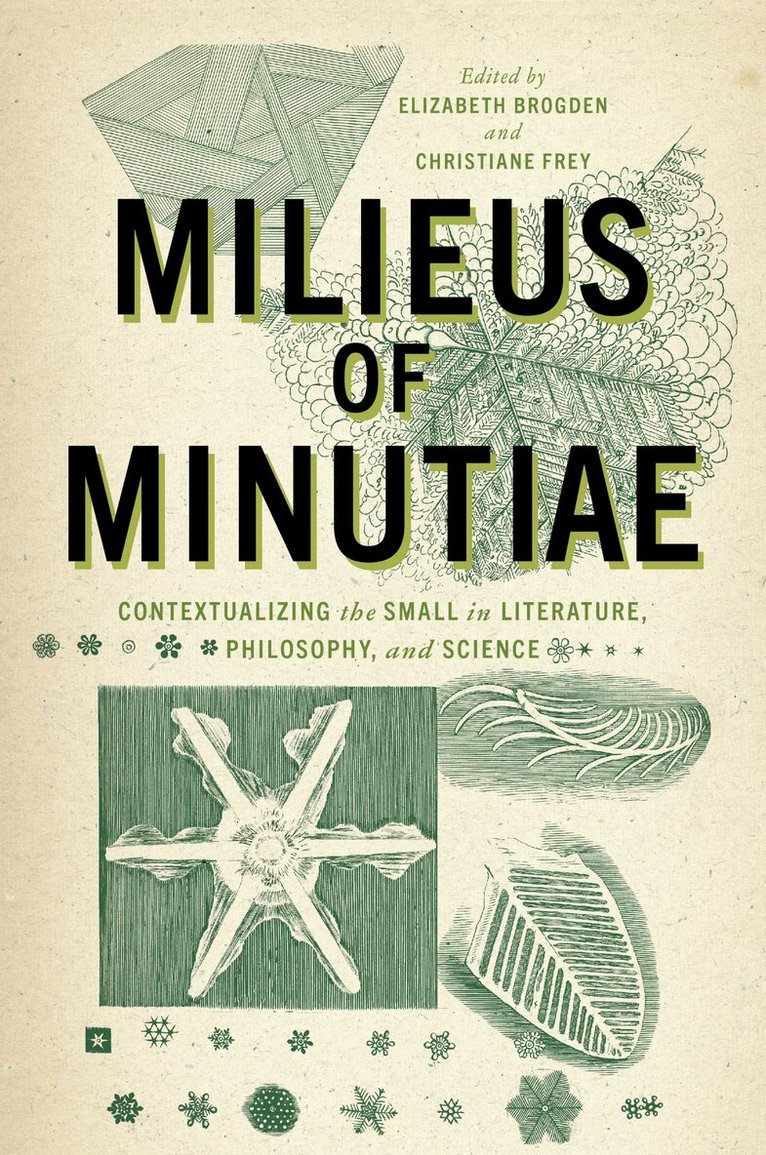
The long history of tiny matter(s) in the sciences, thought, and cultureFrom catastrophic weather and steady warming caused by the accumulation of carbon particles in the Earth’s atmosphere to societies brought to a standstill by microscopic viruses, the new millennium has reminded us of how the minutest of phenomena can have outsized effects. This notion is one that has preoccupied the European and Anglo-American cultural imaginary since at least early modernity.Milieus of Minutiae brings together an interdisciplinary group of scholars to investigate various forms and appearances of minutiae prior to and beyond the advent of magnification. The collection illuminates connections between the empirical practices and technologies with which minutiae have come to be associated and the broader, more diffuse discourses—from the philosophical to the artistic—that have attended theories of smallness before and after Hooke’s Micrographia. Placing essays on Renaissance poetry, Romantic fiction, and matters of punctuation alongside essays on early modern germ theory and the optics of microscopic technology, this rigorously framed volume extends from sixteenth-century pathology to twentieth-century architectural theory, natural science to literature and art.
Milieus of Minutiae
Contextualizing the Small in Literature, Philosophy, and Science
Häftad, Engelska, 2024
469 kr
Skickas inom 10-15 vardagar
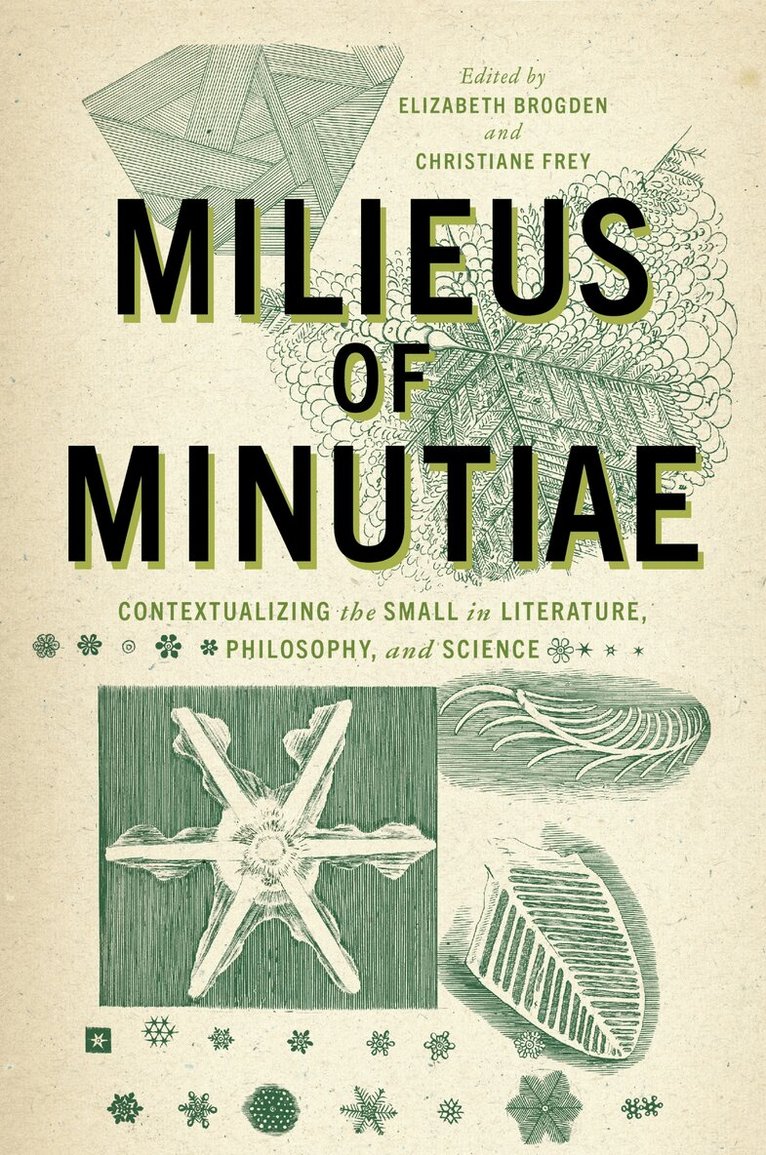
The long history of tiny matter(s) in the sciences, thought, and cultureFrom catastrophic weather and steady warming caused by the accumulation of carbon particles in the Earth’s atmosphere to societies brought to a standstill by microscopic viruses, the new millennium has reminded us of how the minutest of phenomena can have outsized effects. This notion is one that has preoccupied the European and Anglo-American cultural imaginary since at least early modernity.Milieus of Minutiae brings together an interdisciplinary group of scholars to investigate various forms and appearances of minutiae prior to and beyond the advent of magnification. The collection illuminates connections between the empirical practices and technologies with which minutiae have come to be associated and the broader, more diffuse discourses—from the philosophical to the artistic—that have attended theories of smallness before and after Hooke’s Micrographia. Placing essays on Renaissance poetry, Romantic fiction, and matters of punctuation alongside essays on early modern germ theory and the optics of microscopic technology, this rigorously framed volume extends from sixteenth-century pathology to twentieth-century architectural theory, natural science to literature and art.