Maria Luz Cárdenas - Böcker
Visar alla böcker från författaren Maria Luz Cárdenas. Handla med fri frakt och snabb leverans.
4 produkter
4 produkter
2 185 kr
Skickas inom 10-15 vardagar
THIS BOOK collects together papers given at a NATO Advanced Research Workshop held at Il Ciocco (Lucca), Italy, from the 9th to the 15th April, 1989. It sets out to present the current state of understanding of the principles governing the way fluxes and concentrations are maintained and controlled in metabolic systems. Although this is a topic that has held the interest of biochemists for many years, it is only quite recently that the methods of analysing the kinetics of multi-enzyme pathways developed over the past two decades have come to be widely discussed or applied experimentally. Many biochemists remain sceptical that the new methods offer a real advance (except in complexity) over the landmark discoveries of the 1950s and 1960s relating to inhibition of enzymes at branch-points by the end products of metabolic pathways, and the interpretation of allosteric effects and cooperativity. Even those who have become convinced that the classical ideas provide only the starting point for understanding metabolic control have been by no means unanimous in their assess ment of the direction in which one should advance. In this book we have tried to include all of the current points of view, including the view that the classical theories tell us all that we need to know. We have not seen it as our role as editors to paper over the cracks that exist and to pretend that we can speak to the world with one voice.
1 096 kr
Skickas inom 10-15 vardagar
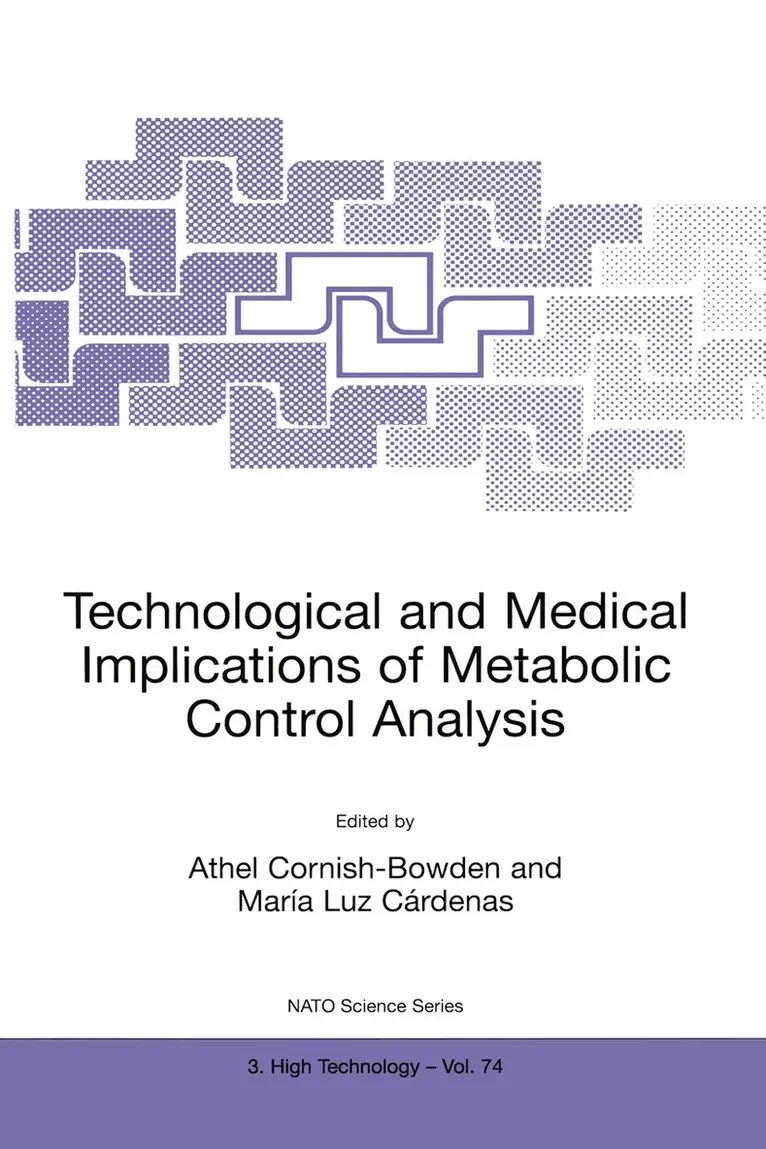
The study of multienzyme systems has advanced considerably during the 1990s. The cell is more complicated than classical biochemistry presents it; it contains more structure, and the behaviour of any system of enzymes is more elaborate than can be explained in simple terms. Nevertheless, classical enzymology and metabolism remain central to any modification of the metabolic behaviour of organisms, as attempted by modern biotechnology and drug development techniques. In this work the authors draw attention to the drawbacks, problems, and opportunities associated with this field. The areas covered include problems with current practice, the imposition of human objectives on organisms, understanding health and disease, computer modelling, the increasingly complex picture of cell structure, control and regulation of metabolism, and the general contribution metabolic control is making to biochemistry on a broader canvas.
1 096 kr
Skickas inom 10-15 vardagar
The study of multienzyme systems has advanced considerably during the 1990s. The cell is more complicated than classical biochemistry presents it; it contains more structure, and the behaviour of any system of enzymes is more elaborate than can be explained in simple terms. Nevertheless, classical enzymology and metabolism remain central to any modification of the metabolic behaviour of organisms, as attempted by modern biotechnology and drug development techniques. In this work the authors draw attention to the drawbacks, problems, and opportunities associated with this field. The areas covered include problems with current practice, the imposition of human objectives on organisms, understanding health and disease, computer modelling, the increasingly complex picture of cell structure, control and regulation of metabolism, and the general contribution metabolic control is making to biochemistry on a broader canvas.
2 185 kr
Skickas inom 10-15 vardagar
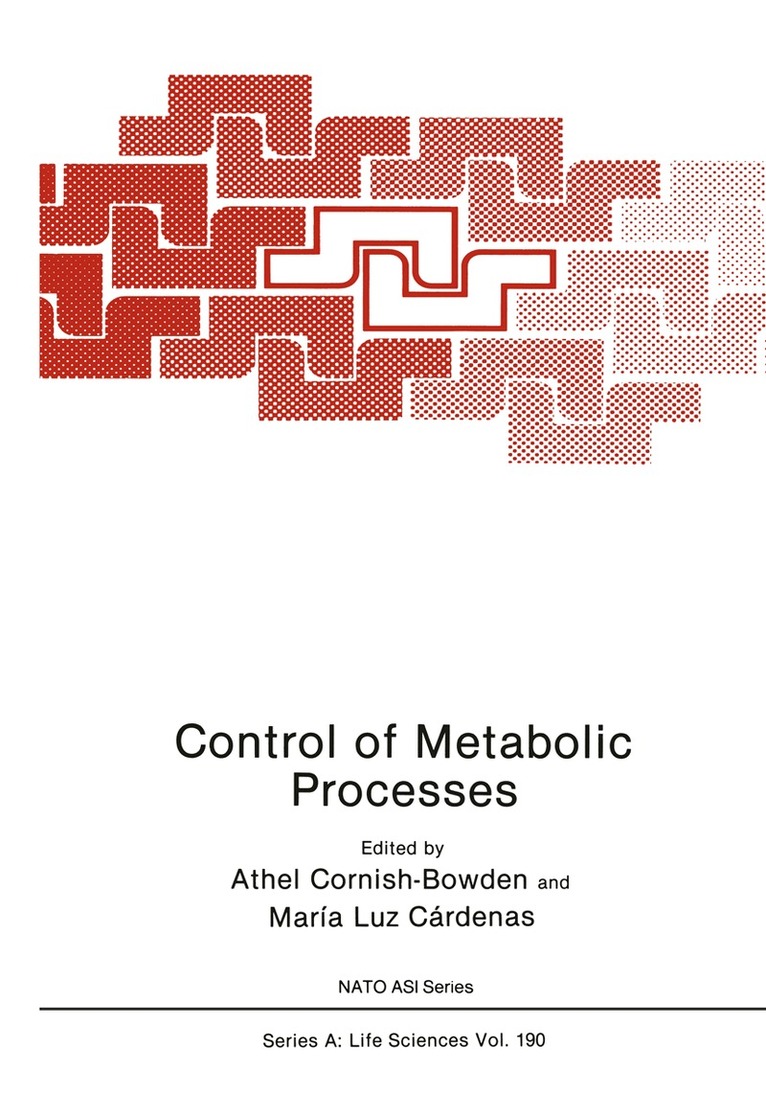
THIS BOOK collects together papers given at a NATO Advanced Research Workshop held at Il Ciocco (Lucca), Italy, from the 9th to the 15th April, 1989. It sets out to present the current state of understanding of the principles governing the way fluxes and concentrations are maintained and controlled in metabolic systems. Although this is a topic that has held the interest of biochemists for many years, it is only quite recently that the methods of analysing the kinetics of multi-enzyme pathways developed over the past two decades have come to be widely discussed or applied experimentally. Many biochemists remain sceptical that the new methods offer a real advance (except in complexity) over the landmark discoveries of the 1950s and 1960s relating to inhibition of enzymes at branch-points by the end products of metabolic pathways, and the interpretation of allosteric effects and cooperativity. Even those who have become convinced that the classical ideas provide only the starting point for understanding metabolic control have been by no means unanimous in their assess ment of the direction in which one should advance. In this book we have tried to include all of the current points of view, including the view that the classical theories tell us all that we need to know. We have not seen it as our role as editors to paper over the cracks that exist and to pretend that we can speak to the world with one voice.