• Fri frakt över 249 kr
  • •
  • Snabba leveranser
  • •
  • Billiga böcker
Kundservice

Du är på sajten för privatpersoner.

Företag, bibliotek eller offentlig verksamhet?

Du handlar på classic.bokus.com, där alla dina funktioner finns intakta.
Till classic.bokus.com
Bokus logotyp. Gå till startsidan.
  • Erbjudanden
  • Nyheter
  • Student
  • Topplistor
  • Barn & ungdom
  • Bokus Play
  • E-böcker
  • Pocketböcker
  • Spel & pussel

10% rabatt på allt med kod: NYSTART10 →

Sidfot

Mina sidor

    Hjälp

    • Kundservice
    • Vanliga frågor och svar
    • Frakt och leverans
    • Retur vid ångerrätt
    • Reklamera vara
    • Betalning
    • Köpvillkor
    • Allmänna villkor
    • Information om webbplatsens tillgänglighet

    Om Bokus

    • Om oss
    • Pressrum
    • För studenter
    • För företag
    • För bibliotek och offentlig verksamhet
    • För leverantörer
    • Hållbarhet

    Populärt

    • Aktuella erbjudanden
    • Presentkort
    • Studentlitteratur
    • Nya böcker
    • Topplistor
    • Signerade böcker
    • Engelska böcker

    Inspiration

    • Boktips
    • BookTok
    • Populära bokserier
    • Barnbokskaraktärer
    • Populära författare
    Logotyp för Bokus
    Följ oss på Facebook (extern länk)Följ oss på Instagram (extern länk)Följ oss på YouTube (extern länk)Följ oss på TikTok (extern länk)
    bokus @ CookiesAnpassa cookiesIntegritetspolicyKöpvillkor
    Till Citymail hemsida (extern länk)Till Budbee hemsida (extern länk)Till Postnord hemsida (extern länk)Till Schenker hemsida (extern länk)Till Early Bird hemsida (extern länk)Till Walleys hemsida (extern länk)
    1. Medicin
    2. Klinisk medicin och internmedicin
    3. Sjukdomar och rubbningar
    4. Onkologi

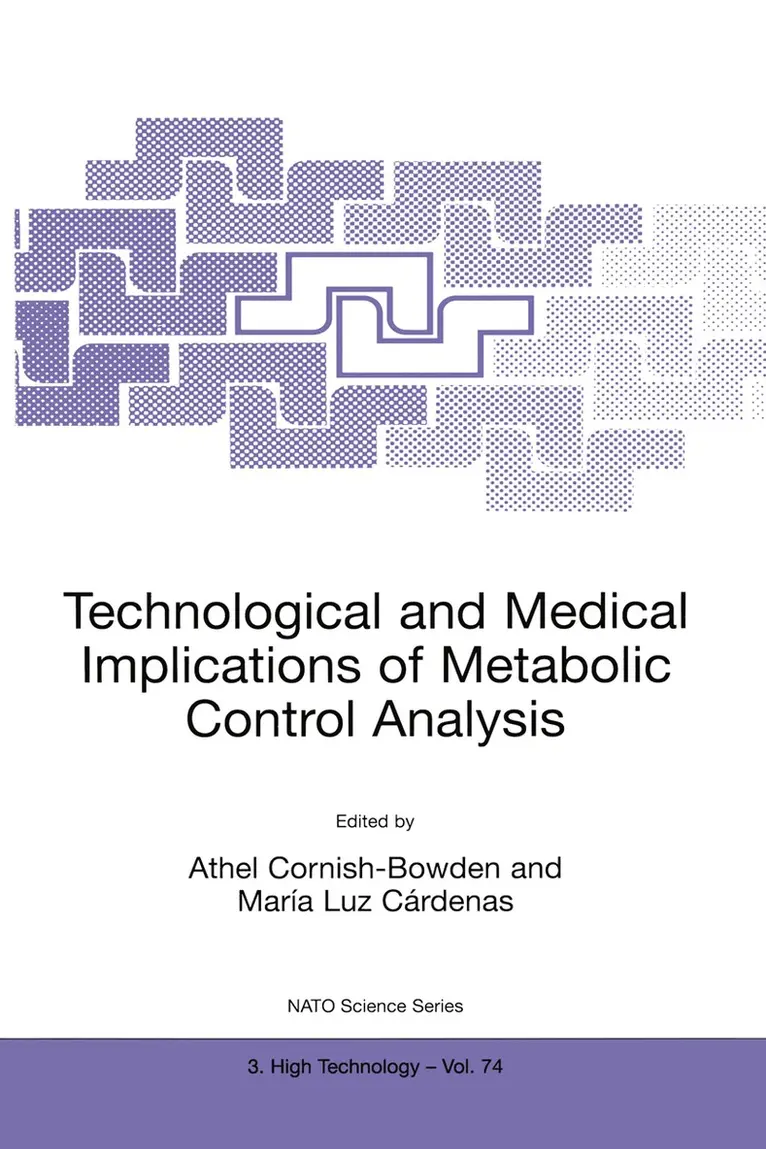
    Technological and Medical Implications of Metabolic Control Analysis

    AvAthel Cornish-Bowden,Maria Luz Cárdenas

    Häftad, Engelska, 2000

    Del i serien NATO Science Partnership Subseries: 3

    1 119 kr

    Beställningsvara. Skickas inom 10-15 vardagar. Fri frakt över 249 kr.

    Beskrivning

    The study of multienzyme systems has advanced considerably during the 1990s. The cell is more complicated than classical biochemistry presents it; it contains more structure, and the behaviour of any system of enzymes is more elaborate than can be explained in simple terms. Nevertheless, classical enzymology and metabolism remain central to any modification of the metabolic behaviour of organisms, as attempted by modern biotechnology and drug development techniques. In this work the authors draw attention to the drawbacks, problems, and opportunities associated with this field. The areas covered include problems with current practice, the imposition of human objectives on organisms, understanding health and disease, computer modelling, the increasingly complex picture of cell structure, control and regulation of metabolism, and the general contribution metabolic control is making to biochemistry on a broader canvas.

    Produktinformation

    • Utgivningsdatum:2000-02-29
    • Mått:160 x 240 x 22 mm
    • Vikt:980 g
    • Format:Häftad
    • Språk:Engelska
    • Serie:NATO Science Partnership Subseries: 3
    • Antal sidor:374
    • Förlag:Kluwer Academic Publishers
    • ISBN:9780792361893

    Utforska kategorier

    • Onkologi inom Medicin

    Innehållsförteckning

    • 1. Provoking an Argument: Problems with Current Approaches to the Analysis of Biochemical Systems.- 1. Snapshots of systems: metabolic control analysis and biotechnology in the post-genomic era.- 2. Moiety conservation and flux enhancement.- 3. On the universality of the universal method.- 2. Imposing Discipline: Manipulation of Organisms for Technological Ends.- 4. Life is complicated.- 5. Regulation and redirection of metabolism: incorporating regulatory information influx calculation.- 6. Recent developments in metabolic pathway analysis and their potential implications for biotechnology and medicine.- 7. Quantifying the importance of regulatory loops in homeostatic control mechanisms: hierarchical control of DNA supercoiling.- 8. An integrated approach to theanalysis of the control andregulation of cellular systems.- 3. Understanding Health and Disease: Why Organisms Behave as They Do.- 9. Mechanism of carcinogenesis by polycyclic aromatic hydrocarbons: aneuploidy precedes malignant transformation and occurs in all cancers.- 10. Metabolic control analysis shows how aneuploidy causes cancer.- 11. The control strength of glucokinase in hepatocytes: a predictor of metabolic defects in maturity onset diabetes of the young, type 2.- 12. Metabolic distress associated with impaired control by alternative substrates: two examples taken from purine metabolism.- 13. Regulation of ATP supply in muscle: implications for importance of flux control coefficients and for the genesis of mitochondrial myopathies.- 14. Regulation of energy metabolism in hepatocytes.- 15. Combined NMR experimental and computer-simulation study of 2,3-bisphosphoglycerate metabolism in human erythrocytes.- 4. Taking Aim: Use of Metabolic Models to Identify Drug Targets.- 16. Computational approaches to the study of biochemical pathways and metabolic control.- 17. Using metabolic control analysis to improve the selectivity and effectiveness of drugs against parasitic diseases.- 18. Computer simulation as a tool for studying metabolism and drug design.- 19. Use of metabolic control analysis to design a new strategy for cancer therapy.- 5. Facing Reality: Not Just a Bag of Enzymes.- 20. Implications of cytoarchitectural analysis.- 21. Probing the cell interior with NMR spectroscopy.- 22. Metabolite channelling and protein-protein interactions in the urea synthesis pathway.- 23. Intracellular distribution of glycogen synthase: Another regulatory mechanism of glycogen metabolism?.- 24. Supramolecular organization and substrate channelling in the mammalian translation system.- 25. Analysis of co-localization of glycolytic enzymes in flight muscle and its relation to muscle function in Drosophila.- 6. Thinking About Metabolism: The Relationship Between Control and Regulation.- 26. Metabolic control from the back benches: biochemistry towards biocomplexity.- 27. Physiological consequences of a non-regulated mutant phosphofructokinase in Escherichia coli.- 28. Time-dependent or steady-state control of metabolic systems?.- 29. Multisite modulation in the control of glycolysis: balance of supply and demand?.- 30. Exercising control when control is distributed.- 31. Metabolic control design: implications and applications.- 32. Determining elasticities in situ.- 33. Coordination and homeostasis in the response to multiple signals: role of metabolic cascades.- 34. Putting the cart before the horse: designing a metabolic system in order to understand it.- 35. Predicting the structural design of metabolic pathways: an evolutionary approach.- 36. Glycogen structure: an evolutionary view.- 7. Taking Stock: Control Analysis in the Context of Metabolic Regulation.- 37. From control to regulation: a new prospect for metabolic control analysis.- 38. Metabolic control and metabolons in the millennium.- In memoriam: Paul Srere, 1925-1999.- A. Cornish-Bowden.- Contributors.