Marian David - Böcker
Visar alla böcker från författaren Marian David. Handla med fri frakt och snabb leverans.
3 produkter
3 produkter
1 513 kr
Skickas inom 5-8 vardagar
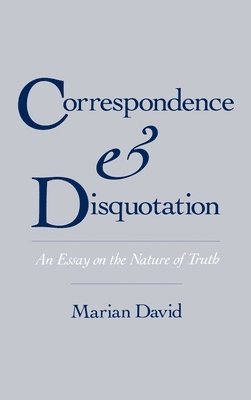
Marian David defends the correspondence theory of truth against the disquotational theory of truth, its current major rival. The correspondence theory asserts that truth is a philosophically rich and profound notion which needs serious explanation. Disquotationalism is a radically deflationary philosophy of truth inspired by Tarski and propagated by Quine and others. It rejects the correspondence theory, insists truth is anemic, and advances an "anti-theory" of truth that is essentially a collection of platitudes: "Snow is white" is true only if snow is actually white; "Grass is green" is true only if grass is actually green. According to disquotationalists the only profound insight about truth is that it lacks profundity. David contrasts the correspondence theory with disquotationalism and then develops the latter position in rich detail - more than has been available in previous literature - to show its faults. He demonstrates that disquotationalism is not a tenable theory of truth, as it has too many absurd consequences.
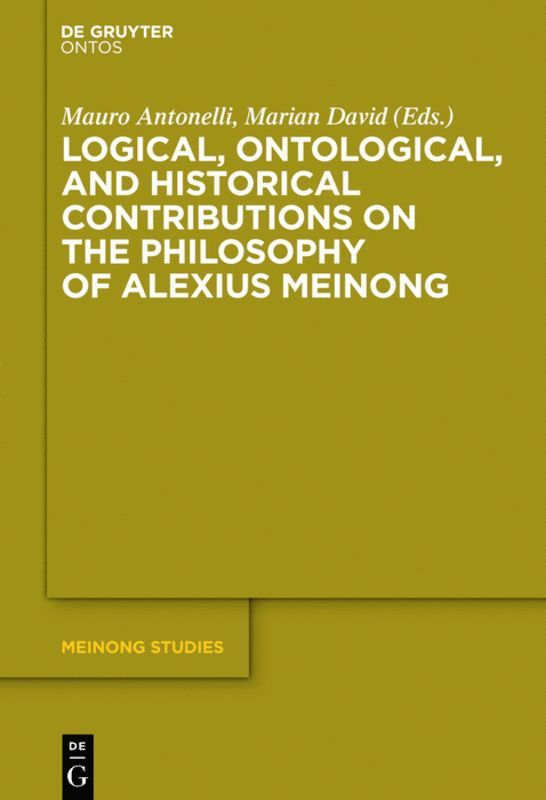
Logical, Ontological, and Historical Contributions on the Philosophy of Alexius Meinong
Inbunden, Engelska, 2014
1 391 kr
Skickas inom 5-8 vardagar
The volume collects papers on central aspects of Alexius Meinong’s Gegenstandstheorie (Theory of Objects) and its transformation in contemporary logic, semantics and ontology covering the impact of his views on grasping and representation, the status of nonexistent or inconsistent objects and their incorporation in theories like Noneism and Possible-World-Semantics. In addition it presents studies on Meinong’s notion of probability and on Auguste Fischer, a student and collaborator of Meinong.
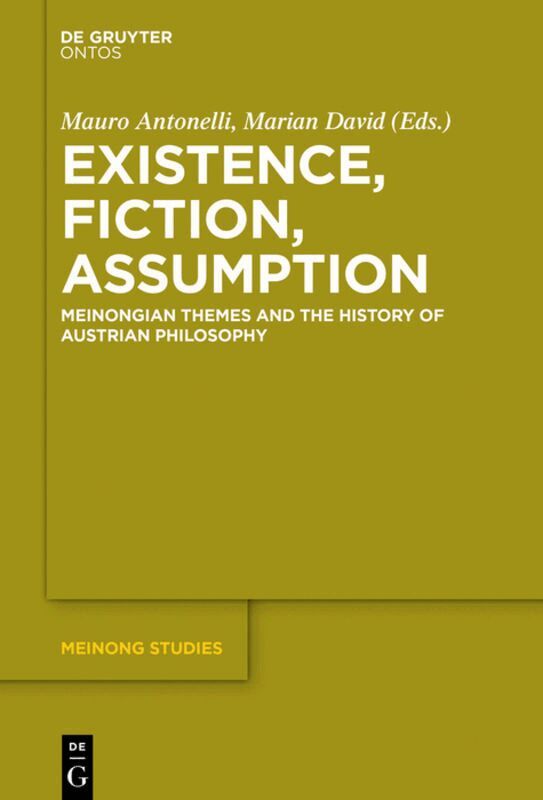
Existence, Fiction, Assumption
Meinongian Themes and the History of Austrian Philosophy
Inbunden, Engelska, 2016
1 362 kr
Skickas inom 5-8 vardagar
Meinong-Studies, Vol. 6, contains papers focusing on the connections between intentionality and nonexistent objects, presenting historical analyses on the background of Meinong’s philosophical position up to the Meinong-Russell-Debate. It also contains systematic studies of fictional characters, of Kripke’s alternative theory of fiction, and of the relevance of fictions playing the role of assumptions in scientific contexts. The volume is completed by biographical sketches of Christian von Ehrenfels, founder of Gestalt-theory and Meinong’s close friend, and of Ernst Mally, disciple of Meinong and successor to his chair.