Mario Baumann - Böcker
Visar alla böcker från författaren Mario Baumann. Handla med fri frakt och snabb leverans.
5 produkter
5 produkter
2 088 kr
Skickas inom 10-15 vardagar
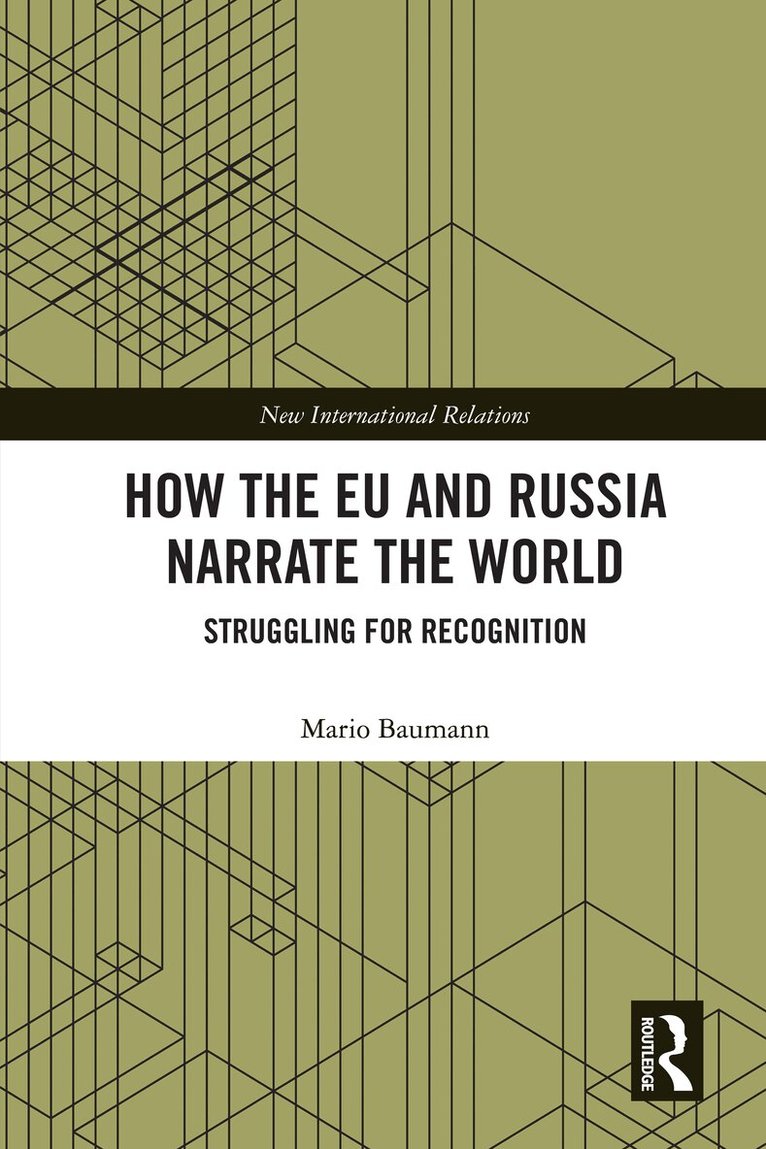
In times of increasing challenges to ‘the Western idea,’ this book illuminates how Russian and EU foreign policy discourses interact. While official Russian and EU articulations on issues of sovereignty, human rights and the shared neighbourhood diverge greatly, they are not articulated in isolation but are entangled and condition each other. To understand this entanglement, this book approaches the relationship between Russia and the EU as an intersubjective one, a social context where diverging interpretations of the world struggle for hegemony. Its theoretical framework marries poststructuralist thought with insights from critical approaches to Hegelian recognition dialectics. Based on an extensive and systematic empirical discourse analysis of Russian and EU foreign policy texts, this study draws a detailed picture of the intensifying discursive dynamics accompanying the deteriorating relationship between Brussels and Moscow. It shows how neither the EU’s nor Russia’s foreign policy articulation has changed substantially. The interaction pattern continues to be an asymmetrical one with Russia’s articulations much more conditioned by the EU’s discourse than vice versa. The book thus argues that the EU is more independent in sovereignly articulating an interpretation of the world, whereas Russia continues to face constraints in the formulation of an autonomous political project. With its novel and innovative conceptual framework, this book furthers the theoretical scholarship on poststructuralism in international relations. It addresses all scholars interested in poststructuralist enquiries and will be of great value to students and scholars of Russian foreign policy and the EU.
1 865 kr
Skickas inom 5-8 vardagar
1 507 kr
Skickas inom 5-8 vardagar
Although the relationship of Greco-Roman historians with their readerships has attracted much scholarly attention, classicists principally focus on individual historians, while there has been no collective work on the matter. The editors of this volume aspire to fill this gap and gather papers which offer an overall view of the Greco-Roman readership and of its interaction with ancient historians. The authors of this book endeavor to define the physiognomy of the audience of history in the Roman Era both by exploring the narrative arrangement of ancient historical prose and by using sources in which Greco-Roman intellectuals address the issue of the readership of history. Ancient historians shaped their accounts taking into consideration their readers’ tastes, and this is evident on many different levels, such as the way a historian fashions his authorial image, addresses his readers, or uses certain compositional strategies to elicit the readers’ affective and cognitive responses to his messages. The papers of this volume analyze these narrative aspects and contextualize them within their socio-political environment in order to reveal the ways ancient readerships interacted with and affected Greco-Roman historical prose.
1 702 kr
Skickas inom 5-8 vardagar
Although digressive discourse constitutes a key feature of Greco-Roman historiography, we possess no collective volume on the matter. The chapters of this book fill this gap by offering an overall view of the use of digressions in Greco-Roman historical prose from its beginning in the 5th century BCE up to the Imperial Era. Ancient historiographers traditionally took as digressions the cases in which they interrupted their focused chronological narration. Such cases include lengthy geographical descriptions, prolepses or analepses, and authorial comments. Ancient historiographers rarely deign to interrupt their narration’s main storyline with excursuses which are flagrantly disconnected from it. Instead, they often "coat" their digressions with distinctive patterns of their own thinking, thus rendering them ideological and thematic milestones within an entire work. Furthermore, digressions may constitute pivotal points in the very structure of ancient historical narratives, while ancient historians also use excursuses to establish a dialogue with their readers and to activate them in various ways. All these aspects of digressions in Greco-Roman historiography are studied in detail in the chapters of this volume.
1 566 kr
Skickas inom 7-10 vardagar
Herodian (active c. 250 CE) was the author of an eight-book Greek history of the Empire from the reign of Commodus (180-192) to the civil wars of the year 238. It has always been a vital historical document, but recent scholarship also recognizes its importance for the development of Greek historiography. As part of this new interest, this collection of articles by leading and emerging scholars addresses important new questions about Herodian’s work and cultural context. These include literary studies of his generic identity, his relationship to earlier and later authors and his techniques of creating time and space; applications of communication and memory theory to his narrative; exploration of his cultural attitudes to the heritage of Greek paideia; his cultural identity and evocation of iconic figures from the past; and his political ideology and conception of the Empire’s functioning and dysfunction. Herodian emerges as a revealing witness of his own times, but also a talented literary artist and a perceptive analyst of the political upheavals through which he lived. These studies will be valuable to all scholars interested in the literary and cultural aspects of Rome’s transition from the High Empire to Late Antiquity.