Vasileios Liotsakis – författare
2 052 kr
Läs direkt efter köp
Art of History
Literary Perspectives on Greek and Roman Historiography
2 014 kr
Skickas inom 5-8 vardagar
2 108 kr
Läs direkt efter köp
2 032 kr
Skickas inom 5-8 vardagar
2 108 kr
Läs direkt efter köp
Since antiquity, Book 8 of Thucydides’ History has been considered an unpolished draft which lacks revision. Even those who admit that the book has some elements of internal coherence believe that Thucydides, if death had not prevented him, would have improved many chapters or even the whole structure of the book. Consequently, while the first seven books of the History have been well examined through the last two centuries, the narrative plan of Book 8 remains an obscure subject, as we do not possess an extensive and detailed presentation of its whole narrative design. Vasileios Liotsakis tries to satisfy this central desideratum of the Thucydidean scholarship by offering a thorough description of the compositional plan, which, in his opinion, Thucydides put into effect in the last 109 chapters of his work. His study elaborates on the structural parts of the book, their details, and the various techniques through which Thucydides composed his narration in order to reach the internal cohesion of these chapters as well as their close connection to the rest of the History. Liotsakis offers us an original approach not only of Book 8 but also of the whole work, since his observations reshape our overall view of the History.
2 108 kr
Läs direkt efter köp
Since antiquity, Book 8 of Thucydides’ History has been considered an unpolished draft which lacks revision. Even those who admit that the book has some elements of internal coherence believe that Thucydides, if death had not prevented him, would have improved many chapters or even the whole structure of the book. Consequently, while the first seven books of the History have been well examined through the last two centuries, the narrative plan of Book 8 remains an obscure subject, as we do not possess an extensive and detailed presentation of its whole narrative design. Vasileios Liotsakis tries to satisfy this central desideratum of the Thucydidean scholarship by offering a thorough description of the compositional plan, which, in his opinion, Thucydides put into effect in the last 109 chapters of his work. His study elaborates on the structural parts of the book, their details, and the various techniques through which Thucydides composed his narration in order to reach the internal cohesion of these chapters as well as their close connection to the rest of the History. Liotsakis offers us an original approach not only of Book 8 but also of the whole work, since his observations reshape our overall view of the History.
350 kr
Skickas inom 5-8 vardagar
Alexander the Great in Arrian’s ›Anabasis‹
A Literary Portrait
1 905 kr
Skickas inom 5-8 vardagar
1 926 kr
Läs direkt efter köp
2 347 kr
Skickas inom 5-8 vardagar
2 373 kr
Läs direkt efter köp
2 290 kr
Läs direkt efter köp
1 749 kr
Skickas inom 5-8 vardagar
1 388 kr
Läs direkt efter köp
The fact that aspects of witnesses and evidence put them in the centre of the institutional and cultural (e.g. religious, literary) construction of ancient societies indicates that it is important to keep offering nuanced approaches to the topic of this volume. To advance knowledge of the processes of presenting witnesses and gathering, or constructing, evidence is, in fact, to better and more fully understand the ways in which deliberative Athenian democracy functions, what the core elements of political life and civic identity are, and how they relate to the system of using logos to make decisions. For, witnesses and evidence were important prerequisites of getting the Athenian citizenship and exerting the civic/political identity as a member of the community. It is important, therefore, all the matters that relate to information-gathering and decision-making to be examined anew. Emphasis can be placed on a variety of genres to allow scholars recreate the fullest and clearest possible image about the witnessing and evidencing in antiquity. Chapters in this volume include considerations of social, political, literary, and moral theory, alongside studies of the impact of information-gathering and decision-making in oratory and drama, with a steady focus on the application of key ideas and values in social and political justice to issues of pressing ethical concern.
1 539 kr
Skickas inom 5-8 vardagar
1 749 kr
Skickas inom 5-8 vardagar
1 646 kr
Läs direkt efter köp
Plato’s contribution to narratology has traditionally been traced in his tripartite categorisation of narrative modes we read of in the Republic. Although other aspects of storytelling are also addressed throughout the Platonic oeuvre, such passages are treated as instantaneous flares of metanarrative speculation on Plato’s part and do not seem to contribute to the reconstruction of his ‘theory of narrative’. Vasileios Liotsakis challenges this view and argues that the Statesman, the Timaeus/Critias and the Laws reveal that Plato had consolidated in his mind and compositionally put into effect one systematic mode in which to express his thoughts on narratives. In these dialogues Liotsakis recognizes the birth of a proto-narratology which differs in many respects from what we today expect from a narratological handbook, but still demonstrates two key-features of narratology: (a) a conscious focus on certain aspects of narrativity which are vastly discussed by narratologists and pertain to the structuring and reception of narratives; and (b) a schematised mode of interaction between metanarrative reflections and textual bodies which serve as the paradigms through which to explore the interpretive potential of these reflections.
1 706 kr
Läs direkt efter köp
Plato’s contribution to narratology has traditionally been traced in his tripartite categorisation of narrative modes we read of in the Republic. Although other aspects of storytelling are also addressed throughout the Platonic oeuvre, such passages are treated as instantaneous flares of metanarrative speculation on Plato’s part and do not seem to contribute to the reconstruction of his ‘theory of narrative’. Vasileios Liotsakis challenges this view and argues that the Statesman, the Timaeus/Critias and the Laws reveal that Plato had consolidated in his mind and compositionally put into effect one systematic mode in which to express his thoughts on narratives. In these dialogues Liotsakis recognizes the birth of a proto-narratology which differs in many respects from what we today expect from a narratological handbook, but still demonstrates two key-features of narratology: (a) a conscious focus on certain aspects of narrativity which are vastly discussed by narratologists and pertain to the structuring and reception of narratives; and (b) a schematised mode of interaction between metanarrative reflections and textual bodies which serve as the paradigms through which to explore the interpretive potential of these reflections.
1 799 kr
Skickas inom 5-8 vardagar
297 kr
Skickas inom 3-6 vardagar
2 224 kr
Kommande
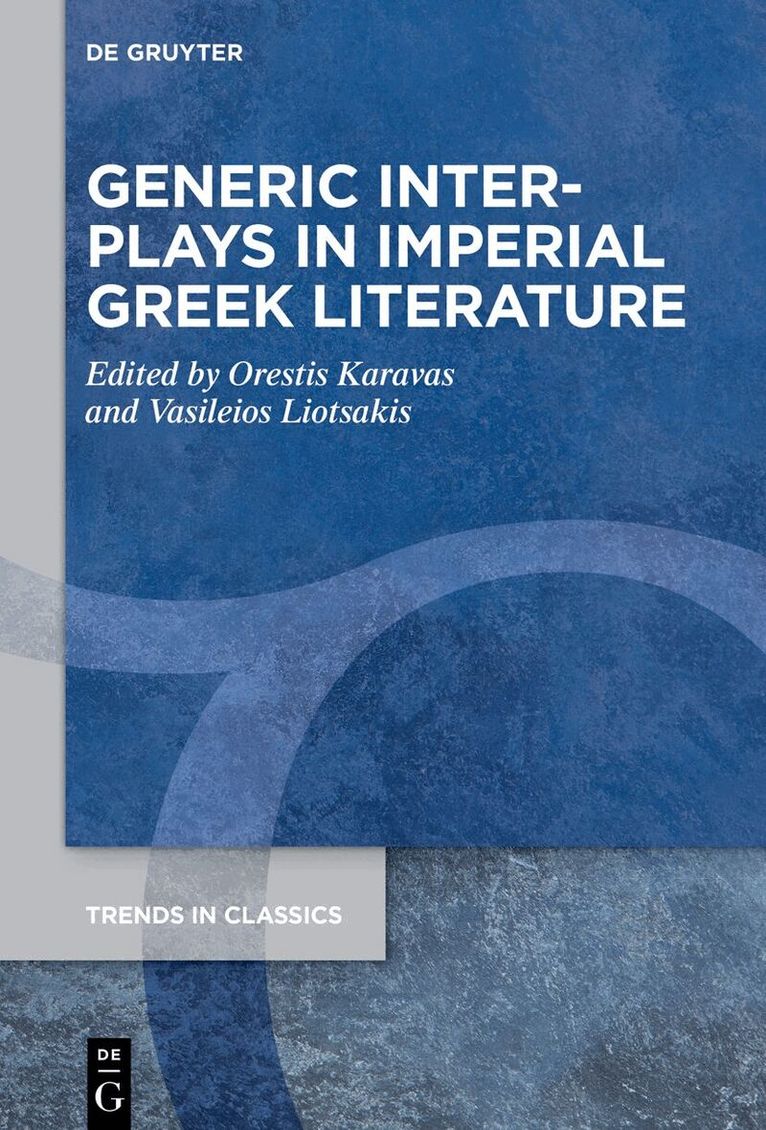
Generic Interplays in Imperial Greek Literature
1 629 kr
Skickas inom 3-6 vardagar