Marisa Abrajano - Böcker
Visar alla böcker från författaren Marisa Abrajano. Handla med fri frakt och snabb leverans.
5 produkter
5 produkter
Talking Politics
Political Discussion Networks and the New American Electorate
Inbunden, Engelska, 2020
1 130 kr
Skickas inom 5-8 vardagar
Over five decades of research has made clear that social networks can have an important impact on our political behavior. Specifically, when we engage in political conversation within these networks we develop connections that increase the likelihood that we will become politically active. Yet, most studies of political behavior focus on individuals, rather than the effects of networks on political behavior. Furthermore, any studies of networks have, by and large, been based on White Americans. Given what we know about the ways in which neighborhood, cultural, friend, and family networks tend to segregate along ethnic and racial lines, the authors of this book argue that we can assume that political networks segregate in much the same way. This book draws on quantitative and qualitative analyses of 4000 White American, African American, Latino, and Asian American people to explore inter and intra-ethnoracial differences in social network composition, size, partisanship, policy attitudes, and homophily in political and civic engagement. The book thus makes three key contributions: 1) it provides, for the first time, detailed comparative analysis of how political networks vary across and within ethnoracial groups; 2) demonstrates how historical differences in partisanship, policy attitudes, and engagement are reflected within groups' social networks; and, 3) reveals the impact that networks can have on individuals' political and civic engagement.
309 kr
Skickas inom 5-8 vardagar
Over five decades of research has made clear that social networks can have an important impact on our political behavior. Specifically, when we engage in political conversation within these networks we develop connections that increase the likelihood that we will become politically active. Yet, most studies of political behavior focus on individuals, rather than the effects of networks on political behavior. Furthermore, any studies of networks have, by and large, been based on White Americans. Given what we know about the ways in which neighborhood, cultural, friend, and family networks tend to segregate along ethnic and racial lines, the authors of this book argue that we can assume that political networks segregate in much the same way. This book draws on quantitative and qualitative analyses of 4000 White American, African American, Latino, and Asian American people to explore inter and intra-ethnoracial differences in social network composition, size, partisanship, policy attitudes, and homophily in political and civic engagement. The book thus makes three key contributions: 1) it provides, for the first time, detailed comparative analysis of how political networks vary across and within ethnoracial groups; 2) demonstrates how historical differences in partisanship, policy attitudes, and engagement are reflected within groups' social networks; and, 3) reveals the impact that networks can have on individuals' political and civic engagement.
1 072 kr
Skickas inom 10-15 vardagar
Presuming that a strong relationship exists between one's identity and political behavior, American politicians have long targeted immigrant and ethnic communities based on their shared ethnic or racial identity. But to what extent do political campaign messages impact voters' actual decisions and behaviors?This new book is one of the first to examine and compare the campaign efforts used to target Latinos with those directed at the rest of the electorate. Specifically, it focuses on televised Spanish and English-language advertising developed for the 2000 and 2004 presidential elections, as well as for dozens of congressional and statewide contests from 2000–2004. Author Marisa Abrajano's research reveals exposure to these televised political ads indeed impacts whether Latinos turn out to vote and, if so, for whom they vote. But the effect of these advertising messages is not uniform across the Latino electorate. Abrajano explores the particular factors that affect Latinos' receptivity to political ads and offers key findings for those interested in understanding how to mobilize this critical swing group in American politics.
256 kr
Skickas inom 7-10 vardagar
Presuming that a strong relationship exists between one's identity and political behavior, American politicians have long targeted immigrant and ethnic communities based on their shared ethnic or racial identity. But to what extent do political campaign messages impact voters' actual decisions and behaviors?This new book is one of the first to examine and compare the campaign efforts used to target Latinos with those directed at the rest of the electorate. Specifically, it focuses on televised Spanish and English-language advertising developed for the 2000 and 2004 presidential elections, as well as for dozens of congressional and statewide contests from 2000–2004. Author Marisa Abrajano's research reveals exposure to these televised political ads indeed impacts whether Latinos turn out to vote and, if so, for whom they vote. But the effect of these advertising messages is not uniform across the Latino electorate. Abrajano explores the particular factors that affect Latinos' receptivity to political ads and offers key findings for those interested in understanding how to mobilize this critical swing group in American politics.
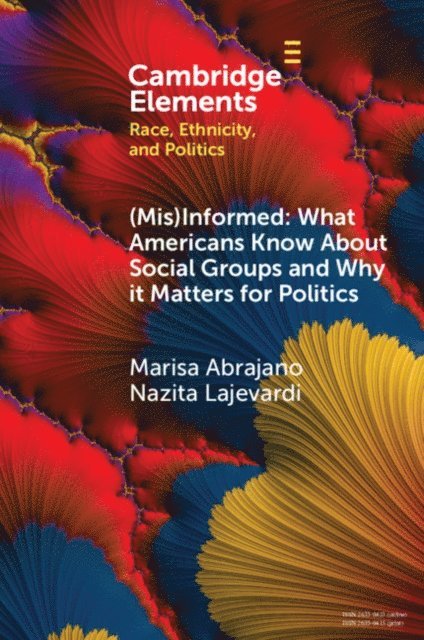
(Mis)Informed: What Americans Know About Social Groups and Why it Matters for Politics
Häftad, Engelska, 2021
234 kr
Skickas inom 7-10 vardagar
This Element examines just how much the public knows about some of America's most stigmatized social groups, who comprise 40.3% of the population, and evaluates whether misinformation matters for shaping policy attitudes and candidate support. The authors design and field an original survey containing large national samples of Black, Latino, Asian, Muslim, and White Americans, and include measures of misinformation designed to assess the amount of factual information that individuals possess about these groups. They find that Republicans, Whites, the most racially resentful, and consumers of conservative news outlets are the most likely to be misinformed about socially marginalized groups. Their analysis also indicates that misinformation predicts hostile policy support on racialized issues; it is also positively correlated with support for Trump. They then conducted three studies aimed at correcting misinformation. Their research speaks to the prospects of a well-functioning democracy, and its ramifications on the most marginalized.