Taylor N. Carlson - Böcker
Visar alla böcker från författaren Taylor N. Carlson. Handla med fri frakt och snabb leverans.
6 produkter
6 produkter
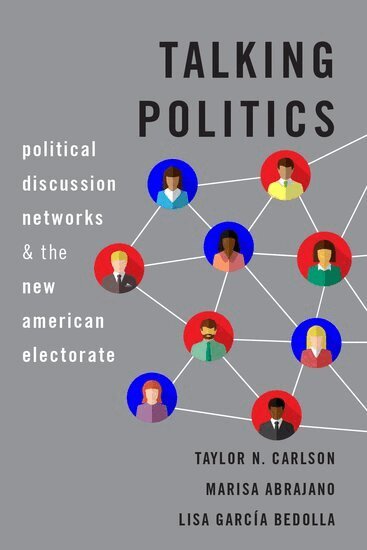
Talking Politics
Political Discussion Networks and the New American Electorate
Inbunden, Engelska, 2020
1 130 kr
Skickas inom 5-8 vardagar
Over five decades of research has made clear that social networks can have an important impact on our political behavior. Specifically, when we engage in political conversation within these networks we develop connections that increase the likelihood that we will become politically active. Yet, most studies of political behavior focus on individuals, rather than the effects of networks on political behavior. Furthermore, any studies of networks have, by and large, been based on White Americans. Given what we know about the ways in which neighborhood, cultural, friend, and family networks tend to segregate along ethnic and racial lines, the authors of this book argue that we can assume that political networks segregate in much the same way. This book draws on quantitative and qualitative analyses of 4000 White American, African American, Latino, and Asian American people to explore inter and intra-ethnoracial differences in social network composition, size, partisanship, policy attitudes, and homophily in political and civic engagement. The book thus makes three key contributions: 1) it provides, for the first time, detailed comparative analysis of how political networks vary across and within ethnoracial groups; 2) demonstrates how historical differences in partisanship, policy attitudes, and engagement are reflected within groups' social networks; and, 3) reveals the impact that networks can have on individuals' political and civic engagement.
309 kr
Skickas inom 5-8 vardagar
Over five decades of research has made clear that social networks can have an important impact on our political behavior. Specifically, when we engage in political conversation within these networks we develop connections that increase the likelihood that we will become politically active. Yet, most studies of political behavior focus on individuals, rather than the effects of networks on political behavior. Furthermore, any studies of networks have, by and large, been based on White Americans. Given what we know about the ways in which neighborhood, cultural, friend, and family networks tend to segregate along ethnic and racial lines, the authors of this book argue that we can assume that political networks segregate in much the same way. This book draws on quantitative and qualitative analyses of 4000 White American, African American, Latino, and Asian American people to explore inter and intra-ethnoracial differences in social network composition, size, partisanship, policy attitudes, and homophily in political and civic engagement. The book thus makes three key contributions: 1) it provides, for the first time, detailed comparative analysis of how political networks vary across and within ethnoracial groups; 2) demonstrates how historical differences in partisanship, policy attitudes, and engagement are reflected within groups' social networks; and, 3) reveals the impact that networks can have on individuals' political and civic engagement.
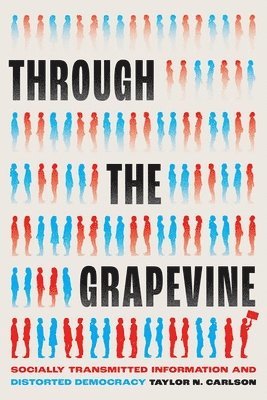
Through the Grapevine
Socially Transmitted Information and Distorted Democracy
Inbunden, Engelska, 2024
1 762 kr
Skickas inom 3-6 vardagar
An enlightening examination of what it means when Americans rely on family and friends to stay on top of politics.Accurate information is at the heart of democratic functioning. For decades, researchers interested in how information is disseminated have focused on mass media, but the reality is that many Americans today do not learn about politics from direct engagement with the news. Rather, about one-third of Americans learn chiefly from information shared by their peers in conversation or on social media. How does this socially transmitted information differ from that communicated by traditional media? What are the consequences for political attitudes and behavior? Drawing on evidence from experiments, surveys, and social media, Taylor N. Carlson finds that, as information flows first from the media then person to person, it becomes sparse, more biased, less accurate, and more mobilizing. The result is what Carlson calls distorted democracy. Although socially transmitted information does not necessarily render democracy dysfunctional, Through the Grapevine shows how it contributes to a public that is at once underinformed, polarized, and engaged.
262 kr
Skickas inom 7-10 vardagar
An enlightening examination of what it means when Americans rely on family and friends to stay on top of politics.Accurate information is at the heart of democratic functioning. For decades, researchers interested in how information is disseminated have focused on mass media, but the reality is that many Americans today do not learn about politics from direct engagement with the news. Rather, about one-third of Americans learn chiefly from information shared by their peers in conversation or on social media. How does this socially transmitted information differ from that communicated by traditional media? What are the consequences for political attitudes and behavior? Drawing on evidence from experiments, surveys, and social media, Taylor N. Carlson finds that, as information flows first from the media then person to person, it becomes sparse, more biased, less accurate, and more mobilizing. The result is what Carlson calls distorted democracy. Although socially transmitted information does not necessarily render democracy dysfunctional, Through the Grapevine shows how it contributes to a public that is at once underinformed, polarized, and engaged.
941 kr
Skickas inom 7-10 vardagar
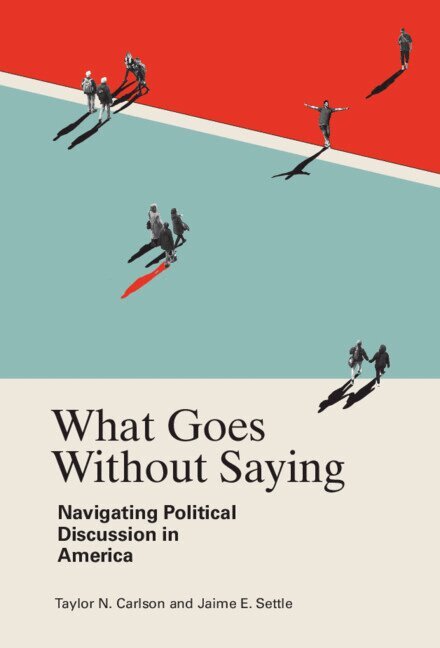
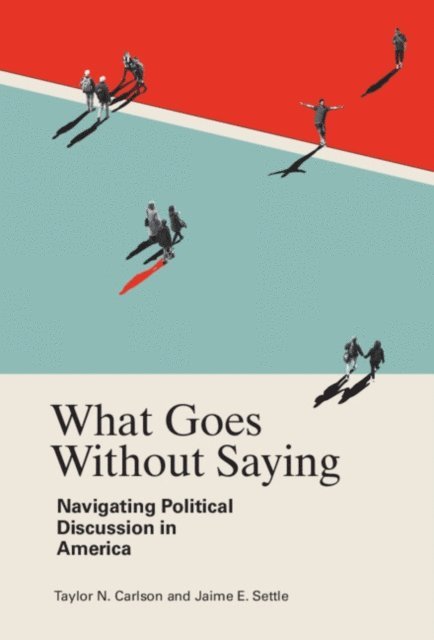
Why are political conversations uncomfortable for so many people? The current literature focuses on the structure of people's discussion networks and the frequency with which they talk about politics, but not the dynamics of the conversations themselves. In What Goes Without Saying, Taylor N. Carlson and Jaime E. Settle investigate how Americans navigate these discussions in their daily lives, with particular attention to the decision-making process around when and how to broach politics. The authors use a multi-methods approach to unpack what they call the 4D Framework of political conversation: identifying the ways that people detect others' views, decide whether to talk, discuss their opinions honestly-or not, and determine whether they will repeat the experience in the future. In developing a framework for studying and explaining political discussion as a social process, What Goes Without Saying will set the agenda for research in political science, psychology, communication, and sociology for decades to come.
301 kr
Skickas inom 7-10 vardagar
Why are political conversations uncomfortable for so many people? The current literature focuses on the structure of people's discussion networks and the frequency with which they talk about politics, but not the dynamics of the conversations themselves. In What Goes Without Saying, Taylor N. Carlson and Jaime E. Settle investigate how Americans navigate these discussions in their daily lives, with particular attention to the decision-making process around when and how to broach politics. The authors use a multi-methods approach to unpack what they call the 4D Framework of political conversation: identifying the ways that people detect others' views, decide whether to talk, discuss their opinions honestly-or not, and determine whether they will repeat the experience in the future. In developing a framework for studying and explaining political discussion as a social process, What Goes Without Saying will set the agenda for research in political science, psychology, communication, and sociology for decades to come.